Attorneys for Federal Employees — Nationwide
Nearly 200,000 federal workers and supporters follow our updates across TikTok, Instagram, YouTube, Facebook, and LinkedIn. Each briefing gives you the three stories that actually matter to your job, plain‑English legal guidance, and one short practice to protect your peace of mind. If it helps you, forward it to a colleague—new readers can subscribe at https://fedlegalhelp.com/newsletter.
Today at a Glance
- Federal Workforce Morale: A new Gallup analysis released this week shows engagement, satisfaction, and burnout among federal employees worsened sharply through 2025 compared with state and local government peers, though some measures rebounded by Q1 2026 — and OPM's cancellation of the 2025 FEVS leaves an annual-survey gap.
- Inspector General Nominees: The president's three most recent IG picks — at DOJ, Education, and HUD — break from the earlier pattern of nominees with overtly political backgrounds, with the DOJ and Education choices drawn from career IG ranks.
- House Settlement Probe: With the May 25 OPM data-return deadline approaching, federal employment attorneys are pushing back on the House Oversight Committee's framing that agencies "inexplicably" settle MSPB cases they would otherwise win.
Top Stories:
1. Gallup: Federal Engagement and Satisfaction Dropped Sharply in 2025, Burnout Spiked, Some Rebound by Early 2026
Source: Government Executive, May 20, 2026
TL;DR: Gallup released a new analysis this week comparing federal civilian workers with state and local government employees from 2022 through the first quarter of 2026. In the second quarter of 2025 — as Schedule Policy/Career, large-scale terminations, and return-to-office mandates rolled out — the share of "engaged" federal workers fell six percentage points further than it did among state and local workers, and federal employees were roughly 15 points less likely than peers to report high job satisfaction. The burnout gap ran eight to nine points between Q2 and Q4 2025 before narrowing to four to six points. By Q1 2026, federal job-search activity was statistically indistinguishable from state and local peers, and the engagement gap had closed to four points. The data set draws on Bureau of Labor Statistics figures and Gallup's longitudinal U.S. adult panel, with controls for age, gender, and race. OPM cancelled the 2025 Federal Employee Viewpoint Survey (FEVS), so the Gallup analysis and the Partnership for Public Service's separate 11,000-employee survey are the closest public substitutes for the governmentwide picture this year.
For federal employees, this means:
- If your engagement scores or pulse-survey results changed materially during 2025, save copies. Engagement data can corroborate hostile-work-environment, constructive-discharge, and reasonable-accommodation claims if you later need to build a record.
- Be cautious about treating internal "performance culture" pulse surveys the same as the FEVS. Some employers tie performance ratings, awards, and PIP — Performance Improvement Plan — triggers to internal scores; ask your HR office for the methodology before responding.
- If you exercised protected disclosure rights — whistleblower complaints under 5 U.S.C. § 2302(b)(8) or EEO activity under 29 C.F.R. § 1614.105 — and saw a retaliatory rating, transfer, or PIP afterward, the timeline matters for filing deadlines.
Legal Insight:
The annual Federal Employee Viewpoint Survey is not optional under federal law. 5 C.F.R. § 250.302, implementing section 1128 of the National Defense Authorization Act for Fiscal Year 2004, Pub. L. No. 108-136, requires each executive agency to conduct an annual survey of its employees on identified workplace topics. OPM's decision not to administer the 2025 FEVS leaves a documentation gap that affects how courts, MSPB administrative judges, and EEOC adjudicators later evaluate workplace-culture evidence in individual cases. A federal employee who suspects retaliation tied to a protected disclosure should contact a federal employment attorney promptly — OSC and EEO deadlines run from the date of the personnel action, not from when survey data later confirms a pattern.
2. Three New Inspector General Nominees Have IG-Office Experience — A Break From Earlier Picks Tied to the Administration
Source: Government Executive, May 19, 2026
TL;DR: The president has nominated career IG attorney Don Berthiaume for Justice Department Inspector General, Heidi Semann for Education Department Inspector General, and Jeffrey Ledbetter of Virginia for Housing and Urban Development Inspector General. At least Berthiaume and Semann come from inside the IG community. Berthiaume served as acting DOJ IG from October 2025 through January 2026; Semann served as acting Education IG before returning to her senior special agent role at the Federal Reserve OIG in December 2025. Each rotation ended because the Federal Vacancies Reform Act limits service in an acting capacity to 210 days. Mark Lee Greenblatt, a former Interior Department IG who was fired by the president and has been a vocal critic of earlier IG picks, called Berthiaume's nomination "a home run" and described him as "a straight shooter." The shift matters because IG offices investigate whistleblower disclosures, audit agency compliance, and produce findings that often shape later MSPB and EEOC proceedings.
For federal employees, this means:
- If you are weighing a whistleblower disclosure, the IG office is one of three principal channels — alongside the Office of Special Counsel (OSC) under 5 U.S.C. § 1213 and the relevant congressional committee under 5 U.S.C. § 2302(b)(8)(C) — and each carries different statutory protections. Pick the channel that fits your facts.
- Cases pending before IG offices that turned over leadership in 2025 may have stalled. If your IG complaint has been open more than 180 days without substantive response, you can ask OSC or the Council of the Inspectors General on Integrity and Efficiency (CIGIE) for status escalation.
- Even with nominees drawn from the IG community, IG independence depends on Senate confirmation, the 30-day removal-notice requirement, and budget protections set by statute. Watch for funding adjustments in the FY 2027 budget cycle.
Legal Insight:
The Inspector General Act of 1978, recodified at 5 U.S.C. §§ 401-414, makes each statutory IG independent of the agency it audits and requires 30 days' advance notice to Congress before removal. Whistleblower retaliation for an IG disclosure is a prohibited personnel practice under 5 U.S.C. § 2302(b)(8), enforceable through OSC and, in some circumstances, through an individual right-of-action MSPB appeal under 5 U.S.C. § 1221. Federal employees considering a disclosure under any of these channels should talk with a federal employment attorney before filing — the channel you choose affects what protections apply.
3. House Oversight's May 25 Deadline for OPM Settlement Data — Federal Employment Attorneys Push Back on the Framing
Source: Government Executive, May 13, 2026
TL;DR: The May 11 letter from House Oversight and Reform Chairman James Comer (R-Ky.) to OPM Director Scott Kupor demands six years of federal-employee settlement data — covering EEOC, MSPB, FLRA, and OSC matters — by May 25, 2026. Chairman Comer cites MSPB data from fiscal years 2005 through 2015 showing a 68 percent settlement rate in adverse-action cases not dismissed at the threshold, alongside an 80-plus percent agency-win rate on cases that proceed to decision, and argues that the gap reflects taxpayer waste. Federal employment attorneys publicly disagree with that framing. Michael Fallings, managing partner at Tully Rinckey, PLLC, told Government Executive that agencies conduct the same risk analysis as any litigant: "people and agencies settle for a multitude of reasons, but mainly: each side wants to prevent liability." Fallings added that abandoning settlements would raise — not lower — taxpayer costs because discovery, attorney time, and agency hearing time all scale up at trial. Comer's letter also frames settlements as a way to "mask patterns of prohibited personnel practices," which Fallings disputes: in his experience, agency counsel addresses underlying misconduct as part of the settlement.
For federal employees, this means:
- A pending MSPB or EEOC matter is unaffected by this congressional letter — your discovery, hearing, and decision rights remain in place under 5 U.S.C. § 7701 and 29 C.F.R. Part 1614.
- If you are negotiating a settlement, the agency's willingness to settle is grounded in standard litigation-risk analysis. Settlements typically include both monetary terms and non-monetary remedies — record corrections, clean-record agreements, neutral references — and the non-monetary terms often matter more over the long run.
- Document the OSC and EEO filing dates in your own file. Even if agencies later face political pressure to settle less often, the 45-day EEO counselor contact deadline under 29 C.F.R. § 1614.105 and the OSC complaint windows under 5 U.S.C. § 1214 still bind both sides.
Legal Insight:
The MSPB's adverse-action and prohibited-personnel-practice authority derives from 5 U.S.C. § 7513 (adverse actions), 5 U.S.C. § 2302 (prohibited personnel practices), and 5 U.S.C. § 7701 (appeals procedure). Settlement of an MSPB appeal is governed by 5 C.F.R. § 1201.41 and is a recognized and routine part of the adjudication process. If your matter is in active litigation, do not adjust strategy based on congressional letters — the operative rules remain those in the statutes and regulations cited above.
Legal Tip of the Day
If Communication from Your Supervisor Changes
A shift in tone or frequency of communication can signal a change in how your performance or role is being viewed. Pay attention to patterns—what is being said, and what is no longer being said. Document key interactions and follow up in writing when appropriate. Clarity early can prevent misunderstandings later.
In Case You Missed It
A few quick hits from our recent videos and posts:
A Quick Check-In for Federal Employees
|

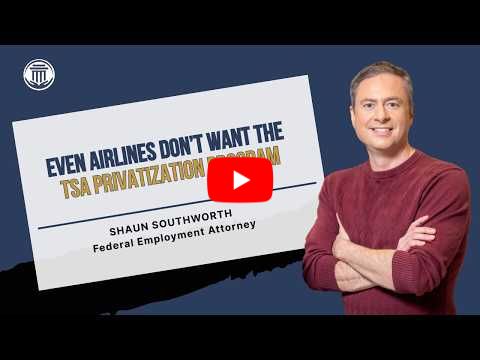
TSA Privatization Threatens Airport Security Jobs
|
Federal Workers Are Not the Villains
|

Worried About Retaliation or Being Targeted for Speaking Up?
If you’ve reported misconduct, safety concerns, discrimination, or waste/fraud/abuse—and now you’re seeing sudden schedule changes, bad performance reviews, or threats of discipline—you may be in whistleblower or retaliation territory.
We represent federal employees who:
-
Reported concerns and then saw adverse actions
-
Were sidelined, reassigned, or given impossible workloads after speaking up
-
Face investigations, PIPs, or proposed removals that look like payback
-
Need help navigating OSC complaints, EEO claims, or MSPB appeals tied to retaliation
A free, confidential consultation can help you sort out what’s normal agency behavior and what may cross the line—and what to do before your options narrow.
👉 Schedule Your Free Consultation Today
|

Disclaimer:
This briefing is for general informational purposes only and does not constitute legal advice or create an attorney‑client relationship. Federal employment law is fact‑specific and time‑sensitive; you should consult a qualified attorney about your own situation and deadlines. Past results do not guarantee future outcomes.
Your service is worth protecting. Let's protect it together at Southworth PC.

Responses