Attorneys for Federal Employees — Nationwide
Nearly 200,000 federal workers and supporters follow our updates across TikTok, Instagram, YouTube, Facebook, and LinkedIn Each briefing gives you the three stories that actually matter to your job, plain‑English legal guidance, and one short practice to protect your peace of mind. If it helps you, forward it to a colleague—new readers can subscribe at https://fedlegalhelp.com/newsletter.
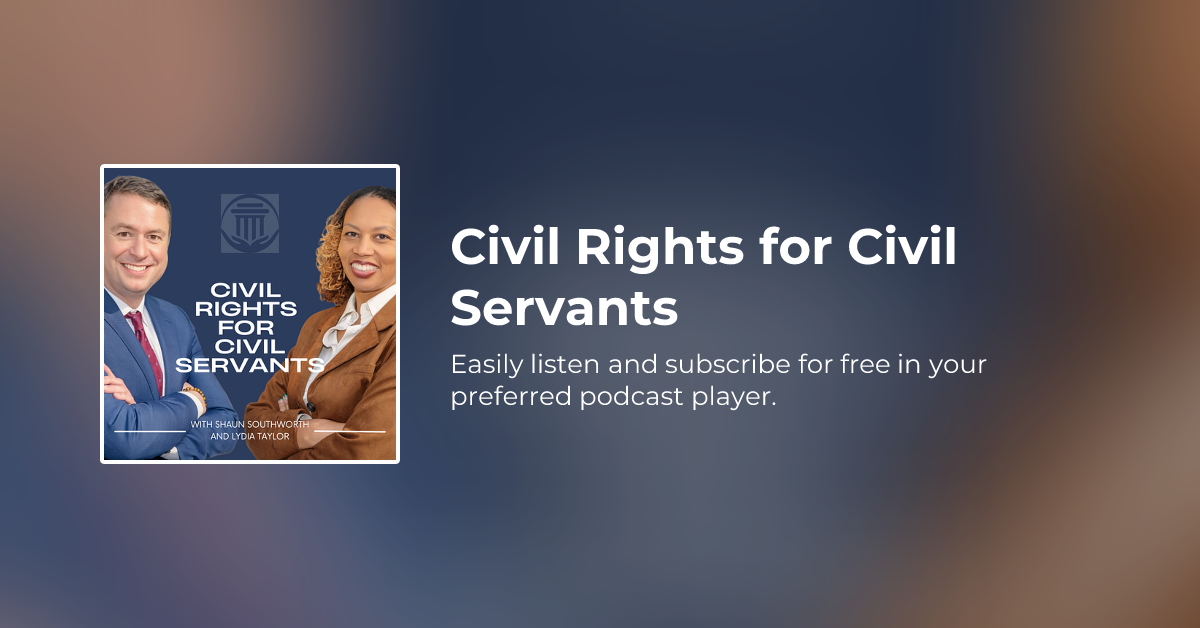
🎧 Listen: Civil Rights for Civil Servants
Shaun Southworth & Lydia Taylor on what's happening to the federal workforce. Latest episode: Apple · Spotify · Amazon Music · Youtube
 |
Today at a Glance
- VA Telework Accommodations: Disabled veterans working at the VA say the department is denying and rescinding telework it had granted as a reasonable accommodation, in some cases forcing employees into multi-hour daily commutes or AWOL status.
- Due Process For Excluded Employees: The Fourth Circuit ruled that CIA and ODNI officers who are excluded from normal civil service removal protections still have a Fifth Amendment right to make their agencies follow their own termination procedures.
- Proposed Employee NDA: A federal employment attorney argues OPM's proposed governmentwide nondisclosure agreement functions as an unconstitutional prior restraint that conflicts with existing whistleblower law.
Top Stories:
1. VA Employees Say Reasonable Accommodations Are Being Denied and Rescinded — Disabled Veterans Caught in the Middle
Source: Government Executive, July 8, 2026
TL;DR: Several disabled veterans who work at the Department of Veterans Affairs say the agency has denied or rescinded telework arrangements they relied on as a reasonable accommodation under the Rehabilitation Act, even though the administration's return-to-office directive specifically exempted employees with qualifying disabilities. The VA employs more than 105,000 veterans, nearly a quarter of its workforce, and several told Government Executive that a post-return-to-office review of accommodations has led officials to deny or claw back arrangements many had relied on for years. One employee, a medically retired soldier with a service-connected leg injury, had his telework accommodation rescinded after the VA determined his commute was not the agency's responsibility, even though returning to the office would mean a roughly six-hour daily round trip. Another employee, a Navy veteran with PTSD and a traumatic brain injury, was terminated in October 2025 after his supervisor cut off his system access; he was later reinstated with back pay through a Merit Systems Protection Board settlement, but the VA is again limiting his telework and has since treated him as absent without leave. A federal employment attorney interviewed for the story said the VA's position that commuting falls outside its accommodation obligation is "not a lawful justification." The VA's press office called claims that it is violating the Rehabilitation Act "absurd" and said it is reviewing accommodations to ensure they go to the employees who need them most.
For federal employees, this means:
- A reasonable accommodation that has already been approved can be reviewed and revised, but an agency cannot simply declare that your commute, or the underlying life activity it depends on, falls outside its duty to accommodate.
- If an accommodation is rescinded, ask in writing for the specific basis and preserve your prior approval, medical documentation, and any correspondence — that record will matter in an EEO complaint or MSPB appeal.
- Being marked AWOL while a disability-accommodation dispute is unresolved carries real pay and disciplinary consequences; treat it as a triggering event and gather your accommodation paperwork before responding.
Legal Insight:
The Rehabilitation Act of 1973, 29 U.S.C. § 791, requires federal agencies to provide reasonable accommodations to qualified employees with disabilities unless doing so would cause an undue hardship, and the applicable complaint procedures run through 29 C.F.R. § 1614.203. A removal tied to a denied accommodation can also trigger adverse-action protections under 5 U.S.C. § 7513 and appeal rights to the Merit Systems Protection Board. Employees facing a rescinded accommodation or an AWOL designation should consult a federal employment attorney promptly, since both the 45-day EEO counselor deadline and MSPB appeal deadlines run quickly.
2. Fourth Circuit: Even Employees Excluded From Normal Civil Service Protections Have a Due Process Right to Their Agency's Own Rules
Source: U.S. Court of Appeals for the Fourth Circuit, July 2, 2026
TL;DR: The Fourth Circuit affirmed a preliminary injunction requiring the CIA and the Office of the Director of National Intelligence to follow their own internal termination procedures before firing 19 career intelligence officers who had been temporarily assigned to diversity, equity, inclusion, and accessibility work. The officers are excluded from the Civil Service Reform Act's normal removal protections under 5 U.S.C. §§ 2302(a)(2)(C)(ii)(I) and 7511(b)(7)-(8), and the National Security Act gives the CIA and ODNI directors broad discretion to terminate employees under 50 U.S.C. §§ 3036(e)(1) and 3024(l)(1). But the court held that once the agencies moved to terminate the officers as part of a reduction in force, the officers had a Fifth Amendment property interest in the specific reassignment and internal-appeal rights their own agency regulation promised, and the CIA could not simply refuse to provide them. Judge Nicole Berner wrote the majority opinion, joined by Judge Stephanie Thacker; Judge Paul Niemeyer dissented, arguing the directors' unfettered statutory discretion precludes any property interest in continued employment. The ruling does not disturb the agencies' ultimate authority to terminate the officers once the required procedures are followed.
For federal employees, this means:
- Working in an excepted-service or otherwise CSRA-excluded position does not make an agency's own internal procedures unenforceable; where an agency's binding regulation promises specific process, courts can require the agency to follow it.
- This reasoning has growing relevance for employees moved into Schedule Policy/Career or other excepted-service categories that lack normal MSPB appeal rights — the theory here is not that Chapter 75 applies, but that the agency's own rules do.
- The reduction-in-force label mattered: the ruling turned on the fact that the agencies were conducting a RIF, which triggered procedural rights under the agencies' own regulation that would not otherwise attach to an ordinary at-will termination.
Legal Insight:
The court relied on the doctrine from United States ex rel. Accardi v. Shaughnessy, 347 U.S. 260 (1954), that an agency's failure to follow its own binding procedures can itself violate an employee's rights, layered onto the Fifth Amendment's due process guarantee. Employees in excepted-service or CSRA-excluded positions who are told their agency's own regulations do not apply to them should ask for the regulation in writing and consult a federal employment attorney before accepting that answer, particularly where the action follows a reduction-in-force designation.
3. A Federal Employment Attorney Lays Out Why OPM's Proposed Employee NDA May Not Survive Legal Challenge
Source: Federal News Network, July 8, 2026
TL;DR: In an interview on The Federal Drive, Protect Democracy counsel Jules Torti walked through why OPM's proposed governmentwide nondisclosure agreement, which drew more than 30,000 public comments before its comment period closed in late June, is likely to face serious legal challenges if OPM moves to finalize it. Torti's central point is that federal employees retain a First Amendment right to speak on matters of public concern, subject to narrower limits than private-sector workers, and that a mandatory NDA requiring advance sign-off before any disclosure functions as a prior restraint, a category the Supreme Court has treated as one of the most serious First Amendment violations. She also argued the proposed NDA sits in tension with existing whistleblower law, which permits disclosure of fraud, waste, and abuse unless a specific law forbids it, rather than requiring advance authorization from the same officials an employee might be reporting. Torti noted that OPM's own stated justification, that the NDA merely restates existing legal obligations and creates nothing new, cuts against the agency's stated need for it. She also flagged that the venue for challenging any resulting adverse action is less predictable than it once was, given recent Supreme Court precedent affecting the independence of adjudicative bodies such as the Merit Systems Protection Board.
For federal employees, this means:
- If OPM finalizes the NDA as proposed, an agency cannot lawfully require pre-approval before you report fraud, waste, or abuse to Congress, an Inspector General, or the Office of Special Counsel — that pre-authorization requirement is the core legal vulnerability critics have identified.
- Signing a nondisclosure form under protest, or declining to sign, may itself become the subject of litigation; keep a copy of anything you are asked to sign along with the date and circumstances.
- This proposal is not yet final. Watch for a Federal Register notice announcing a final rule before assuming any new signing obligation actually applies to you.
Legal Insight:
Federal whistleblower law protects disclosures of a violation of law, gross mismanagement, gross waste of funds, abuse of authority, or a substantial and specific danger to public health or safety, 5 U.S.C. § 2302(b)(8), and separately bars agencies from implementing any nondisclosure policy, form, or agreement that omits the statutorily required notice of those rights, 5 U.S.C. § 2302(b)(13). Any final NDA rule would also need to be reconciled with federal employees' right to furnish information to Congress under 5 U.S.C. § 7211.
Mindful Moment of the Day
The Tasking Triage Moment
A new tasking that arrives late in the day can feel like the final straw, especially when it comes with a short deadline and little context. You may feel irritation, fatigue, or the urge to shut down. Before reacting, take a breath and write three words: “Due, owner, unclear.” Fill in what you know under each one. What is the deadline? Who needs the response? What needs clarification? This turns a stressful tasking into something more workable. Mindfulness here is not accepting unreasonable pressure without question; it is slowing down enough to see what the next wise step actually is.
In Case You Missed It
A few quick hits from our recent posts:
OPM's Proposed Rule: A 30-Day PIP Cap and Removal by Default
|

DOGE Is Dead. The Damage to the Federal Workforce Isn't.
|

OPM Wants to Cut the Survey Questions That Measure Federal Employee Morale
|

Worried About Retaliation or Being Targeted for Speaking Up?
If you’ve reported misconduct, safety concerns, discrimination, or waste/fraud/abuse—and now you’re seeing sudden schedule changes, bad performance reviews, or threats of discipline—you may be in whistleblower or retaliation territory.
We represent federal employees who:
-
Reported concerns and then saw adverse actions
-
Were sidelined, reassigned, or given impossible workloads after speaking up
-
Face investigations, PIPs, or proposed removals that look like payback
-
Need help navigating OSC complaints, EEO claims, or MSPB appeals tied to retaliation
A free, confidential consultation can help you sort out what’s normal agency behavior and what may cross the line—and what to do before your options narrow.
👉 Schedule Your Free Consultation Today
|

Disclaimer:
This briefing is for general informational purposes only and does not constitute legal advice or create an attorney‑client relationship. Federal employment law is fact‑specific and time‑sensitive; you should consult a qualified attorney about your own situation and deadlines. Past results do not guarantee future outcomes.
Your service is worth protecting. Let's protect it together at Southworth PC.

Responses