Attorneys for Federal Employees — Nationwide
Nearly 200,000 federal workers and supporters follow our updates across TikTok, Instagram, YouTube, Facebook, and LinkedIn. Each briefing gives you the three stories that actually matter to your job, plain‑English legal guidance, and one short practice to protect your peace of mind. If it helps you, forward it to a colleague—new readers can subscribe at https://fedlegalhelp.com/newsletter.
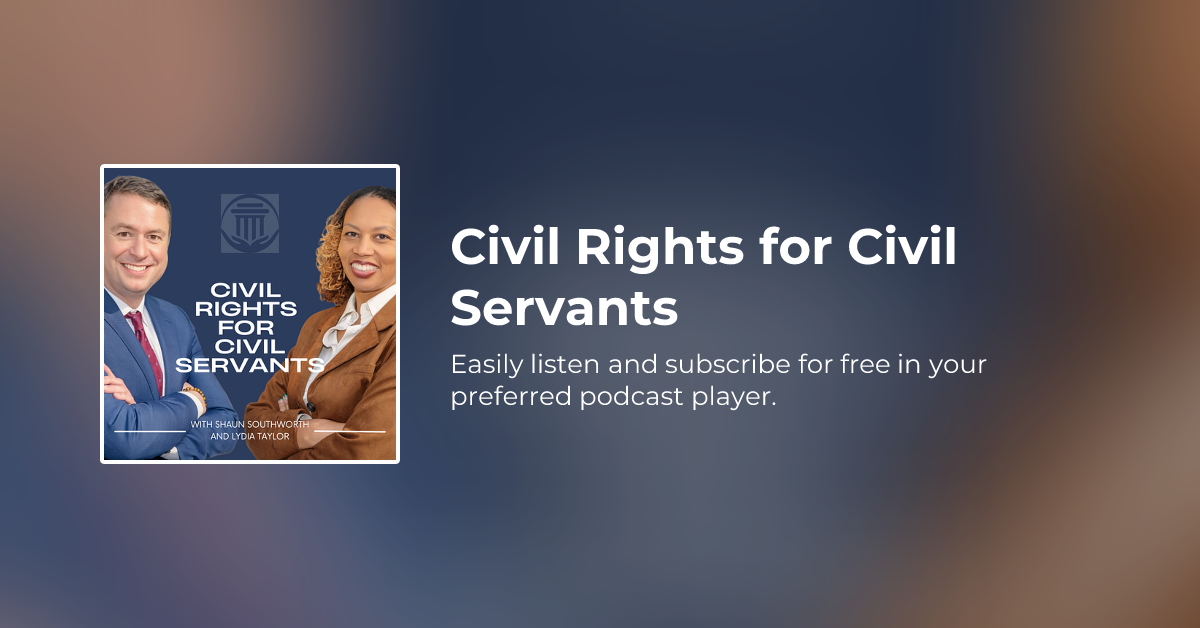
🎧 Listen: Civil Rights for Civil Servants
Shaun Southworth & Lydia Taylor on what's happening to the federal workforce. Latest episode: Apple · Spotify · Amazon Music · Youtube
 |
Today at a Glance
-
VA Union Contract: VA has told its workforce the AFGE master agreement "no longer applies" to most bargaining unit employees as of October 8; grievances, arbitrations, and union office space end, union-use equipment is due back October 22, and AFGE says the First Circuit's October 2 stay never authorized a re-termination.
-
EEOC Class Complaints: The EEOC has moved to dismiss the union lawsuit over its pause on federal-sector class complaints, arguing that employees can simply sue after 180 days. The judge has refused to halt discovery into whether a pause policy existed.
-
FEHB 2027: Open Season opens November 9, and OPM's 2027 highlights require documented intensive behavioral therapy before and during anti-obesity drug coverage, remove provider vaccine incentives while keeping vaccines fully covered, and steer care to "preferred" sites.
Top Stories:
1. VA Tells Its Workforce the AFGE Contract "No Longer Applies" — Grievances, Arbitrations, and Union Office Space End, Equipment Is Due Back October 22, and the Union Says the Appeals Court Never Authorized a Re-Termination
Source: Federal News Network, October 15, 2026
TL;DR: The Department of Veterans Affairs has moved again to end its master collective bargaining agreement (CBA) with the American Federation of Government Employees (AFGE), which covers more than 320,000 VA employees. Per internal documents reviewed by Federal News Network, VA revised its collective bargaining guidance on October 8 to state that the AFGE national agreement "no longer applies" to most bargaining unit employees, citing the March 2025 executive order excluding VA from the labor-relations statute, the contract's August 8 expiration date, and the First Circuit's October 2 stay. The guidance says negotiations, grievance and arbitration proceedings, union office space, and other contractual provisions "shall immediately cease," and that government equipment used for union work is due back by October 22; only police officers, firefighters, and security guards are exempt. VA notified AFGE on October 10 that it considers the 2023 agreement expired, and AFGE says VA will no longer recognize it as exclusive representative outside those three groups. The First Circuit's October 2 order stayed only the district court's August 7 enforcement order, finding the judge likely lacked jurisdiction to decide a disputed contract-extension question while the injunction was on appeal; the March 13 injunction ordering VA to reinstate the CBA remains in effect, and the appeals court noted that the parties' dispute over whether the contract's automatic extension was triggered remains unresolved. AFGE says the ruling "did not sanction the VA's interpretation of the duration of agreement article, nor did it give the VA permission to re-terminate the CBA."
For federal employees, this means:
- If you are a VA bargaining unit employee with a pending grievance or arbitration, ask your steward in writing where the case stands and keep copies of every filing and deadline. The guidance says those proceedings "shall immediately cease," and the union says it is weighing every legal option.
- Your statutory rights do not depend on the contract. A proposed suspension of more than 14 days, demotion, or removal may still carry advance notice, a reply, and a 30-day MSPB appeal window, and discrimination or reprisal claims still run through the EEO process and its 45-day counselor-contact deadline.
- Stewards and local officers: document what equipment is turned in and when before October 22, and report any discipline threatened over union activity to your local and the AFGE National VA Council.
Legal Insight
The Federal Service Labor-Management Relations Statute lets the President exclude an agency from collective bargaining only on a determination that it "has as a primary function intelligence, counterintelligence, investigative, or national security work" and that the statute "cannot be applied to that agency or subdivision in a manner consistent with national security requirements and considerations." 5 U.S.C. § 7103(b)(1). Executive Order 14251, 90 Fed. Reg. 14553 (Apr. 3, 2025), invoked that authority as to VA, and whether that determination is lawful is the merits question AFGE's lawsuit still presents; until it is decided, a recognized union remains "the exclusive representative of the employees in the unit it represents," 5 U.S.C. § 7114(a)(1), and interfering with employees' statutory rights or refusing to negotiate is an unfair labor practice under 5 U.S.C. § 7116(a)(1) and (5). If you are facing discipline or an adverse action while the contract's status is contested, consult a federal employment attorney: your MSPB and EEO deadlines run from the agency's action, not from the court case.
2. The EEOC Asks a Judge to Throw Out the Suit Over Its Pause on Federal-Sector Class Complaints — the Agency Says Employees Can Simply Sue After 180 Days, and the Judge Has Ordered Limited Discovery Into Whether a Pause Policy Existed
TL;DR: In American Federation of Government Employees v. EEOC, No. 1:26-cv-02640 (D.D.C.), the union and two Bureau of Prisons employees allege that the Equal Employment Opportunity Commission adopted a categorical policy of pausing federal-sector class complaints after an Administrative Judge wrote in December 2025 that case processing in Pippen v. Federal Bureau of Prisons was "paused until further notice" and that "[t]his notification applies to all class cases in the federal sector." On September 28, the EEOC moved to dismiss, arguing that months of inaction is not a concrete injury, that Title VII already supplies an adequate remedy because a class agent may sue 180 days after filing, and that a processing pause is not "final agency action" under the Administrative Procedure Act. The motion states that "neither the Commission nor the Chair directed anything of the sort" and that Pippen "is plowing ahead" under an August 10 scheduling order. On October 3, Judge Colleen Kollar-Kotelly denied the EEOC's request to stay discovery, writing that the record "does not demonstrate why the Administrative Judge issued this order or believed it applied to 'all cases in the federal sector,'" and that limited discovery will help the court "ascertain the contours of the precise policy at issue." The court had earlier found "a substantial body of evidence that tends to support an inference that the lengthy delays in Pippen and other cases did result from a coordinated policy," and the EEOC itself told the court that it "agrees that the processing of class complaints should not have been suspended." The plaintiffs filed their opposition on October 13, and the EEOC's reply is due October 20.
For federal employees, this means:
- If you are a class agent or member in a federal-sector class complaint, ask your representative for the current scheduling order; a case "paused" without one deserves a written inquiry to the Administrative Judge.
- The EEOC's lead argument highlights a right many employees overlook: 180 days after a class or individual complaint is filed with no final agency action, the class agent or complainant may file a civil action in federal district court.
- Going to court is a choice with consequences: it ends the administrative case, restarts the matter as a fresh (de novo) proceeding, and brings its own deadlines and costs, so weigh it with counsel.
Legal Insight
The Commission's regulations require that a class complaint "shall be processed promptly; the parties shall cooperate and shall proceed at all times without undue delay." 29 C.F.R. § 1614.204(c)(3). The same rules authorize a class agent, an individual complainant, or a class claimant to file a civil action "[a]fter 180 days from the date of filing an individual or class complaint if agency final action has not been taken," 29 C.F.R. § 1614.407(b); see 42 U.S.C. § 2000e-16(c), which is why the EEOC argues the courthouse, not the APA, is the remedy for delay. Whether an unexplained "pause" is agency action a court can review is the question the judge has kept alive for now. If your class or individual complaint has sat for more than 180 days, consult a federal employment attorney about whether to stay the course or go to court; the 180-day door is already open.
3. FEHB Open Season Opens November 9 — For 2027, Every Plan Will Require Documented Behavioral-Therapy Participation Before and During Anti-Obesity Drug Treatment, Vaccine Incentives to Providers Are Gone but Coverage Stays, and Plans Are Steering Care to "Preferred" Sites
Source: FEDweek, October 13, 2026
TL;DR: Open Season for the 2027 plan year runs November 9 through December 14, and OPM's "Federal Benefits Open Season Highlights, 2027 Plan Year," reproduced by FEDweek this week, spells out coverage changes beyond the premium increase announced September 30. Plans will continue to cover at least one GLP-1 anti-obesity medication and at least two oral anti-obesity medications, but "for 2027, all FEHB and PSHB Carriers will require documented participation in an evidence-based intensive behavioral therapy (IBT) program both prior to and during treatment with anti-obesity medications," with plans expected to cover between 12 and 22 IBT sessions a year "depending on progress." On vaccines, carriers "were directed to remove provider-based monetary incentives tied to pediatric and prenatal vaccine uptake," while plans "must continue to fully cover vaccinations delivered by in-network providers and recommended by the Advisory Committee on Immunization Practices and issued by the CDC." OPM also says a majority of plan options have identified "preferred sites" of care such as urgent care, office-based infusion, and virtual-first care instead of hospital outpatient departments. FEDweek notes plan brochures are due in early November. Health, dental, and vision enrollments continue automatically unless changed; a flexible spending account does not.
For federal employees, this means:
- If you or a covered family member takes an anti-obesity medication, ask your prescriber about an IBT program your plan will recognize. Starting in 2027, documented participation is a coverage condition, not a suggestion.
- Read your plan's site-of-care rules before you schedule an infusion, imaging, or a minor procedure. A "preferred site" policy can change what you owe for the same service.
- Mark the dates: Open Season closes Monday, December 14, FSAFEDS requires re-enrollment every year, and the enrollee share of FEHB premiums rises 10.9 percent on average.
Legal Insight
OPM sets these terms through its contracts with carriers: each FEHB contract "shall contain a detailed statement of benefits offered and shall include such maximums, limitations, exclusions, and other definitions of benefits as the Office considers necessary or desirable." 5 U.S.C. § 8902(d). The annual Open Season is fixed by regulation, running "from the Monday of the second full workweek in November through the Monday of the second full workweek in December." 5 C.F.R. § 890.301(f)(1). The plan brochure is the contract document that controls what is covered, so read the brochure itself, not a summary, before deciding whether to stay or switch.
Legal Tip of the Day
Keep Your Own Calendar While the Rules Are Being Fought Over
When the rules around your job are being fought over in court, it is easy to assume your own situation is on hold. Do not assume that. A lawsuit about a contract, an agency policy, or a processing pause may or may not change your own deadlines, so ask in writing which deadline applies to you and who is tracking it, then put that date on your own calendar. Keep copies of every notice, filing, and message about your case outside government systems. Ask your representative in writing where your matter stands, and note the date you asked. Until you have an answer in writing, treat every deadline as still running and act before it passes.
In Case You Missed It
A few quick hits from our recent posts:
Schedule G Explained: 25 Political Appointees, 22 at the VA, and No Public Record for a Year
|

FLRA Puts Union Election Rules Back After Court Ruling: What the Fine Print Says
|

Labor Department to Recertify Every Approved Accommodation Each Year: What Employees Should Know
|

Worried About Retaliation or Being Targeted for Speaking Up?
If you’ve reported misconduct, safety concerns, discrimination, or waste/fraud/abuse—and now you’re seeing sudden schedule changes, bad performance reviews, or threats of discipline—you may be in whistleblower or retaliation territory.
We represent federal employees who:
-
Reported concerns and then saw adverse actions
-
Were sidelined, reassigned, or given impossible workloads after speaking up
-
Face investigations, PIPs, or proposed removals that look like payback
-
Need help navigating OSC complaints, EEO claims, or MSPB appeals tied to retaliation
A free, confidential consultation can help you sort out what’s normal agency behavior and what may cross the line—and what to do before your options narrow.
👉 Schedule Your Free Consultation Today
|

Disclaimer:
This briefing is for general informational purposes only and does not constitute legal advice or create an attorney‑client relationship. Federal employment law is fact‑specific and time‑sensitive; you should consult a qualified attorney about your own situation and deadlines. Past results do not guarantee future outcomes.
Your service is worth protecting. Let's protect it together at Southworth PC.

Responses