Attorneys for Federal Employees — Nationwide
Nearly 200,000 federal workers and supporters follow our updates across TikTok, Instagram, YouTube, Facebook, and LinkedIn. Each briefing gives you the three stories that actually matter to your job, plain‑English legal guidance, and one short practice to protect your peace of mind. If it helps you, forward it to a colleague—new readers can subscribe at https://fedlegalhelp.com/newsletter.
🎧 Listen: Civil Rights for Civil Servants
Shaun Southworth & Lydia Taylor on what's happening to the federal workforce. Latest episode: Apple · Spotify · Amazon Music · Youtube
 |
Today at a Glance
- DHS Reassignments Under Review: The Department of Homeland Security's inspector general is investigating whether senior-staff reassignments made between January 2025 and March 2026 — a period when hundreds of employees received management-directed reassignments — complied with federal laws and regulations.
- DoD Cyber Apprenticeship Deadline: Applications for the Defense Department's 12-month paid cyber apprenticeship close July 17 on USAJobs.gov. No prior cyber experience is required, but the posted pay terms deserve a close read.
- Skills-Based Hiring Push: A new bipartisan House bill would require agencies to credit military service, apprenticeships, and community college in place of four-year degrees for many federal jobs, and would create a separate USAJobs portal for positions that do not require a degree.
Top Stories:
1. DHS Inspector General Opens Review of Senior Executive Reassignments Made Under Former Secretary Noem
Source: Federal News Network, July 9, 2026
TL;DR: The Department of Homeland Security's Office of Inspector General is reviewing whether DHS followed the law when it reassigned senior career staff under former Secretary Kristi Noem. In a July 1 notice to the department's chief human capital officer, Inspector General Joseph Cuffari said his office will examine Senior Executive Service (SES) reassignments made between January 25, 2025, and March 24, 2026, to determine "whether such reassignments were conducted in accordance with federal laws, regulations, and policies," with initial fieldwork beginning this month. The review follows waves of management-directed reassignments — MDRs — that reached hundreds of DHS employees over the past year, in some cases ordering employees on short notice to report to positions hundreds of miles from their duty stations and outside their areas of expertise, including immigration-enforcement roles. The number of career SES members at DHS fell from 723 in January 2025 to 513 by March 2026, according to Office of Personnel Management data cited in Federal News Network's reporting.
For federal employees, this means:
- If you received an MDR at DHS during the review window, preserve the paperwork now — the reassignment notice, your SF-50s, and any emails about the timing and stated reasons for the move. Those records matter both to the IG's review and to any individual claim you may have.
- The IG review does not pause or reverse anyone's reassignment, and it is not a substitute for your own case. The 45-day deadline to contact an Equal Employment Opportunity (EEO) counselor and the timelines for an Office of Special Counsel complaint run independently of the review.
- Refusing a directed reassignment is a serious step that can end in a removal action. Employees considering it should understand their appeal rights before deciding, not after.
Legal Insight:
For career senior executives, 5 U.S.C. § 3395(a)(2) requires advance written notice before an involuntary reassignment — at least 60 days, plus consultation, for a move outside the commuting area, and at least 15 days within it — and § 3395(e) bars involuntary reassignment within 120 days after a new agency head or a new noncareer supervisor with appraisal authority takes office. A reassignment is also a "personnel action" under 5 U.S.C. § 2302(a)(2)(A)(iv), so an MDR imposed because an employee reported wrongdoing can constitute whistleblower reprisal under 5 U.S.C. § 2302(b)(8), raisable with the Office of Special Counsel and, if OSC closes the matter, through an Individual Right of Action appeal to the Merit Systems Protection Board under 5 U.S.C. § 1221. Employees who believe a reassignment was retaliatory should consult a federal employment attorney promptly, because these claims are usually won or lost on how early and how well the record is built.
2. DoD's Paid Cyber Apprenticeship Is Open — Applications Close July 17, and the Fine Print Matters
Source: Federal News Network, July 7, 2026
TL;DR: Applications are open for the Defense Department's long-awaited cyber apprenticeship, a 12-month paid pilot that the DoD chief information officer's office announced July 6 after receiving more than 70,000 inquiries from prospective candidates. Applications will be accepted through July 17 on USAJobs.gov. No prior professional cyber experience is required, and the stated qualifications are that applicants be at least 18 years old, U.S. citizens, and able to obtain a security clearance. The program offers two tracks — a Technical Specialist Pathway with no degree requirement, and a Defense Manpower Data Center pathway that does require an accredited degree — and prepares participants for entry-level roles under the DoD 8140 cyber workforce framework. Federal News Network flagged a discrepancy worth a careful read: the CIO's office pointed to pay of roughly $57,735 for a GG-7, step 1, in the Washington, D.C. area, but the USAJobs posting lists the salary at $22,584 per year, with most vacancies in the D.C. area and relocation costs on the applicant. The Pentagon did not answer Federal News Network's questions about cohort size, the start date, or whether positions will be available at other duty stations.
For federal employees, this means:
- The window is short — applications close July 17. If you, a colleague displaced by a RIF (Reduction in Force), or a family member is interested, apply through the USAJobs posting and treat the posting, not the press materials, as the controlling description of the job.
- The posted salary ($22,584) and the CIO office's quoted figure (roughly $57,735 for a GG-7, step 1, in D.C.) do not match, and DoD has not explained the difference. Before accepting any offer, get the grade, step, locality pay, and appointment type in writing.
- These are GG-graded positions, which sit in the excepted service rather than the competitive service. Job protections and appeal rights build differently there, so the appointment paperwork matters more than most applicants realize.
Legal Insight:
Adverse-action appeal rights for excepted-service employees turn on 5 U.S.C. § 7511: a nonpreference excepted-service employee generally becomes an "employee" with Merit Systems Protection Board appeal rights only after two years of current continuous service under other than a temporary appointment limited to two years or less (5 U.S.C. § 7511(a)(1)(C)), while a veterans'-preference eligible needs one year (§ 7511(a)(1)(B)). The Board's recent precedential decision in Davis v. Department of Defense, 2026 MSPB 5, held that a preference-eligible DoD cyber hire with a year of current continuous service had appeal rights even though she was still within a three-year probationary period. Anyone separated during or after a program like this should have a federal employment attorney review the appointment type and service history before assuming no appeal exists.
3. A Bipartisan Bill Would Push Federal Hiring Further From Four-Year Degree Requirements
Source: Federal News Network, July 9, 2026
TL;DR: A bipartisan group of House members has introduced the Federal Jobs for STARs Act, the latest congressional push toward skills-based federal hiring. The bill, from Reps. Janelle Bynum (D-Ore.), Raja Krishnamoorthi (D-Ill.), Ryan Mackenzie (R-Pa.), and John McGuire (R-Va.), would push agencies to ease college-degree requirements for many federal jobs and require them to consider alternative qualifications such as military service, apprenticeships, and community college. It would also create a separate USAJobs portal for positions that do not require a four-year degree. The bill builds on the Chance to Compete Act of 2024, which requires agencies to replace self-assessments and degree-based screens with technical, skills-based assessments, with implementation phasing in over three years. The new bill is at the introduction stage — it would need to pass both chambers and be signed before anything changes on USAJobs.
For federal employees, this means:
- Qualification standards are not just an applicant issue. How agencies define minimum qualifications affects internal movement, promotions, and requalifying after a RIF, so current employees have a stake in how this framework develops.
- Veterans and employees who came up through apprenticeships or community college would see those routes expressly credited as qualifying experience if the bill becomes law.
- Nothing changes today. Until Congress acts, the binding framework remains the Chance to Compete Act's assessment requirements and the Office of Personnel Management's existing qualification standards.
Legal Insight:
Federal law already limits degree gatekeeping in the competitive service: under 5 U.S.C. § 3308, the Office of Personnel Management (OPM) and examining agencies may not prescribe a minimum educational requirement except where OPM finds the duties of a scientific, technical, or professional position cannot be performed without it. The Chance to Compete Act of 2024, Pub. L. No. 118-188, layered on a governmentwide mandate for skills- and competency-based assessments in competitive hiring. The Federal Jobs for STARs Act would extend that framework by crediting alternative qualification routes and standing up a dedicated non-degree USAJobs portal, but unless and until it becomes law, current qualification standards govern.
Legal Tip of the Day
If You Feel Pressured to Resign
Pressure to resign can sound like advice, a threat, or a promise that leaving quietly will protect your record. Resignation can limit appeal rights, affect benefits, and make it harder to challenge what happened later. If you are urged to resign, ask for the proposal in writing, request time to review it, and save any messages suggesting negative consequences if you do not leave. Do not sign resignation, retirement, settlement, or release documents while panicked or without understanding the impact. A short pause can make a major difference.
A few quick hits from our recent videos and posts:
Federal Discipline Without the Douglas Factors: What a New OPM-MSPB Rule Would Change
|

OPM Wants to Stop Measuring Federal Employee Morale. A New Survey Shows Why That Matters.
|
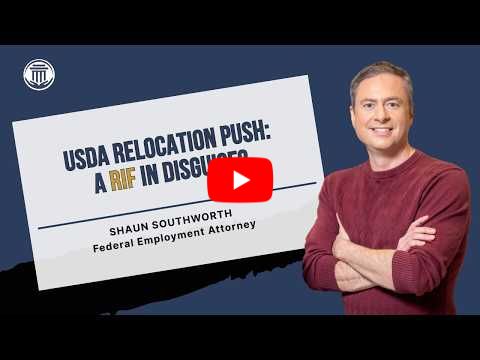
Is USDA's Reorganization a RIF in Disguise? What a New Court Filing Alleges
|

Worried About Retaliation or Being Targeted for Speaking Up?
If you’ve reported misconduct, safety concerns, discrimination, or waste/fraud/abuse—and now you’re seeing sudden schedule changes, bad performance reviews, or threats of discipline—you may be in whistleblower or retaliation territory.
We represent federal employees who:
-
Reported concerns and then saw adverse actions
-
Were sidelined, reassigned, or given impossible workloads after speaking up
-
Face investigations, PIPs, or proposed removals that look like payback
-
Need help navigating OSC complaints, EEO claims, or MSPB appeals tied to retaliation
A free, confidential consultation can help you sort out what’s normal agency behavior and what may cross the line—and what to do before your options narrow.
👉 Schedule Your Free Consultation Today
|

Disclaimer:
This briefing is for general informational purposes only and does not constitute legal advice or create an attorney‑client relationship. Federal employment law is fact‑specific and time‑sensitive; you should consult a qualified attorney about your own situation and deadlines. Past results do not guarantee future outcomes.
Your service is worth protecting. Let's protect it together at Southworth PC.

Responses