Attorneys for Federal Employees — Nationwide
Nearly 200,000 federal workers and supporters follow our updates across TikTok, Instagram, YouTube, Facebook, and LinkedIn. Each briefing gives you the three stories that actually matter to your job, plain‑English legal guidance, and one short practice to protect your peace of mind. If it helps you, forward it to a colleague—new readers can subscribe at https://fedlegalhelp.com/newsletter.
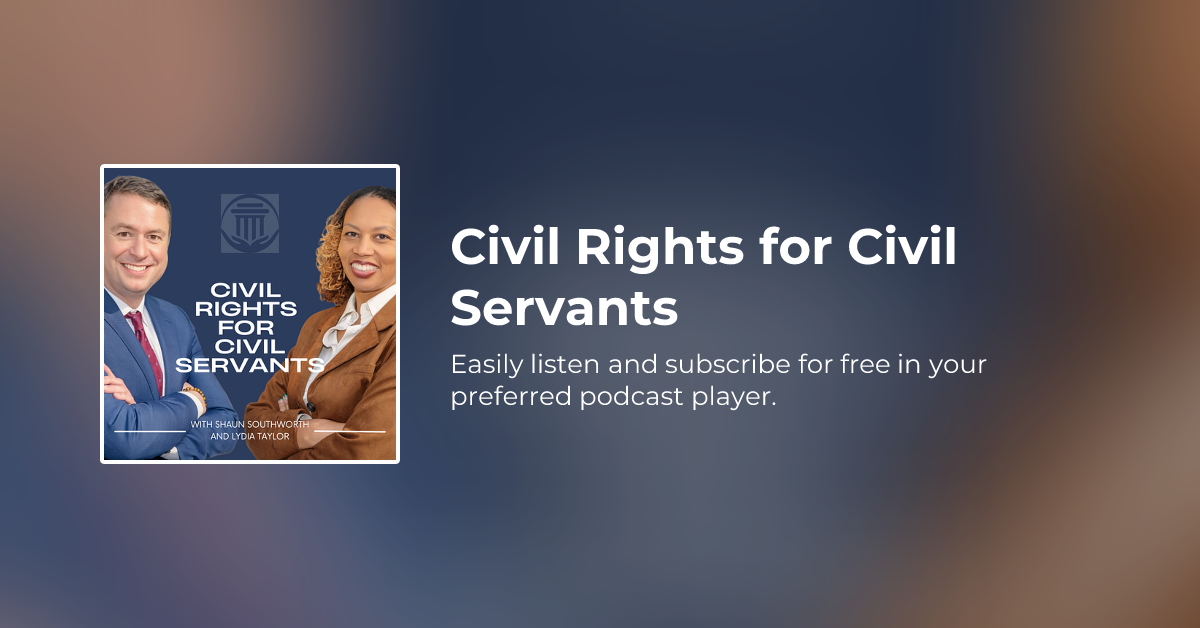
🎧 Listen: Civil Rights for Civil Servants
Shaun Southworth & Lydia Taylor on what's happening to the federal workforce. Latest episode: Apple · Spotify · Amazon Music · Youtube
 |
Today at a Glance
-
DHS Whistleblower Cases Take Years: GAO found the DHS Inspector General took more than three years to close most whistleblower retaliation investigations, and the Secretary missed a 30-day deadline in every substantiated case. The Inspector General route and the OSC/MSPB route are not the same thing.
-
OPM Proposes an Excepted-Service Overhaul: A proposed rule published this morning would let Pathways hires convert directly into Schedule Policy/Career and would replace the standing priority reemployment lists for excepted-service employees separated by RIF. Comments are due November 17.
-
VA Disputes an Arbitrator's Bill: After an arbitrator found the VA violated its master agreement by denying official time, the VA says it cannot pay for arbitration services performed while it did not recognize AFGE.
Top Stories:
1. GAO: DHS Whistleblower Retaliation Complaints Jumped From 75 to 834 a Year, Most Investigations Took Over Three Years, and the Secretary Missed Every 30-Day Deadline — Why the OSC Route Still Matters
Source: Federal News Network, September 17, 2026
TL;DR: The Government Accountability Office (GAO) released a report Thursday, GAO-26-108106, on how the Department of Homeland Security (DHS) handles whistleblower retaliation complaints. From fiscal 2018 through 2025, the DHS Office of Inspector General (OIG) identified 3,025 complaints alleging whistleblower retaliation out of about 236,000 complaints of wrongdoing; the yearly count rose from 75 to 834, and Immigration and Customs Enforcement, Customs and Border Protection, FEMA, and the Coast Guard accounted for 69 percent. The OIG's Whistleblower Protection Division opened 115 investigations and closed 73. Those investigations ran from 14 days to about six years; 39 of the 73 took more than three years, and only eight closed within a year. OIG substantiated retaliation in 11 cases, but the Secretary of Homeland Security did not decide on corrective action within 30 days in any of them, as GAO says the law requires; the cases waited from about four months to more than two years, and six were still pending as of May 2026. GAO made three recommendations on investigation timeliness and on deciding the pending cases, and DHS and the OIG agreed. Inspector General Joseph Cuffari told GAO the division has new leadership and more staff and that "it is reasonable to set timeliness goals."
For federal employees, this means:
- An Inspector General complaint is not an OSC complaint. The OIG can investigate and report, but for Title 5 employees the office that can seek enforceable corrective action is the Office of Special Counsel (OSC), and only an OSC filing opens the door to an Individual Right of Action appeal at the Merit Systems Protection Board (MSPB). GAO notes complainants may go to OSC before, during, or after an OIG complaint.
- The 30-day deadline GAO applied comes from the statutes covering Coast Guard members and contractor employees, 10 U.S.C. § 1034(f)(1) and 41 U.S.C. § 4712(c)(1), not from Title 5. For a civilian DHS employee, no comparable Title 5 deadline binds the Secretary after an OIG finding; the enforceable route runs through OSC and the MSPB.
- Build your own record now. GAO found that in some cases the employee or the manager had left the agency by the time the investigation ended, so a promotion or discipline was no longer a viable remedy. Keep the disclosure, proof of who knew about it, and every personnel action that followed, in writing.
Legal Insight
Federal law prohibits taking or threatening a personnel action because of a protected disclosure, 5 U.S.C. § 2302(b)(8), and separately protects "cooperating with or disclosing information to the Inspector General . . . or the Special Counsel," § 2302(b)(9)(C). An employee "shall seek corrective action from the Special Counsel before seeking corrective action from the Board," and may file an Individual Right of Action appeal only after OSC closes the matter or 120 days pass without OSC taking it up, 5 U.S.C. § 1214(a)(3); the Board's rule sets the window at 65 days from OSC's written closure notice, 5 C.F.R. § 1209.5(a). An OIG complaint does not start that clock or satisfy that requirement, so anyone waiting on a DHS OIG investigation should consult a federal employment attorney about whether and when to file with OSC.
2. OPM Proposes to Rewrite the Excepted-Service Rules — Pathways Hires Could Convert Straight Into Schedule Policy/Career, and Excepted Employees Separated by RIF Would Lose the Standing Priority List; Comments Due November 17
Source: Federal Register (OPM proposed rule), September 18, 2026
TL;DR: The Office of Personnel Management (OPM) published a proposed rule this morning, "Employment in the Excepted Service," 91 Fed. Reg. 59076 (Sept. 18, 2026), RIN 3206-AO92, Docket OPM-2026-0166; comments are due November 17, 2026. The rule would conform ten parts of OPM's regulations to the excepted-service schedules created by recent executive orders, including Schedule Policy/Career for career positions of a "confidential, policy-determining, policy-making, or policy-advocating character" and Schedule G for noncareer policy positions. Two changes reach beyond housekeeping. First, Pathways interns, recent graduates, and Presidential Management Fellows could be converted noncompetitively into permanent Schedule Policy/Career positions, with no trial period, no competitive status until two years of Schedule Policy/Career service, and no credit for Pathways time toward those two years. Second, OPM would eliminate the standing priority reemployment lists agencies now keep for excepted-service employees separated by a reduction in force (RIF) or returning from a compensable injury, replacing them with a vacancy-by-vacancy priority-consideration process agencies must document. The rule would also allow a position in a personnel system outside title 5 to be designated Schedule Policy/Career "to the extent permitted by the statute governing the position," exclude Schedule G appointees from chapter 43 performance procedures and severance pay, and treat Schedule G supervisors as noncareer for the 120-day protections that shield career Senior Executive Service members after a leadership change. OPM asks whether the new framework "adequately preserves rights of employees who are furloughed, separated by RIF or similar workforce reduction action."
For federal employees, this means:
- If you are in a Pathways program, read proposed § 362.107. Conversion into Schedule Policy/Career confers no competitive status or career tenure, and because those positions sit outside chapter 75, the converted employee has no MSPB appeal right against a removal while the position stays in that schedule. The June 3, 2026 order that placed roughly 8,000 career positions in the schedule, per earlier Government Executive and Federal News Network reporting, is being challenged in a pending District of Columbia federal case.
- If you are an excepted-service employee facing a RIF, including a preference eligible, the proposal shifts the work to you: apply for priority consideration vacancy by vacancy and keep your availability, location, and grade information current. Agencies would still have to select qualified priority candidates first, but their pre-selection records would decide whether you were in the pool.
- If you are a career SES member or work in a personnel system outside title 5, watch two provisions: Schedule G supervisors would trigger the 120-day moratorium on involuntary reassignment and the post-transition removal restrictions, and proposed § 213.3601(f) would open Schedule Policy/Career designation to personnel systems outside title 5, such as title 38 and FAA positions, to the extent those statutes allow.
Legal Insight
Chapter 75's adverse-action protections do not apply to an employee "whose position has been determined to be of a confidential, policy-determining, policy-making or policy-advocating character" by the President or by OPM, 5 U.S.C. § 7511(b)(2), and the prohibited-personnel-practice statute excludes the same positions from the definition of "covered position," § 2302(a)(2)(B)(i) — so the designation changes an employee's rights even when the duties do not change. Excepted-service hiring must still honor veterans' preference "in the same manner and under the same conditions" as the competitive service, 5 U.S.C. § 3320, and OPM has asked whether its new priority framework meets that standard; comments go to regulations.gov under Docket OPM-2026-0166 by November 17. Anyone whose position has been or may be designated Schedule Policy/Career should consult a federal employment attorney before responding to a proposed action; the deadlines and forums differ from the chapter 75 process.
3. The VA Says It Cannot Pay an Arbitrator for the Months It Refused to Recognize AFGE — After the Arbitrator Found the VA Violated the Contract by Denying Official Time
Source: Government Executive, September 17, 2026
TL;DR: In April, arbitrator James M. Cooney found that the Department of Veterans Affairs (VA) violated its 2023 master agreement with the American Federation of Government Employees (AFGE) by refusing official time to representatives of AFGE Local 0025 in Hagerstown, Maryland, and ordered the VA to "cease and desist from refusing to recognize the Union," pay back pay with interest, and restore leave, Government Executive reports. The VA had terminated most of its union contracts on August 6, 2025, under Executive Order 14251, which excluded the VA from the federal labor-relations statute. On March 13, 2026, Judge Melissa DuBose of the U.S. District Court for the District of Rhode Island ordered the VA to reinstate the master agreement "for the remainder of the agreed-upon term," and on August 28 she denied the VA's renewed request to stay that order pending its First Circuit appeal. The master agreement splits arbitrator fees, but in emails obtained by Government Executive the VA told the arbitrator it "is unable to pay" for services billed in August 2025, September 2025, and January 2026. The local grieved; a VA official denied the grievance September 1, writing that the fee clause does not authorize spending appropriated funds "for arbitration services performed during a period in which the Agency was prohibited from recognizing or administering the collective bargaining agreement," a period the VA dates from August 6, 2025, to March 27, 2026. Cooney told the outlet Thursday that "the VA has initiated the payment process"; the VA declined to comment.
For federal employees, this means:
- If you are in a VA bargaining unit, the master agreement is in force under the court's order, and its grievance and arbitration deadlines apply now. File in writing and on time, and ask your steward which step and time limit governs your issue.
- An arbitrator's award is not advice. Once the 30-day window to file exceptions with the Federal Labor Relations Authority closes, the award is final and binding and the agency must carry it out; if it does not, the union can pursue an unfair labor practice charge.
- Keep your own records of official time denied or a grievance left unprocessed during the months the VA did not recognize the union. Whether that period gets remedied is still being litigated, and documentation is what turns a grievance into back pay.
Legal Insight
The labor-relations statute requires every negotiated grievance procedure to end in "binding arbitration which may be invoked by either the exclusive representative or the agency," 5 U.S.C. § 7121(b)(1)(C)(iii). If no exception is filed with the Authority within 30 days of service, "the award shall be final and binding" and "[a]n agency shall take the actions required by an arbitrator's final award," § 7122(a)–(b); noncompliance can be charged as an unfair labor practice, § 7116(a)(8), and official time itself is a statutory entitlement, § 7131(d). The VA's position rests on Executive Order 14251, § 1-404, 90 Fed. Reg. 14,553 (Apr. 3, 2025), which excluded the VA from chapter 71; the March 13 injunction remains in effect while the First Circuit considers the government's appeal.
Legal Tip of the Day
Reporting to the Inspector General Does Not Stop Other Clocks
Filing a complaint with your agency’s Inspector General can be the right step when you see waste, fraud, abuse, or retaliation, but it is not the same as filing with the Office of Special Counsel, an EEO counselor, a union grievance process, or the MSPB. Each of those has its own process and its own deadlines, and an open IG matter does not pause them. Keep a private timeline of what you reported, when, to whom, and every personnel action that followed, and save copies outside government systems. Before you decide to wait for the IG’s findings, find out what other deadlines may be running and how long you have. Do not assume that because one office is looking into it, your rights are protected everywhere else.
In Case You Missed It
A few quick hits from our recent posts:
Every VA Hospital Reported Severe Staffing Shortages. Then VA Called Its Own IG Report Unreliable.
|

OPM Calls $9.5 Billion in Paid Leave a "400% Return." Its Own Numbers Say Otherwise.
|

Worried About Retaliation or Being Targeted for Speaking Up?
If you’ve reported misconduct, safety concerns, discrimination, or waste/fraud/abuse—and now you’re seeing sudden schedule changes, bad performance reviews, or threats of discipline—you may be in whistleblower or retaliation territory.
We represent federal employees who:
-
Reported concerns and then saw adverse actions
-
Were sidelined, reassigned, or given impossible workloads after speaking up
-
Face investigations, PIPs, or proposed removals that look like payback
-
Need help navigating OSC complaints, EEO claims, or MSPB appeals tied to retaliation
A free, confidential consultation can help you sort out what’s normal agency behavior and what may cross the line—and what to do before your options narrow.
👉 Schedule Your Free Consultation Today
|

Disclaimer:
This briefing is for general informational purposes only and does not constitute legal advice or create an attorney‑client relationship. Federal employment law is fact‑specific and time‑sensitive; you should consult a qualified attorney about your own situation and deadlines. Past results do not guarantee future outcomes.
Your service is worth protecting. Let's protect it together at Southworth PC.

Responses