Nearly 200,000 federal workers and supporters follow our updates across TikTok, Instagram, YouTube, Facebook, and LinkedIn. Each briefing gives you the three stories that actually matter to your job, plain‑English legal guidance, and one short practice to protect your peace of mind. If it helps you, forward it to a colleague—new readers can subscribe at https://fedlegalhelp.com/newsletter.
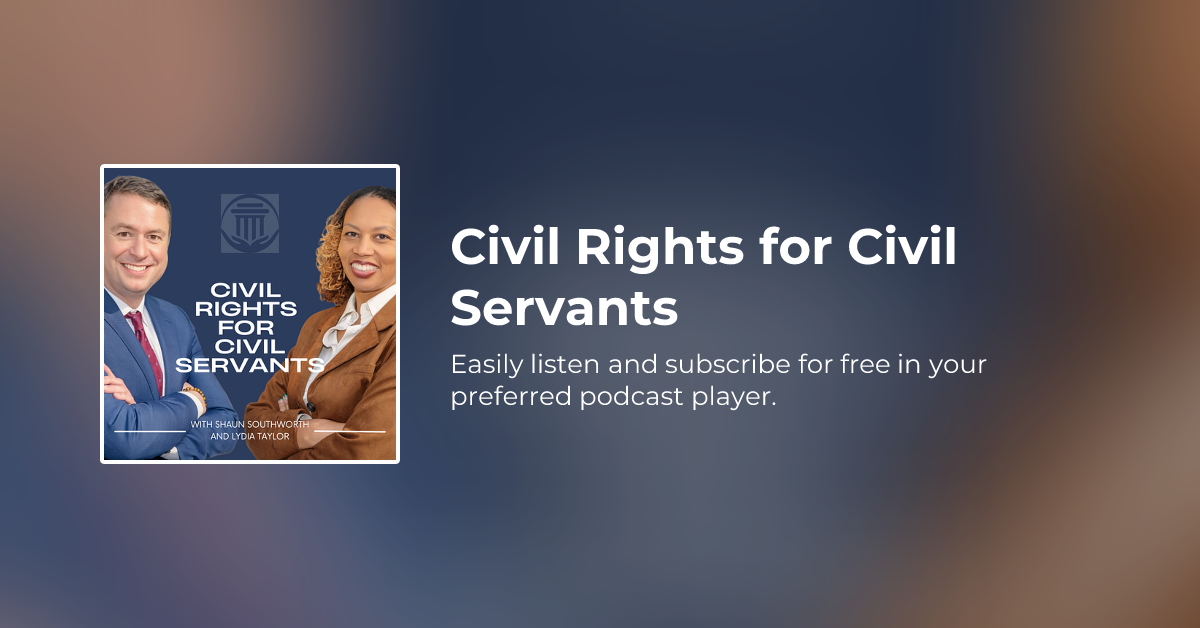
Our New Podcast Dropped Last Friday — Tune in to Episode 1 Now
We've been telling you for weeks: it's time federal employees had a show of their own. Civil Rights for Civil Servants, co-hosted by Shaun Southworth and Lydia Taylor, premiered last Friday, June 19. Give it a listen or watch and subscribe so each episode lands in your feed the moment it drops.
Listen/Watch and subscribe wherever you get your podcasts (Apple, Spotify, Amazon Music, Youtube).
 |
Today at a Glance
-
MSPB Appeal Rights: The Merit Systems Protection Board ruled that a preference-eligible Defense Department cyber hire could appeal her firing despite a three-year probationary period, because veterans' preference gave her "employee" status after just one year.
-
FEHB/PSHB Medical Data: OPM is defending a plan to pull detailed medical records from health-plan carriers, now saying the data it receives will be de-identified — but the safeguards live in a blog post, not yet in the formal notice.
-
IRS Staffing: A Treasury inspector general found IRS staffing fell about 30% before rehiring began, with revenue agents, examiners, and analysts hit hardest and backlogs growing.
Top Stories:
1. MSPB Says a Long-Probation Cyber Hire Still Had Appeal Rights — Veterans' Preference Was the Key
Source: FEDweek, June 16, 2026
TL;DR: The Merit Systems Protection Board (MSPB) issued a precedential decision, Davis v. Department of Defense, 2026 MSPB 5 (Docket No. DC-0752-25-0273-I-1), holding that a preference-eligible employee whom the Defense Department hired into an excepted-service cybersecurity position under 10 U.S.C. § 1599f had the right to appeal her removal even though she had not finished her probationary period. DoD set a three-year probationary period and removed her at roughly 34 months without giving her a chance to respond. The Board agreed with its administrative judge that, because she was a preference eligible with more than one year of current continuous service, she met the definition of "employee" in 5 U.S.C. § 7511(a)(1)(B) and was not excluded by § 7511(b) — so the agency owed her the adverse-action procedures in 5 U.S.C. § 7513, and her removal was canceled. The Board reasoned that when Congress wants to strip appeal rights it says so, pointing to a neighboring statute, 10 U.S.C. § 1599e, where Congress extended certain probationary periods and expressly excluded those employees, and to Lal v. MSPB, 821 F.3d 1376 (Fed. Cir. 2016). The Board also excused her four-month-late filing for good cause, because the agency never notified her of her appeal rights, and held that her earlier complaint to the Office of Special Counsel (OSC) did not bar her Board appeal because she had not knowingly elected that remedy.
For federal employees, this means:
-
Preference eligibles can reach "employee" status faster: one year of current continuous service in the excepted service, regardless of a longer assigned probationary period, can be enough to carry full adverse-action and appeal rights.
-
A late MSPB appeal is not automatically dead. If an agency removes you without telling you about your appeal rights, that omission can be good cause to waive the filing deadline.
-
Filing an OSC complaint does not necessarily forfeit a later Board appeal — unless the agency warned you in writing that choosing OSC is a binding election of remedies.
Legal Insight:
The Civil Service Due Process Amendments define who counts as an "employee" with appeal rights, and 5 U.S.C. § 7511(a)(1)(B) reaches preference eligibles in the excepted service with one year of current continuous service unless a specific exclusion in § 7511(b) applies; an employee who qualifies is entitled to the notice-and-reply protections of 5 U.S.C. § 7513 before removal. The ordinary deadline to file an MSPB appeal is 30 days from the action's effective date or notice (5 C.F.R. § 1201.22(b)), but that clock can be equitably tolled. If you were removed during a long probationary period and hold veterans' preference — or were told an OSC complaint was your only option — consult a federal employment attorney promptly, because these deadlines and election rules are easy to miss.
2. OPM Tries to Calm Privacy Fears Over Its Plan to Pull Health-Plan Medical Data
Source: FEDweek, June 17, 2026
TL;DR: OPM is defending a plan to obtain detailed medical data from Federal Employees Health Benefits (FEHB) and Postal Service Health Benefits (PSHB) carriers — including office visits, treatments, and prescriptions — after a Federal Register notice posted in December drew opposition once it surfaced publicly in April. The National Active and Retired Federal Employees Association (NARFE), the AFGE union, and about a dozen House and Senate Democrats warned that the original notice did not adequately explain why OPM needed the data, how it would be secured, or how enrollees' privacy would be protected. In a blog post, OPM Director Scott Kupor said the data OPM receives will be stripped by OPM's inspector general of names, Social Security numbers, phone numbers, and addresses (except ZIP codes), leaving only ZIP code, year of birth, and a member ID that will be replaced with random characters and held encrypted in a separate environment, so that it "cannot be mapped back to any plan participant." Kupor framed the effort as a way to catch mis-billing and fraud as it happens rather than after the fact. NARFE called the longer explanation helpful but noted "it remains a blog post." Separately, OPM reminded carriers of required fraud-prevention programs and finalized rules tightening proof of family-member eligibility.
For federal employees, this means:
-
If you are enrolled in FEHB or PSHB, OPM's data request is still a proposal. Watch the Federal Register docket and submit a comment if the privacy questions matter to you.
-
OPM now says the data it ultimately receives will be de-identified, but those safeguards are described in a blog post — not yet written into the formal notice or a binding system-of-records rule.
-
A separate, finalized change requires documenting family-member eligibility, so keep marriage and birth certificates and similar records handy for Open Season and qualifying life events.
Legal Insight:
Federal agencies' collection, storage, and sharing of records about individuals — including health data — are governed by the Privacy Act of 1974, 5 U.S.C. § 552a, which generally requires a published system-of-records notice, a lawful "routine use" for any disclosure, and reasonable safeguards against unauthorized access. The FEHB program itself operates under the FEHB Act, 5 U.S.C. Chapter 89. Commitments made only in a blog post do not carry the same legal force as terms set out in a Privacy Act notice or rule, which is why commenters are pressing OPM to put its de-identification promises into the formal record.
3. IRS Lost Nearly a Third of Its Workforce Before Rehiring Began, Inspector General Says
Source: FEDweek, June 16, 2026
TL;DR: A Treasury Inspector General for Tax Administration (TIGTA) report — the third in a series — found IRS staffing fell about 30% in the 12 months starting last January before the agency began backfilling, leaving a net cut of about 28% and total staff near 74,000. The reductions came mostly through deferred-resignation offers and buyouts; two separate planned reductions in force (RIFs) were canceled after courts blocked them. Certain job series were hit hardest: about 33% of revenue agents, 32% of tax examiners, 31% of management and program analysts, and 30% of clerks and assistants. About 2,000 positions have been backfilled, and roughly 2,900 of the 7,300 probationary employees who received termination notices early last year have returned to work or are being rehired. Earlier reports in the series found an 11% cut as of last March and a 25% cut as of last May. TIGTA did not assess the impact of the losses but warned the agency faces elevated operational risk and growing backlogs of amended returns and taxpayer correspondence, noting that many departing employees carried "institutional knowledge and technical expertise that cannot easily be replaced."
For federal employees, this means:
-
If you took a deferred-resignation or buyout offer, keep your SF-50s and separation paperwork; those records govern severance, reemployment, and future annuity questions.
-
If you are a displaced or surplus employee, the Career Transition Assistance Plan (CTAP) and Interagency Career Transition Assistance Plan (ICTAP) can give you selection priority for other federal jobs.
-
If a RIF reaches your position, your retention standing and appeal rights are set by the RIF rules, not by an agency's informal explanation — know them before you sign anything.
Legal Insight:
Reductions in force are governed by 5 U.S.C. § 3502 and the detailed regulations at 5 C.F.R. Part 351, which set retention factors (tenure, veterans' preference, length of service, and performance) and require specific notice; an employee may generally appeal a RIF action to the MSPB to test whether the agency followed those rules. Displaced employees also have selection priority under CTAP and ICTAP, 5 C.F.R. Part 330, Subparts F and G. If you are facing a RIF notice or believe a separation was mislabeled to avoid RIF procedures, consult a federal employment attorney, because the deadlines to challenge the action are short.
Legal Tip of the Day
Requesting a Reasonable Accommodation the Right Way
If a medical condition affects your ability to work, a reasonable accommodation request should be handled carefully and in writing. Explain that you have a medical condition affecting work and identify practical changes that may help, such as schedule adjustments, telework, equipment, modified duties, or reassignment when appropriate. Keep copies of the request, medical documentation, agency forms, and all responses. Do not disclose more medical detail than necessary, and do not rely only on verbal conversations about what the agency will do. Southworth PC can help federal employees prepare accommodation requests, respond to agency questions, and evaluate delays, denials, or ineffective proposals.
In Case You Missed It
A few quick hits from our recent videos and posts:
Political Favoritism and Federal Employee Rights
|

Jackler v. DOJ and MSPB Appeal Rights
|

Can the Executive Branch Dismantle a Department Congress Created?
|

Need Help with Discipline or Performance?
If you’ve just been put on a PIP, received a proposed suspension or removal, or are worried your “coaching” has turned into a paper trail, it’s time to get real advice—not just hallway rumors.
At Southworth PC, we represent federal employees nationwide in:
-
Proposed discipline and removals
-
Performance issues and PIPs
-
EEO discrimination, harassment, and retaliation
-
Whistleblower and civil rights matters
-
MSPB, EEOC, and OSC cases
-
OPM/FERS disability retirement applications (flat‑fee full‑service assistance)
In a free, confidential consultation, you speak directly with an attorney about your timeline, key documents, and options. Deadlines can be quick in the federal sector, so if you have a deadline, don’t wait.
👉 Schedule Your Free Consultation Today
|

Disclaimer:
This briefing is for general informational purposes only and does not constitute legal advice or create an attorney‑client relationship. Federal employment law is fact‑specific and time‑sensitive; you should consult a qualified attorney about your own situation and deadlines. Past results do not guarantee future outcomes.
Your service is worth protecting. Let's protect it together at Southworth PC.

Responses