Attorneys for Federal Employees — Nationwide
Nearly 200,000 federal workers and supporters follow our updates across TikTok, Instagram, YouTube, Facebook, and LinkedIn. Each briefing gives you the three stories that actually matter to your job, plain‑English legal guidance, and one short practice to protect your peace of mind. If it helps you, forward it to a colleague—new readers can subscribe at https://fedlegalhelp.com/newsletter.
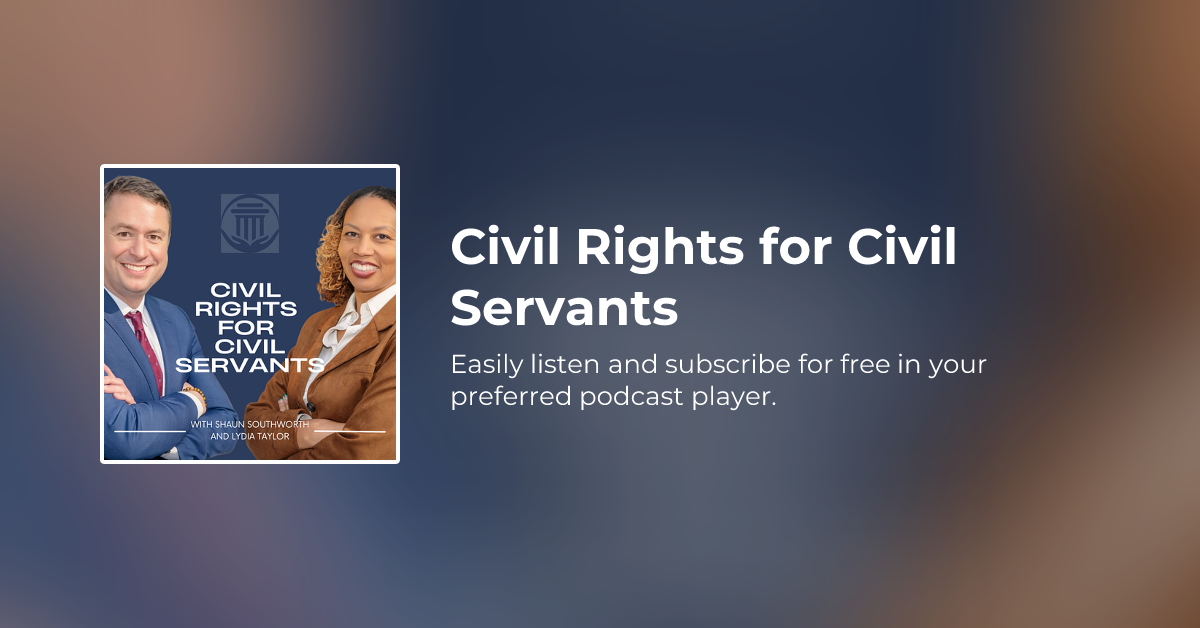
🎧 Listen: Civil Rights for Civil Servants
Shaun Southworth & Lydia Taylor on what's happening to the federal workforce. Latest episode: Apple · Spotify · Amazon Music · Youtube
 |
Today at a Glance
- Governmentwide NDA: The public comment window on OPM’s proposed nondisclosure agreement closes tomorrow, June 26, and whistleblower advocates and at least one member of Congress are urging employees to weigh in before it does.
- Employee Viewpoint Survey: Twenty-three House and Senate Democrats are pressing OPM to administer the 2026 Federal Employee Viewpoint Survey after the agency skipped the legally required survey last year.
- Workforce Numbers: New GAO data show governmentwide civilian employment is down about 11% since the start of 2025, and a watchdog group has put a multibillion-dollar price tag on the deferred resignation program.
Top Stories:
1. OPM’s Governmentwide NDA — Public Comment Closes June 26, as Whistleblower Advocates Press Their Case
Source: Federal News Network, June 24, 2026
TL;DR: The public comment period on OPM's proposed governmentwide nondisclosure agreement (NDA) closes tomorrow, June 26, 2026. OPM published the draft in the Federal Register on May 27, 2026 (Docket OPM-2026-0100) and has said the form does not create new restrictions on speech — it asks employees to acknowledge existing duties to protect "confidential government information" and expressly preserves disclosures authorized by law, including protected whistleblowing. The draft defines that information broadly, reaching internal agency operations, personnel matters, procurement, and pre-decisional or deliberative material. Whistleblower advocates, including Project on Government Oversight senior policy counsel Joe Spielberger, warn the form could have a chilling effect even with the carve-out, because rights that exist "on paper" can be undercut if employees fear discipline for speaking up. In a June 9 letter, Rep. Raja Krishnamoorthi (D-Ill.) asked OPM to define what the NDA covers, explain how it squares with the First Amendment and whistleblower law, and say what happens to employees who decline to sign; as of Federal News Network's reporting, the docket had drawn more than 11,600 public comments.
For federal employees, this means:
- If you want your views on the record, you can comment through tomorrow, June 26, at regulations.gov under Docket OPM-2026-0100.
- Signing an agency NDA does not strip your statutory whistleblower rights — lawful disclosures to the Office of Special Counsel, an Inspector General, or Congress remain protected regardless of the form's language.
- If you are asked to sign and are unsure what it covers, keep a copy of exactly what you were given and the date, and do not assume a signature waives a right the law says cannot be waived.
Legal Insight:
The anti-gag prohibited personnel practice at 5 U.S.C. § 2302(b)(13) bars an agency from implementing or enforcing any nondisclosure policy, form, or agreement that does not contain a statement preserving employees' rights under whistleblower and other disclosure laws. Those underlying rights include protected disclosures under 5 U.S.C. § 2302(b)(8) and the right to furnish information to Congress under 5 U.S.C. § 7211. If you are presented with an NDA and are concerned about how it interacts with a disclosure you have made or plan to make, consider speaking with a federal employment attorney before you sign.
2. Twenty-Three Lawmakers Press OPM to Run the Employee Viewpoint Survey It Skipped Last Year
Source: Government Executive, June 23, 2026
TL;DR: A group of 23 House and Senate Democrats, in a letter led by Sen. Chris Van Hollen (D-Md.) and Rep. James Walkinshaw (D-Va.), is asking OPM to detail its plans for the 2026 Federal Employee Viewpoint Survey (FEVS), nearly a year after the agency canceled the 2025 survey. FEVS is the governmentwide questionnaire that measures employee engagement, satisfaction, and views of agency leadership. OPM Director Scott Kupor canceled the 2025 survey, citing a need to "transform" it and to remove diversity-related questions added under the prior administration, and OPM has pointed to internal "pulse" surveys as a substitute. The lawmakers note that the cancellation came in the same year roughly 317,000 employees left the federal government, according to OPM's own data, and that the pulse surveys do not publish the questions asked or the underlying data. They are asking OPM for the planned 2026 survey questions, a deployment timeline, and any changes to how responses are collected. The letter lands as the survey's usual spring administration window closes.
For federal employees, this means:
- FEVS is the established, anonymized channel for telling agency leadership and oversight bodies how the workforce is actually faring — its return would restore a comparable year-over-year measure that the pulse surveys do not provide.
- If your agency runs an internal pulse survey in the meantime, be aware that those results are reported without the question text or raw data, so they are harder to compare against past FEVS results.
- Watch for an OPM announcement on whether and when a 2026 FEVS will run; participation is how the workforce-level data gets built.
Legal Insight:
An annual survey of federal employees has been required since Section 1128 of the National Defense Authorization Act for Fiscal Year 2004 (Pub. L. No. 108-136), and OPM's implementing rules at 5 C.F.R. §§ 250.301–250.302 direct agencies to conduct the survey each year and prescribe a set of core questions every agency must include. The lawmakers' letter frames the 2025 cancellation as a departure from that annual requirement and seeks a commitment to administer the survey in 2026.
3. Federal Employment Is Down About 11% Since Early 2025 — and the Resignation Program's Price Tag Comes Into View
Source: FedWeek, June 23, 2026
TL;DR: Drawing on Government Accountability Office (GAO) data, FedWeek reports that governmentwide civilian employment is down about 11.3% since the start of 2025, with every major department and large independent agency except the Department of Homeland Security cut by at least 7%. The steepest percentage reductions were at USAID (about 95%), the Education Department (about 45.6%), the Small Business Administration (about 37%), the General Services Administration (about 36.8%), OPM itself (about 33.9%), the National Science Foundation (about 32.5%), and the Department of Housing and Urban Development (about 30.5%). Much of the decline ran through the deferred resignation program (DRP) and through retirements and resignations. The advocacy group Public Citizen has estimated the lost-labor cost of the DRP — the pay for employees who remained on the rolls in a non-duty status for months — at between $11.1 billion and $15.1 billion. Since the cuts, a number of agencies have ramped hiring back up to backfill positions they decided they needed after all, while components of several others have announced new resignation offers or extended earlier ones.
For federal employees, this means:
- If you were separated in a reduction in force (RIF) and your former agency is now backfilling, displaced-employee selection priority under CTAP/ICTAP can matter — confirm whether you are eligible and how to claim it.
- RIF actions carry short, specific appeal windows; a separation labeled something other than a RIF may still be appealable depending on what actually happened.
- If you are weighing a new deferred resignation or buyout offer, read the paid-status terms and effective dates closely before you sign, because the financial and benefits consequences turn on those details.
Legal Insight:
Reductions in force are governed by 5 U.S.C. § 3502 and the regulations at 5 C.F.R. Part 351, and displaced competitive-service employees may be entitled to selection priority under the Career and Interagency Career Transition Assistance Programs at 5 C.F.R. Part 330, Subparts F and G. Separately, Public Citizen and others have questioned whether keeping employees in paid, non-duty status for months fits within the Administrative Leave Act's general 10-workday annual cap on administrative leave (5 U.S.C. § 6329a). If you have been separated or are facing a RIF, the appeal deadlines are short, and it is worth speaking with a federal employment attorney promptly.
Mindful Moment of the Day
The After-Meeting Reset
Some meetings end, but your body stays in them. You may leave a tense Teams call or SES briefing still replaying a comment, a deadline, or a disagreement. Before jumping straight into the next email, take 60 seconds to close the meeting in your body. Look away from the screen, relax your hands, and take three slow breaths. Write one sentence: “The next step from that meeting is ______.” Then let the rest of the noise settle. This small reset helps you carry forward the useful information without dragging the whole emotional weight of the meeting into the next task.
In Case You Missed It
A few quick hits from our recent videos and posts:
Education Department IG Report: RIF Cuts May Have Left Legally Required Work Unstaffed
|

Federal Student Loan Deadlines Are Here: What Feds Need to Know Before July 1
|

Detailed Into a Job You Were Never Trained For — Then Disciplined for It
|

Worried About Retaliation or Being Targeted for Speaking Up?
If you’ve reported misconduct, safety concerns, discrimination, or waste/fraud/abuse—and now you’re seeing sudden schedule changes, bad performance reviews, or threats of discipline—you may be in whistleblower or retaliation territory.
We represent federal employees who:
-
Reported concerns and then saw adverse actions
-
Were sidelined, reassigned, or given impossible workloads after speaking up
-
Face investigations, PIPs, or proposed removals that look like payback
-
Need help navigating OSC complaints, EEO claims, or MSPB appeals tied to retaliation
A free, confidential consultation can help you sort out what’s normal agency behavior and what may cross the line—and what to do before your options narrow.
👉 Schedule Your Free Consultation Today
|

Disclaimer:
This briefing is for general informational purposes only and does not constitute legal advice or create an attorney‑client relationship. Federal employment law is fact‑specific and time‑sensitive; you should consult a qualified attorney about your own situation and deadlines. Past results do not guarantee future outcomes.
Your service is worth protecting. Let's protect it together at Southworth PC.

Responses