Attorneys for Federal Employees — Nationwide
Nearly 200,000 federal workers and supporters follow our updates across TikTok, Instagram, YouTube, Facebook, and LinkedIn Each briefing gives you the three stories that actually matter to your job, plain‑English legal guidance, and one short practice to protect your peace of mind. If it helps you, forward it to a colleague—new readers can subscribe at https://fedlegalhelp.com/newsletter.
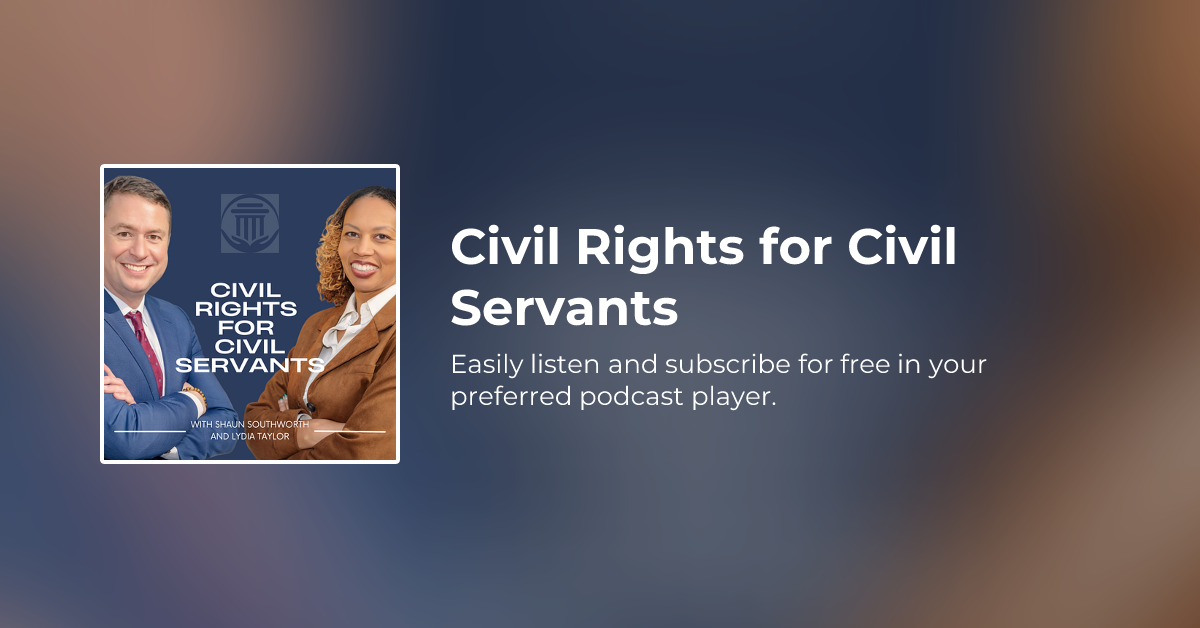
🎧 Listen: Civil Rights for Civil Servants
Shaun Southworth & Lydia Taylor on what's happening to the federal workforce. Latest episode: Apple · Spotify · Amazon Music · Youtube
 |
Today at a Glance
-
OPM, DOGE, and Your Records: A federal judge in New York ruled Tuesday that OPM violated the Privacy Act when it gave DOGE-affiliated individuals broad access to systems holding the personal information of tens of millions of past, current, and prospective federal employees. The remedy is still to come; a schedule is due November 6.
-
Telework and the Return-to-Office Memo: The FLRA denied HHS's challenge to an arbitration award finding an unfair labor practice in the agency's termination of NTEU members' telework agreements, and found 35 of the 42 citations in HHS's brief "fictitious, erroneous, or irrelevant." HHS has until December 21 to seek court review.
-
USDA Relocations: NRCS opened a "critical vacancy" portal through November 2 that lets employees facing cross-country moves apply for local jobs at their current grade or lower, while a judge's stay keeps the relocations on hold into December.
Top Stories:
1. A Federal Judge Rules OPM Broke the Privacy Act by Giving DOGE Agents Broad Access to the Records of Tens of Millions of Federal Employees — the Remedy Is Still Open, With a Scheduling Deadline of November 6
TL;DR: On Tuesday, Judge Denise Cote granted summary judgment to current and former federal employees and their unions, including AFGE, holding that OPM's decision to give DOGE Agents broad access to its systems of records "without a demonstrated need was unlawful." The 39-page opinion opens by finding that, beginning January 20, 2025, OPM granted access to systems "containing the personal information of tens of millions of past, current, and aspiring federal employees, even though no credible need for this access had been demonstrated," and that OPM "violated the law and bypassed its established cybersecurity practices." The court found violations of two Privacy Act provisions, the disclosure limits in 5 U.S.C. § 552a(b) and the safeguarding duty in § 552a(e)(10), and held the grants of access "not in accordance with law" under the Administrative Procedure Act. It rejected the government's mootness argument, although only one DOGE Agent remains at OPM and none has had access to the systems since September 2025, because OPM still maintains the access was lawful and the timing of its policy changes "closely tracks this litigation's deadlines." Relief is not decided; the opinion says it "will be addressed by separate order," and a companion order directs the parties to propose a schedule by November 6. The plaintiffs have asked for an accounting of the disclosures and deletion of any extracted copies.
For federal employees, this means:
- The ruling is about liability, not yet relief. OPM's own review, described in the opinion, reported no evidence that DOGE Agents exported records outside OPM systems, but the court has not decided whether to order an accounting, deletion, or a permanent injunction. Watch the November 6 scheduling order.
- Your records are the ones at issue. OPM's systems hold the files of current, former, and prospective employees, so this decision reaches most readers, not only the named plaintiffs.
- Individual Privacy Act damages suits are a harder road: the statute's own remedy, 5 U.S.C. § 552a(g)(4), requires an "intentional or willful" violation and proof of actual damages. This case was won under the APA after the court earlier dismissed the direct Privacy Act claims except as a basis for the APA claims.
Legal Insight
The Privacy Act lets an agency share a record internally only with "those officers and employees of the agency which maintains the record who have a need for the record in the performance of their duties," 5 U.S.C. § 552a(b)(1), and requires every agency to "establish appropriate administrative, technical, and physical safeguards to insure the security and confidentiality of records," § 552a(e)(10). The court found that access was granted in case it "might be needed," which "does not qualify as a showing of need," and that required cybersecurity training and the principle of least privilege were set aside. Because those violations were "not in accordance with law," the court granted judgment under the APA, 5 U.S.C. § 706(2)(A), noting the access permissions have already been rescinded.
2. The FLRA Leaves HHS's Telework Loss Intact — the Return-to-Office Memo Had to Be Implemented "Consistent With Applicable Law," and 35 of the Agency's 42 Citations Were "Fictitious, Erroneous, or Irrelevant"
Source: Government Executive, October 21, 2026
TL;DR: On Wednesday, the Federal Labor Relations Authority denied HHS's exceptions to a January 2026 arbitration award finding that the agency committed an unfair labor practice when it implemented the President's January 20, 2025 "Return to In-Person Work" memorandum by terminating telework and remote-work agreements for NTEU-represented employees. U.S. Dep't of Health & Human Servs., 74 FLRA No. 87 (Oct. 21, 2026). Arbitrator Michael J. Falvo had found that the parties' 2023 agreement allows the agency to end telework or remote work only "for cause," that the memorandum is a "rule or regulation" issued after the agreement took effect, and that 5 U.S.C. § 7116(a)(7) therefore barred HHS from enforcing it against the contract; he ordered HHS to rescind its February 7, 2025 directive, reinstate the terminated agreements, and post a notice. The Authority rejected HHS's nonfact, essence, and exceeded-authority arguments, noting that the memorandum itself requires implementation "consistent with applicable law" and that HHS never argued the arbitrator's reading of it was contrary to law. It also found that 22 of the 29 footnotes and 35 of the 42 citations in HHS's brief were "fictitious, erroneous, or irrelevant" and said it "appears that the Agency may have used a generative artificial-intelligence (AI) tool in drafting its brief." NTEU called the decision a "big win for telework rights" but said employees are "unlikely to see immediate changes" because HHS has until December 21 to seek review in a federal court of appeals, according to Government Executive.
For federal employees, this means:
- If you are in an NTEU unit at HHS, nothing changes at your desk yet. HHS can seek court review through December 21, and reinstatement will likely wait on that. Watch for NTEU's guidance.
- The principle travels. A presidential memorandum that must be implemented "consistent with applicable law" does not override a contract in effect before the memorandum issued. The questions for you are whether your contract is still in effect and whether its telework article limits terminations to specific causes.
- The AI lesson applies to employees, too. A party challenging an award must explain how it is deficient under existing case law, 5 C.F.R. § 2425.6(b), and unsupported arguments can be denied on that basis alone. Verify every citation in anything you file.
Legal Insight
Under 5 U.S.C. § 7116(a)(7), it is an unfair labor practice for an agency "to enforce any rule or regulation ... which is in conflict with any applicable collective bargaining agreement if the agreement was in effect before the date the rule or regulation was prescribed." The Authority reviews an award only on narrow grounds, 5 U.S.C. § 7122(a), and an Authority order on an arbitration award can be taken to a court of appeals only when it "involves an unfair labor practice," within 60 days, 5 U.S.C. § 7123(a). If your agency ended a telework agreement that your contract says can end only for cause, the grievance procedure is the vehicle and its deadlines are short; talk with your union representative promptly, and consult a federal employment attorney if the change is tied to discipline or a performance action.
3. USDA's Conservation Agency Opens a "Critical Vacancy" Portal Through November 2 — Lateral or Lower-Grade Only — While a Judge's Stay Keeps the Cross-Country Relocations on Hold
Source: Government Executive, October 21, 2026
TL;DR: On Tuesday, the Natural Resources Conservation Service (NRCS), USDA's second-largest component, opened an online "critical vacancy" portal that lets employees apply through November 2 for voluntary reassignment to vacant positions in their local commuting area, Government Executive reported Wednesday. An internal notice says employees "may apply only for positions that are at their current grade level (lateral moves) or lower grade levels." One NRCS employee said anything local would be a "voluntary downgrade"; another called it a "last chance to stay where you are" move. USDA has sent letters of intent telling NRCS employees they may have to relocate to Fort Worth, Raleigh, or Indianapolis. The relocations are on hold: on October 13, Judge Vince Chhabria stayed USDA's plan to relocate about 2,600 employees, barring the department from "closing or eliminating offices" at the affected components or "relocating or reassigning employees or their positions or functions to different and/or new locations outside the local commuting area," while leaving moves within the D.C. region untouched. The administration has appealed to the Ninth Circuit, which has left the stay in place for now; the government's brief is due in mid-November and the challengers' by December 11, the same day the appropriations provision barring USDA from spending on reorganization is set to expire.
For federal employees, this means:
- Before you accept a lower-graded job to stay put, ask in writing whether the agency will grant grade retention. Under 5 C.F.R. § 536.202, grade retention for a voluntary move to a lower grade is optional, but an agency may provide it when it has announced a reorganization in writing and the employee moves before the reorganization takes effect. Without it, the downgrade is permanent.
- Do not resign to avoid a move. If you decline a directed reassignment outside your commuting area, the separation counts as "involuntary" for severance-pay purposes when your position description or a written agreement does not require such moves, 5 C.F.R. § 550.703, and is also the gateway to discontinued service retirement for those who meet the age and service thresholds.
- The stay is not permanent. Keep every letter of intent, reassignment letter, and portal notice; calendar the November 2 deadline; and watch the Ninth Circuit schedule and the December 11 expiration of the spending restriction.
Legal Insight
An agency may reassign an employee outside the local commuting area for legitimate management reasons, but an employee who declines can be removed only through adverse-action procedures: at least 30 days' advance written notice, a reasonable time to reply, the right to a representative, and a written decision, 5 U.S.C. § 7513(b), with an appeal to the MSPB under § 7513(d). Whether the reassignment was bona fide is a question the Board examines on appeal. If you receive a directed reassignment or a proposed removal for declining one, consult a federal employment attorney before the reply deadline.
Mindful Moment of the Day
The Folder and the Calendar Date
A reassignment letter, a portal deadline, and a court stay that could change next month can have you checking your phone for news before you finish your coffee. Notice what your body does with that uncertainty: the tight jaw, the shallow breath, the mind racing through three possible futures. Place both feet on the floor, take three slow breaths, and say silently, "I do not have to decide everything today." Then do one small thing: put every letter and notice in a single folder and write the next date on a sticky note. Mindfulness here does not mean pretending the situation is settled; it means giving your mind one steady place to rest while it is not.
In Case You Missed It
A few quick hits from our recent posts:
Federal Judge Rules OPM Violated the Privacy Act by Giving DOGE Access to Employee Records
|

Can a Federal Employee Refuse an Illegal Order? What 5 U.S.C. § 2302(b)(9)(D) Protects
|

Calibration Panels and the 40 Percent Cap: What Federal Employees Should Ask For
|

Worried About Retaliation or Being Targeted for Speaking Up?
If you’ve reported misconduct, safety concerns, discrimination, or waste/fraud/abuse—and now you’re seeing sudden schedule changes, bad performance reviews, or threats of discipline—you may be in whistleblower or retaliation territory.
We represent federal employees who:
-
Reported concerns and then saw adverse actions
-
Were sidelined, reassigned, or given impossible workloads after speaking up
-
Face investigations, PIPs, or proposed removals that look like payback
-
Need help navigating OSC complaints, EEO claims, or MSPB appeals tied to retaliation
A free, confidential consultation can help you sort out what’s normal agency behavior and what may cross the line—and what to do before your options narrow.
👉 Schedule Your Free Consultation Today
|
Disclaimer:
This briefing is for general informational purposes only and does not constitute legal advice or create an attorney‑client relationship. Federal employment law is fact‑specific and time‑sensitive; you should consult a qualified attorney about your own situation and deadlines. Past results do not guarantee future outcomes.
Your service is worth protecting. Let's protect it together at Southworth PC.

Responses