Attorneys for Federal Employees — Nationwide
Nearly 200,000 federal workers and supporters follow our updates across TikTok, Instagram, YouTube, Facebook, and LinkedIn Each briefing gives you the three stories that actually matter to your job, plain‑English legal guidance, and one short practice to protect your peace of mind. If it helps you, forward it to a colleague—new readers can subscribe at https://fedlegalhelp.com/newsletter.
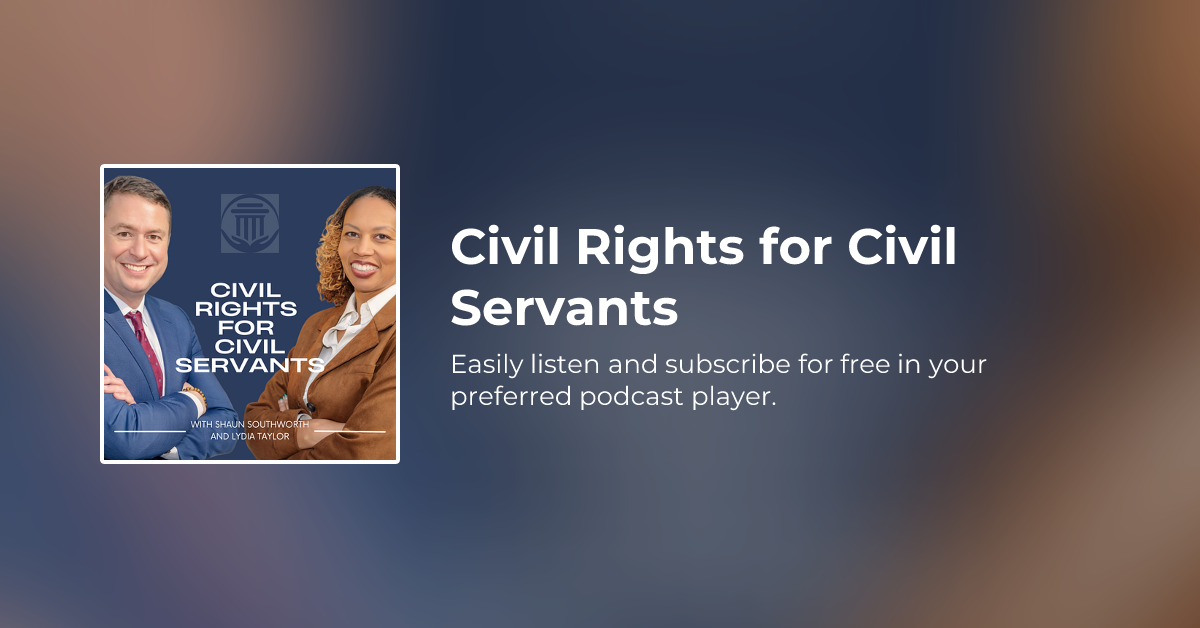
🎧 Listen: Civil Rights for Civil Servants
Shaun Southworth & Lydia Taylor on what's happening to the federal workforce. Latest episode: Apple · Spotify · Amazon Music · Youtube
 |
Today at a Glance
-
Arbitration Access: The Federal Mediation and Conciliation Service published a final rule today that lets it decline or hold a union's request for an arbitrator when the agency says an executive order excluded it from collective bargaining. New guardrails add written notice and fee refunds; the power to decline stays.
-
Hiring Committees And Surveys: OPM's final rule rewriting 5 C.F.R. Part 250, also published today and effective November 30, puts every agency's hiring under a Strategic Hiring Committee of the deputy secretary, the chief of staff, and the CHCO, cuts the required employee-survey questions from 16 to 10, and lets each agency decide which results it publishes.
-
Retirement Services: OPM's Inspector General says staffing losses remain the agency's top management challenge. The retirement backlog fell from 65,237 cases in February to 15,427 in August, but callers still face long hold times, and a denied or miscomputed claim carries a 30-day clock of its own.
Top Stories:
1. FMCS Finalizes the Rule That Lets It Refuse an Arbitrator When an Agency Claims an Executive-Order Exclusion — Written Notice, a Preserved Place in Line, and Fee Refunds Are New; the Power to Decline Stays
Source: Government Executive, October 28, 2026
TL;DR: The Federal Mediation and Conciliation Service (FMCS), which supplies arbitrators for federal-sector grievances, published a final rule in today's Federal Register (91 FR 68030) adopting the "threshold inquiry" it first created by interim rule on August 4, 2026. Under revised 29 C.F.R. § 1404.9(b)(3), FMCS's Office of Arbitration may ask whether issuing a panel or appointing an arbitrator "would be inconsistent with applicable law, a court order, or FMCS's statutory or regulatory authority," and may then issue the panel, decline, or hold the request "in abeyance." FMCS built the rule around Executive Orders 14251 and 14343, which excluded much of the federal workforce from Chapter 71 of Title 5; Executive Order 14251 also directed excluded agencies to stop participating in pending grievances once their contracts ended, and agencies that had terminated their contracts told FMCS they could not lawfully take part in arbitration. All five comments FMCS received came from federal-employee unions, all opposed the rule, and FMCS declined to withdraw it. It added guardrails: a party's claim that a grievance "lacks merit, is untimely, or is not arbitrable" does not by itself justify refusing service; FMCS must tell both parties in writing what it did and why; a request held in abeyance keeps its original date of receipt; FMCS must reconsider when a party submits a court order or other new information; and a party that paid the fee may take a refund or a credit. Government Executive reports that a suit by four unions challenging the policy is pending in federal district court in Washington, D.C. The rule took effect on publication.
For federal employees, this means:
- If your agency is named in Executive Order 14251 or 14343 and has cancelled its contract, a grievance that reaches the arbitration step may stall at FMCS even if the events happened before the contract ended. The agency's termination and refusal to participate, not the merits of your grievance, is the trigger.
- Your union now has a paper trail to build on. FMCS must state its reason in writing, keep your request's original date, and reconsider when handed a court order or a new authorization, so ask your steward whether each pending request has been resubmitted with its legal basis attached.
- Nothing in the rule decides whether your grievance is valid. Section 1404.9(b)(4) says an FMCS refusal is not a ruling on the contract, the grievance, or arbitrability, so that fight continues before arbitrators, the FLRA, and the courts.
Legal Insight
Under 5 U.S.C. § 7121(a)(1), every collective bargaining agreement must contain a grievance procedure "including questions of arbitrability," and union counsel quoted by Government Executive cite Supreme Court and FLRA precedent that disputes arising under a contract remain arbitrable after it expires. FMCS's position is that none of that reaches an agency the President has excluded under 5 U.S.C. § 7103(b)(1), and that it will furnish an arbitrator only where the agency consents or a court orders it. Whether that is lawful is the question in the pending suit. Until then, an employee whose grievance is stalled should preserve every contract deadline, document the agency's refusal in writing, and consult the union or a federal employment attorney about the unfair-labor-practice and court options the rule says remain open.
2. OPM Rewrites Its Human-Capital Rules — Every Agency Must Run Hiring Through a Strategic Hiring Committee, the Required Employee-Survey Questions Drop From 16 to 10, and Agencies Decide Which Results to Publish
Source: Federal Register (Office of Personnel Management), October 29, 2026
TL;DR: OPM today published a final rule (91 FR 68013), effective November 30, 2026, replacing the planning-and-review framework in 5 C.F.R. Part 250 with Annual Staffing Plans, Annual Staffing Reviews conducted by OPM and OMB, and quarterly performance reviews. Each plan must steer new hires to "the highest-need areas" and must "consider potential efficiencies" from restructuring, eliminating "unnecessary management layers," cutting "duplicative or nonessential functions and positions," and internal reassignments. Each agency must also establish a Strategic Hiring Committee, made up of the deputy secretary or equivalent, the chief of staff to the agency head, and the Chief Human Capital Officer (CHCO), to "oversee hiring within the agency," which Executive Order 14356 required in October 2025. Subpart C changes the annual employee survey: the governmentwide core question set shrinks from 16 items to 10, agencies administer their own surveys, each agency "may determine the specific content of its public disclosure" of the results, and results go to OPM and OMB within 90 days. The rule also removes the references to a "diverse" workforce from § 250.203. Of nine comments, several argued that centralizing career hiring decisions in political appointees conflicts with the merit system principles; OPM answered that the committee has no authority to prefer or exclude a candidate on political grounds and that chapters 23 and 33 of Title 5 continue to govern every hiring decision.
For federal employees, this means:
- Expect hiring decisions at your agency to run through a three-person committee at the top of the organization, and expect the staffing plan to carry an explicit review of management layers, duplicate positions, and reassignments. Read it when it is posted; it previews which positions will be filled.
- The survey item "I can disclose a suspected violation of any law, rule or regulation without fear of reprisal" survives the cut to 10 questions, and two new items ask whether your unit deals with poor performers. Your agency decides which results to post, so compare what it publishes with what it collected.
- Removing the word "diverse" does not change your rights. OPM says the rule leaves the statutory bars on discrimination intact and neither requires nor permits race- or sex-based decisions, so document any selection that appears to turn on a prohibited factor and raise it through EEO or the Office of Special Counsel.
Legal Insight
The CHCO Act, 5 U.S.C. § 1401, places workforce strategy with a senior official who must act "in accordance with merit system principles," and the survey mandate in section 1128 of the Fiscal Year 2004 National Defense Authorization Act (5 U.S.C. § 7101 note) requires common questions across agencies and public results; OPM's position is that a ten-item core satisfies that statute. The committee and the staffing plans do not change the merit system principles in 5 U.S.C. § 2301(b) or the prohibited personnel practices in 5 U.S.C. § 2302(b), including the bar in § 2302(b)(1)(E) on discrimination based on political affiliation. A selection that turns on politics remains a prohibited personnel practice reportable to the Office of Special Counsel, no matter which committee approved it.
3. OPM's Inspector General Says Staffing Losses Are Still the Agency's Top Management Challenge — the Retirement Backlog Fell From 65,237 to 15,427, Callers Still Cannot Get Through, and a Denied or Miscomputed Claim Has a 30-Day Clock
Source: Federal News Network, October 28, 2026
TL;DR: OPM's Office of Inspector General, in its October 15 Top Management Challenges report for fiscal 2027, lists delivering OPM's mission with fewer resources as the agency's first challenge, ahead of trust-fund integrity, improper payments, and health-benefits fraud. According to Federal News Network's reporting, OPM's own workforce shrank by roughly one-third last year. The OIG reports that the retirement claims backlog rose from 34,587 at the end of October 2025 to 65,237 at the end of February 2026, then fell to 15,427 by August 2026 as digital filing took hold; digital claims closed in 34 to 66 days on average between January and May, against 60 to 87 days overall. Customer service remains the weak point. About 450 OIG hotline contacts over the last two semiannual periods, nearly 30 percent of all retirement-related contacts, involved unanswered calls and long hold times, and this year's shift to digital 1099-R forms left annuitants with problems unable to reach anyone. OPM spokesperson Kiki Nyoh said the agency is "strengthening cybersecurity, modernizing legacy systems and managing expanded in-house responsibilities with a smaller workforce."
For federal employees, this means:
- If you are retiring, file digitally and keep your own complete copy of the application and every supporting document. The OIG's numbers show digital claims closing weeks faster, and your copy is your protection if OPM asks again.
- Read the adjudication letter the day it arrives. If it is an initial decision that states a right to reconsideration, you have 30 calendar days to ask OPM to review it, and the clock runs from the date of the decision, not from the day you finally reach a representative.
- If you cannot get through by phone, put your request in writing through OPM's online channels and keep the record. The OIG hotline refers customer-service problems back to the program office, so a written trail is what moves a stalled file.
Legal Insight
A retirement claim is an adjudication with appeal rights. Under 5 C.F.R. § 831.109 (CSRS) and 5 C.F.R. § 841.306 (FERS), an OPM initial decision that affects your rights can be challenged by a written request for reconsideration that must reach OPM within 30 calendar days of the decision, and OPM's final decision is then appealable to the Merit Systems Protection Board under 5 U.S.C. § 8347(d)(1) or § 8461(e)(1). Delay alone is generally not an appealable decision, but a denial, a miscomputed annuity, or disallowed service credit is, and the 30-day clock does not wait for a call to be answered. A retiree who receives an adverse decision should consult a federal employment attorney promptly.
Mindful Moment of the Day
The Hold Music Pause
You have been on hold for forty minutes, or you have refreshed the status page for the third time this morning, and your shoulders have crept up toward your ears. Before you hang up or click again, pause. Feel both feet on the floor. Take three slow breaths, letting each exhale run longer than the inhale. Silently say, "I can only do the next small thing." Then do that thing: write down the date and time of the call, or save a copy of what you sent. Waiting on a system you cannot control is tiring, and the strain is real. Mindfulness here does not mean pretending the delay is fine; it means steadying yourself enough to keep a clear record and act on your own timeline.
In Case You Missed It
A few quick hits from our recent posts:
Shutdown Layoff Guidance Rescinded: What OMB Memo M-27-01 Means for Federal Employees
|

OPM’s “Hire-Palooza” Recruiting Tour: What Federal Merit Principles Say About Hiring
|

USAID Official Who Signed Mass Terminations Had No HR Record, Emails Show: Why Paperwork Matters
|

Worried About Retaliation or Being Targeted for Speaking Up?
If you’ve reported misconduct, safety concerns, discrimination, or waste/fraud/abuse—and now you’re seeing sudden schedule changes, bad performance reviews, or threats of discipline—you may be in whistleblower or retaliation territory.
We represent federal employees who:
-
Reported concerns and then saw adverse actions
-
Were sidelined, reassigned, or given impossible workloads after speaking up
-
Face investigations, PIPs, or proposed removals that look like payback
-
Need help navigating OSC complaints, EEO claims, or MSPB appeals tied to retaliation
A free, confidential consultation can help you sort out what’s normal agency behavior and what may cross the line—and what to do before your options narrow.
👉 Schedule Your Free Consultation Today
|

Disclaimer:
This briefing is for general informational purposes only and does not constitute legal advice or create an attorney‑client relationship. Federal employment law is fact‑specific and time‑sensitive; you should consult a qualified attorney about your own situation and deadlines. Past results do not guarantee future outcomes.
Your service is worth protecting. Let's protect it together at Southworth PC.

Responses