Attorneys for Federal Employees — Nationwide
Nearly 200,000 federal workers and supporters follow our updates across TikTok, Instagram, YouTube, Facebook, and LinkedIn Each briefing gives you the three stories that actually matter to your job, plain‑English legal guidance, and one short practice to protect your peace of mind. If it helps you, forward it to a colleague—new readers can subscribe at https://fedlegalhelp.com/newsletter.
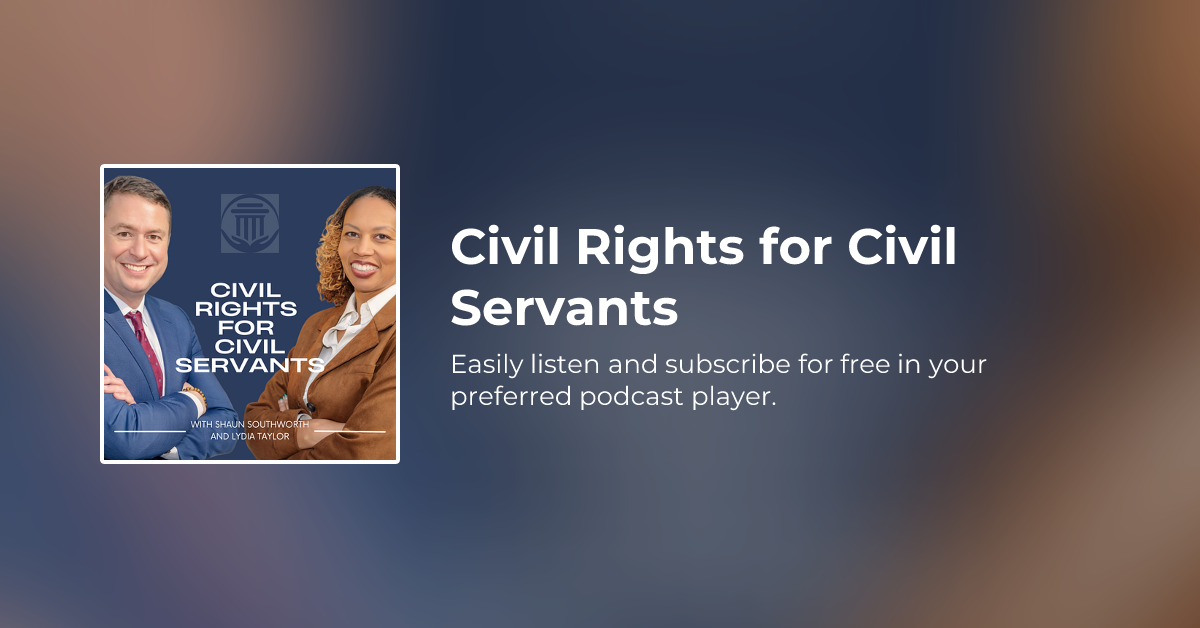
🎧 Listen: Civil Rights for Civil Servants
Shaun Southworth & Lydia Taylor on what's happening to the federal workforce. Latest episode: Apple · Spotify · Amazon Music · Youtube
 |
Today at a Glance
-
Post-Election Push on Pay and Bargaining Rights: With Democrats projected to win both chambers, federal unions are asking Congress to override the 2027 civilian pay freeze in the spending bill due by December 11 and to pass the House-passed bill nullifying the two executive orders that removed most agencies from the collective bargaining law.
-
IRS Workforce Under the Watchdog's Microscope: The IRS inspector general's fiscal 2027 plan will audit how the agency collects advanced-leave and salary-overpayment debts from employees, how it used mandatory overtime last filing season, and how it reassigned mid-career staff to frontline jobs.
-
A Whistleblower Disclosure That Was Not Substantiated Still Changed a VA Hospital: The Office of Special Counsel's report to the President and Congress shows how the 5 U.S.C. § 1213 process works even when the specific allegation does not hold up.
Top Stories:
1. Unions Ask Congress to Override the 2027 Pay Freeze by December 11 and Pass the Bill Restoring Bargaining Rights — What the Law Lets Congress Do, and When
Source: Federal News Network, November 4, 2026
TL;DR: Democrats were projected Tuesday night to win majorities in both chambers of Congress, and on Wednesday federal employee unions laid out what they will ask lawmakers to do first. The American Federation of Government Employees (AFGE) called for passage of the Protect America's Workforce Act (H.R. 2550), which would nullify the two executive orders that removed roughly two-thirds of the federal workforce from the collective bargaining law; the House passed the bill 231–195 on December 11, 2025, after a discharge petition, but the Senate has not acted on it. AFGE also asked Congress to override the President's planned 2027 pay freeze for most civilian employees and give everyone "at least" the 3.8 percent raise planned for law enforcement officers. The International Federation of Professional and Technical Engineers told Government Executive it will press for both items when lawmakers return next week for the lame-duck session, noting that the House draft of the fiscal 2027 defense authorization bill already contains language nullifying the union order for the Defense Department workforce. Leaders of the Federal Workforce Caucus said in September they would try to attach a pay raise to the fiscal 2027 spending legislation, which must pass before the current continuing resolution expires December 11. The new Congress is not seated until January, and as Federal News Network notes, the incoming Senate majority will not have 60 votes to overcome a filibuster.
For federal employees, this means:
- Nothing has changed yet: your bargaining rights, contract status, and 2027 pay are what they were on Monday. What changed is the negotiating leverage in the December spending talks and who controls the committees in January.
- Watch two dates: December 11, when current funding runs out and any 2027 raise would likely ride on the spending bill, and the December executive order that sets the final pay tables. If Congress does nothing, the alternative pay plan controls and most of you get 0 percent.
- If your agency terminated your contract under the executive orders, the union lawsuits and the pending legislation are separate tracks. Keep a copy of the old agreement; its grievance, arbitration, and scheduling terms will matter again the day the contract is restored.
Legal Insight
Federal pay raises are set by a formula in 5 U.S.C. § 5303(a), but § 5303(b)(1) lets the President transmit an "alternative pay plan" to Congress before September 1 if he considers the formula raise inappropriate because of "national emergency or serious economic conditions affecting the general welfare"; the President did that in late August, setting 0 percent for most civilians and 3.8 percent for law enforcement officers. The alternative plan becomes the actual adjustment unless Congress enacts a different figure by statute. On bargaining, Executive Orders 14251 (March 27, 2025) and 14343 (August 28, 2025) invoked 5 U.S.C. § 7103(b)(1), which allows the President to exclude an agency or subdivision from the labor-relations statute only on a determination that its "primary function" is intelligence, counterintelligence, investigative, or national security work and that the statute cannot be applied there consistently with national security. H.R. 2550 would nullify those orders by statute, and an executive order cannot override an Act of Congress.
2. The IRS Watchdog Will Audit Advanced-Leave Debt Collection, Mandatory Overtime, and Employee Reassignments in Fiscal 2027 — the Rules Behind Each
Source: Government Executive, November 4, 2026
TL;DR: The Treasury Inspector General for Tax Administration (TIGTA) has released its fiscal 2027 program plan, and a cluster of the planned reviews concern how the IRS is treating its own employees after its workforce fell from about 103,000 to 74,000 between January 2025 and January 2026, a 30 percent drop that TIGTA says "occurred rapidly and resulted in the departure of many experienced employees." The plan includes a follow-up audit of whether the IRS is collecting employees' non-tax debts, "such as advanced leave and salary overpayments," on time; a review of its controls over premium pay, "including mandatory overtime," during the 2026 filing season; a review of "Strategic Staffing and Reassignments"; and a follow-up on compliance with the full-time return-to-office requirement. Government Executive notes that the IRS put an indefinite hold on new advanced annual and sick leave in July, that TIGTA reported in May that regular hours fell 14 percent while overtime rose 12 percent between 2024 and 2025, and that IT and human-resources employees were detailed to frontline taxpayer-service work in February. TIGTA's separate management-challenges report says the IRS is relying on automation and "Super Intelligence" to offset the staffing loss.
For federal employees, this means:
- If you owe the IRS, or any agency, for advanced leave, you are entitled to see the computation. Ask for the leave audit in writing and check the hours against your leave and earnings statements. Advanced leave becomes a debt only if you separate before you earn it back.
- If you were detailed to a different job, check the paperwork. A detail inside a department is supposed to be by written order for no more than 120 days at a time, renewable in writing; one with no end date and no written order is a question for HR and your union.
- Ordered overtime must be paid as the statute and your contract provide. Keep your own record of the hours ordered and worked; premium-pay disputes are won on contemporaneous records.
Legal Insight
Advanced annual leave rests on 5 U.S.C. § 6302(d), which lets an agency grant leave "that will accrue to an employee during the year" before it is earned, and advanced sick leave on 5 C.F.R. § 630.402, which caps it at 240 hours for a serious health condition and 104 hours for routine medical care; neither provision requires an agency to advance leave, which is why the IRS could stop. When an employee with a negative balance separates, 5 C.F.R. § 630.209 requires the agency to recover the value of the unearned leave or deduct it from any pay due, with narrow exceptions for death and disability. Details within an executive department are governed by 5 U.S.C. § 3341, which requires a written order and limits each detail to 120 days, renewable in writing. If an agency asserts a leave or salary debt you believe is wrong, the notice and hearing rights of 5 U.S.C. § 5514 apply and the clock is short; a federal employment attorney or your union representative can help you contest it.
3. A VA Whistleblower's Disclosure Was Not Substantiated — and It Still Forced a Missouri Hospital to Rewrite Its Psychiatric Admission Rules
Source: U.S. Office of Special Counsel, November 2, 2026
TL;DR: On November 2, the Office of Special Counsel (OSC) notified the President and Congress of the results of a Department of Veterans Affairs investigation into the acute psychiatric unit at the Harry S. Truman Memorial Veterans' Hospital in Columbia, Missouri, prompted by a whistleblower's disclosure about how patients were admitted. The VA Office of the Medical Inspector investigated on site in June 2025 and did not substantiate the specific concerns, but it found that the unit's local admission procedures were stricter than national VA policy allows, that some staff mistakenly believed they could override a provider's decision to admit a patient, and that limited training on complex cases such as dementia may have made staff reluctant to accept those patients. The VA adopted three recommendations: rewrite the unit's procedures to match national policy, train staff on the new process and on nurses' role in admissions, and provide clinical training on patients with complex needs; the hospital confirmed all three are complete, and the revised procedures were published July 18, 2025. Special Counsel Charles Baldis called the case "a reminder that whistleblower disclosures can lead to improvements in unexpected ways."
For federal employees, this means:
- A disclosure to OSC does not have to be proven right to matter. The statute tests it at the front end, asking whether there is a substantial likelihood of wrongdoing; the agency must then investigate and report whatever it finds, including problems the whistleblower never raised.
- The process has deadlines you can hold the agency to: a written report from the agency head within 60 days, your right to comment on that report within 15 days, and OSC's review of whether the findings "appear reasonable" before the file goes to the President and Congress.
- Your name stays with OSC. The Special Counsel may not disclose a whistleblower's identity without consent, except where necessary because of an imminent danger to public health or safety or an imminent criminal violation.
Legal Insight
Disclosures to OSC are governed by 5 U.S.C. § 1213. Under § 1213(b), the Special Counsel reviews the disclosure within 15 days to decide whether there is a "substantial likelihood" that it shows a violation of law, rule, or regulation, gross mismanagement, a gross waste of funds, an abuse of authority, or a substantial and specific danger to public health or safety; if so, § 1213(c) requires the agency head to investigate and submit a written report within 60 days (or longer by written agreement). Section 1213(d) dictates what the report must contain, including "a description of any action taken or planned as a result of the investigation," and § 1213(e) gives the whistleblower 15 days to comment, requires OSC to decide whether the findings "appear reasonable," and sends the package to the President and the congressional committees with jurisdiction over the agency; confidentiality is in § 1213(h). Retaliation for a disclosure is a separate prohibited personnel practice under 5 U.S.C. § 2302(b)(8) with its own complaint path; pursue the two together, with a representative or a federal employment attorney.
Mindful Moment of the Day
The Morning-After Exhale
It is the morning after the election, and your phone is full of projections, statements, and predictions about your pay and your contract. Before you open the next alert, notice what your body is doing. Maybe your shoulders have crept toward your ears, or your jaw is set. Feel both feet on the floor and take three slow breaths, letting each exhale run longer than the inhale. Silently say one plain sentence: "Nothing has changed today, and I can wait for facts." Then choose one small next step, such as checking your own pay statement or saving one email you may need later. Mindfulness here does not mean ignoring the news or pretending you are unaffected; it means meeting uncertainty with a steady breath instead of a racing mind.
In Case You Missed It
A few quick hits from our recent posts:
What the Midterm Results Could Mean for Federal Employees: Oversight, Shutdowns, and the VA
|

NTEU Wins Two Arbitration Cases Against the IRS: What the Law Says About Enforcing Final Awards
|

Six Places a New Congress Could Look First on Federal Workforce Accountability
|

Worried About Retaliation or Being Targeted for Speaking Up?
If you’ve reported misconduct, safety concerns, discrimination, or waste/fraud/abuse—and now you’re seeing sudden schedule changes, bad performance reviews, or threats of discipline—you may be in whistleblower or retaliation territory.
We represent federal employees who:
-
Reported concerns and then saw adverse actions
-
Were sidelined, reassigned, or given impossible workloads after speaking up
-
Face investigations, PIPs, or proposed removals that look like payback
-
Need help navigating OSC complaints, EEO claims, or MSPB appeals tied to retaliation
A free, confidential consultation can help you sort out what’s normal agency behavior and what may cross the line—and what to do before your options narrow.
👉 Schedule Your Free Consultation Today
|

Disclaimer:
This briefing is for general informational purposes only and does not constitute legal advice or create an attorney‑client relationship. Federal employment law is fact‑specific and time‑sensitive; you should consult a qualified attorney about your own situation and deadlines. Past results do not guarantee future outcomes.
Your service is worth protecting. Let's protect it together at Southworth PC.

Responses