Attorneys for Federal Employees — Nationwide
Nearly 200,000 federal workers and supporters follow our updates across TikTok, Instagram, YouTube, Facebook, and LinkedIn Each briefing gives you the three stories that actually matter to your job, plain‑English legal guidance, and one short practice to protect your peace of mind. If it helps you, forward it to a colleague—new readers can subscribe at https://fedlegalhelp.com/newsletter.
🎧 Listen: Civil Rights for Civil Servants
Shaun Southworth & Lydia Taylor on what's happening to the federal workforce. Latest episode: Apple · Spotify · Amazon Music · Youtube
 |
Today at a Glance
- Pay and the Shutdown Clock: Congress is far behind on funding bills with the fiscal year ending September 30, and the spending bill that usually signals the next federal pay raise is on track to say nothing, letting the administration's no-raise recommendation for January 2027 take effect by default.
- The 2027 Retirement COLA: The running estimate for the January 2027 cost-of-living adjustment has slipped to 3.1% through June; the official figure is set from July-September inflation data and announced in October, and FERS and CSRS retirees will see different numbers.
- Space Force Civilian Staffing: A new GAO report says the hiring freeze, return-to-office mandate, and last year's buyouts have left the Space Force short of civilian cyber and intelligence talent, and that the service cannot reliably measure how many people it needs.
Top Stories:
1. The Funding Clock Is Running — and the Spending Bill That Signals Your Raise May Stay Silent
Source: FEDweek, July 14, 2026
TL;DR: Congress has little time left to fund the government before the current fiscal year ends September 30. Of the 12 regular appropriations bills, the House has passed just two and the Senate none, and after next week lawmakers are scheduled to be in session only four weeks in September before the November elections. In past years Congress would pass a stopgap continuing resolution to buy time, but a record-setting shutdown last fall and a DHS-only shutdown earlier this year show both Congress and the White House have been willing to let funding lapse. The general government appropriations bill is also the vehicle Congress uses to weigh in on the next January's pay raise, and early signs are that it will take no position, allowing the administration's recommendation to take effect by default. The administration's budget proposed no across-the-board raise for January 2027, while signaling an unspecified increase for certain law enforcement positions. The annual defense authorization bill is also stalled: the House version would repeal the Pentagon's order cancelling union contracts for most of its bargaining-unit employees, while the Senate version would leave that cancellation in place but set civilian-staffing floors at public shipyards and working-capital-fund operations.
For federal employees, this means:
- If Congress takes no position on the 2027 raise, the President's alternative pay plan controls, and the current proposal is zero for most employees, with a possible separate increase only for some law enforcement roles.
- Plan now for the possibility of a lapse on October 1: build a cash cushion, confirm your agency's contingency status, and know in advance whether you would be furloughed or designated "excepted" and required to work.
- Back pay after a lapse is guaranteed by law for both furloughed and excepted employees, but it arrives after the shutdown ends, not during it, so the cash-flow gap is real.
Legal Insight:
Federal pay adjustments run through 5 U.S.C. § 5303, but the President may substitute an "alternative plan" under 5 U.S.C. § 5303(b) and § 5304a when Congress does not set the figure, the mechanism by which the 1% base and 0% locality adjustment took effect for 2026. During a funding lapse, the Antideficiency Act (31 U.S.C. §§ 1341-1342) bars agencies from paying most employees until appropriations are restored, and the Government Employee Fair Treatment Act of 2019 (Pub. L. No. 116-1, codified at 31 U.S.C. § 1341(c)) guarantees retroactive pay at the earliest date possible once the lapse ends. If a lapse is paired with a reduction in force or other adverse action, that action carries appeal rights to the Merit Systems Protection Board (MSPB) with short filing deadlines, generally 30 days (5 U.S.C. § 7701; 5 C.F.R. § 1201.22), so an employee facing one should consult a federal employment attorney promptly.
2. The 2027 Retirement COLA Estimate Slips to 3.1% — Why FERS and CSRS Retirees Will See Different Numbers
Source: FEDweek, July 14, 2026
TL;DR: The running estimate for the January 2027 cost-of-living adjustment (COLA) for federal retirees has fallen to 3.1% through June, down from 3.6% through May, after the inflation index used to set the COLA dropped half a percentage point. FEDweek attributes the June decline largely to easing energy prices following a suspension of the conflict with Iran, though renewed attacks in recent days have started to push those costs back up. The official COLA is not set by this running estimate; it is calculated from the third-quarter (July-September) Consumer Price Index for Urban Wage Earners and Clerical Workers (CPI-W) and announced in October. Where the final number lands matters, because the two federal retirement systems treat it differently. Employees under the Civil Service Retirement System (CSRS) receive the full CPI-W increase, while those under the Federal Employees Retirement System (FERS) are subject to a reduced, or "diet," COLA. For the three most recent years the adjustments have been 3.2%, 2.5%, and 2.8% under CSRS, and 2.2%, 2%, and 2% under FERS.
For federal employees, this means:
- If the final CPI-W increase lands above 3%, FERS retirees who are eligible for COLAs receive one percentage point less than the full figure; if it lands between 2% and 3%, they receive a flat 2%; CSRS retirees receive the full amount either way.
- Most FERS retirees do not begin receiving COLAs until age 62, an exception applies to law enforcement officers, firefighters, air traffic controllers, and certain disability and survivor annuitants, so a younger FERS retiree should not yet count on an annual increase.
- Nothing is final until October; the July, August, and September inflation figures still control, so treat 3.1% as an estimate, not a promise.
Legal Insight:
FERS cost-of-living adjustments are governed by 5 U.S.C. § 8462, which caps the increase: when the CPI-W rises more than 3%, FERS retirees receive that increase minus one percentage point; between 2% and 3%, a flat 2%; and at 2% or less, the full amount. CSRS adjustments under 5 U.S.C. § 8340 track the full CPI-W increase. Because the measure is the change in the third-quarter CPI-W over the prior year, the figure is not fixed until the September data is published.
3. GAO: Hiring Freeze, Return-to-Office, and Buyouts Have Left the Space Force Short of Civilian Talent
Source: FEDweek, July 14, 2026
TL;DR: A new Government Accountability Office (GAO) report finds that administration personnel policies have compounded the Space Force's existing difficulty staffing its civilian workforce, according to officials the GAO interviewed. Unit officials said they need more people, particularly cybersecurity personnel and intelligence analysts, and that filling civilian jobs with qualified candidates is harder than filling military ones because of private-sector competition and recent Defense Department policy changes. Officials pointed to the governmentwide civilian hiring freeze, whose exception process they called "laborious," and the return-to-office mandate, which they said reversed the service's prior practice of hiring talent wherever it lived by offering remote work. Separation incentives offered last year, including early retirement and deferred resignation, left the service with about 1,000 fewer civilian "Guardians" than expected by the end of 2025. The GAO also concluded the Space Force has no reliable process to determine how many people it actually needs, does not accurately track its roughly 17,000 contractor personnel, and should build a strategic workforce plan; management agreed with the recommendations.
For federal employees, this means:
- If you are a civilian Guardian or another DoD civilian, expect continued workload pressure: senior officials told the GAO that shortfalls and hiring restrictions are driving burnout and raising the risk of workplace errors and injuries.
- The report is the latest in a GAO series documenting how the hiring freeze, return-to-office policy, and separation incentives are affecting agency missions, useful context if you are weighing a buyout, a transfer, or a return-to-office question.
- Workforce-planning gaps can reach you directly: without an accurate count of needs and contractors, staffing and reassignment decisions may rest on incomplete data.
Legal Insight:
Federal agencies are bound by the merit system principles at 5 U.S.C. § 2301(b), which call for recruiting and retaining a quality workforce and using it efficiently, and by the strategic human-capital planning duties Congress imposed through the Chief Human Capital Officers Act (5 U.S.C. §§ 1401-1402). The GAO's findings come through its statutory audit authority (31 U.S.C. § 712). These provisions set expectations for how agencies plan and manage their workforces, but they do not by themselves create individual enforcement rights for employees affected by staffing decisions.
Mindful Moment of the Day
The Backlog Without Shame
Backlogs can create a quiet sense of shame, especially for mission-driven employees who care about the people waiting on decisions, benefits, claims, inspections, or responses. You may feel like the delay is personal, even when the causes are staffing, systems, policy changes, and volume. When shame shows up, pause and speak to yourself plainly: “I care, and I am one person.” Then choose one concrete action that moves one item forward. Mindfulness helps you hold compassion for the people affected without turning impossible conditions into self-punishment. You can remain responsible without making yourself the entire system.
In Case You Missed It
A few quick hits from our recent posts:
GAO Clears DOGE at NLRB — But the Agency Deleted the Access Logs First
|

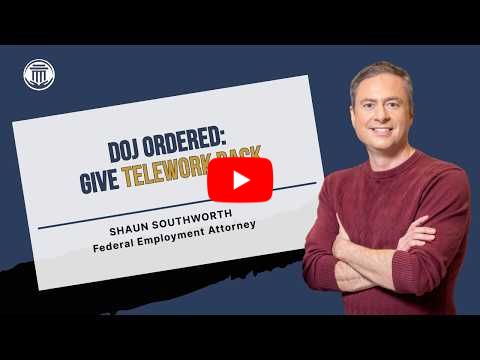
Judge Orders DOJ to Restore Telework for Two Disabled EOIR Attorneys
|
Your Agency's NDA Cannot Erase Your Whistleblower Rights
|

Worried About Retaliation or Being Targeted for Speaking Up?
If you’ve reported misconduct, safety concerns, discrimination, or waste/fraud/abuse—and now you’re seeing sudden schedule changes, bad performance reviews, or threats of discipline—you may be in whistleblower or retaliation territory.
We represent federal employees who:
-
Reported concerns and then saw adverse actions
-
Were sidelined, reassigned, or given impossible workloads after speaking up
-
Face investigations, PIPs, or proposed removals that look like payback
-
Need help navigating OSC complaints, EEO claims, or MSPB appeals tied to retaliation
A free, confidential consultation can help you sort out what’s normal agency behavior and what may cross the line—and what to do before your options narrow.
👉 Schedule Your Free Consultation Today
|

Disclaimer:
This briefing is for general informational purposes only and does not constitute legal advice or create an attorney‑client relationship. Federal employment law is fact‑specific and time‑sensitive; you should consult a qualified attorney about your own situation and deadlines. Past results do not guarantee future outcomes.
Your service is worth protecting. Let's protect it together at Southworth PC.

Responses