Attorneys for Federal Employees — Nationwide
Nearly 200,000 federal workers and supporters follow our updates across TikTok, Instagram, YouTube, Facebook, and LinkedIn. Each briefing gives you the three stories that actually matter to your job, plain‑English legal guidance, and one short practice to protect your peace of mind. If it helps you, forward it to a colleague—new readers can subscribe at https://fedlegalhelp.com/newsletter.
🎧 Listen: Civil Rights for Civil Servants
Shaun Southworth & Lydia Taylor on what's happening to the federal workforce. Latest episode: Apple · Spotify · Amazon Music · Youtube
 |
Today at a Glance
-
Disability Accommodations: A federal judge ordered the Justice Department to restore full-time telework accommodations for two disabled attorneys while their Rehabilitation Act lawsuit proceeds — the first preliminary injunction to come out of the wave of return-to-office accommodation cases.
-
Student Loans: Two federal judges struck down the Education Department rule that would have disqualified certain employers from Public Service Loan Forgiveness, leaving the existing eligibility rules in place for public servants working toward forgiveness.
-
Retirement Processing: OPM says more than 95% of retirement applications now arrive electronically, and its Online Retirement Application portal is now mandatory — including for former employees filing deferred or postponed retirement claims, where a filing mistake can permanently cost insurance benefits.
Top Stories:
1. Judge Orders DOJ to Restore Telework Accommodations for Two Disabled Attorneys While Their Lawsuit Proceeds
Source: Federal News Network, July 14, 2026
TL;DR: A federal judge in the U.S. District Court for the Eastern District of Virginia granted a preliminary injunction ordering the Justice Department to restore full-time telework accommodations for two attorney-advisors in DOJ's Executive Office for Immigration Review (EOIR) while their lawsuit proceeds. The decision came during a July 10 hearing. Plaintiffs Kimberly Panian, who has Type 1 diabetes and severe migraines, and Hoi Yee "Cherry" Baxter, who is severely immunocompromised due to Stage IV lung cancer and its treatment, had teleworked for years as an accommodation until DOJ's 2025 return-to-office orders. Their June lawsuit alleges EOIR systematically denied telework accommodation requests after the mandate, and both say they exhausted hundreds of hours of sick and annual leave to avoid risking their health. Their attorneys are now seeking class certification, arguing hundreds of other EOIR employees have been denied telework accommodations since early 2025 — some marked AWOL, which can carry discipline. Similar allegations are pending against the Treasury Department and the Department of Health and Human Services in a separate union lawsuit.
For federal employees, this means:
- A court has now ordered an agency to restore telework as a disability accommodation while litigation continues — the return-to-office directives do not override the Rehabilitation Act's requirement to assess each accommodation request individually.
- If your telework accommodation was rescinded or denied after a return-to-office order, document the denial, your medical documentation, and any leave you burned as a result — that record is what these cases are built on.
- Watch the class-certification decision. If a class is certified, EOIR employees denied telework accommodations since early 2025 could be covered without filing their own cases.
Legal Insight:
Section 501 of the Rehabilitation Act (29 U.S.C. § 791) requires federal agencies to provide reasonable accommodations to qualified employees with disabilities absent undue hardship, and the EEOC's federal-sector regulations at 29 C.F.R. § 1614.203 hold agencies to an individualized, interactive process — a blanket no-telework-accommodations practice is difficult to square with that standard. Separate from any lawsuit, the administrative clock is short: an employee must contact an EEO counselor within 45 days of a denial or rescission (29 C.F.R. § 1614.105(a)(1)). If your accommodation has been rescinded and you are facing AWOL charges or forced leave, consult a federal employment attorney promptly — the 45-day deadline and any discipline both move quickly.
2. Judges Strike Down the Rule That Would Have Cut Some Employers Out of Public Service Loan Forgiveness
Source: Government Executive, July 9, 2026
TL;DR: Two federal district judges — Myong Joun in Massachusetts and Amir Ali in Washington, D.C. — struck down the Education Department regulation that would have excluded employers the Department determined were engaged in "specific enumerated illegal activities such that they have a substantial illegal purpose" from the Public Service Loan Forgiveness (PSLF) program. The rulings came June 30, hours before the rule's July 1 effective date. Both judges held that the PSLF statute unambiguously defines qualifying employment — government at any level and 501(c)(3) nonprofit organizations — and that the Department has no authority to rewrite those eligibility criteria by regulation. Judge Joun went further, finding the rule facially unconstitutional as viewpoint discrimination. Because the rulings vacated the regulation rather than merely enjoining it, the Department cannot implement the rule anywhere in the country while any appeal plays out. PSLF has canceled more than $87 billion in student loans for nearly 1.2 million borrowers — about $74,000 per borrower on average.
For federal employees, this means:
- Federal employment remains qualifying employment for PSLF — that was never at issue in the rule — and existing eligibility standards stay in place for now.
- If you are pursuing PSLF, keep certifying your employment regularly and keep your own records of qualifying payments; program rules have shifted repeatedly over the past two years, and your paper trail is your protection.
- If a spouse or family member works for a nonprofit that could have been affected, their eligibility also continues under the existing standards unless an appellate court revives the rule.
Legal Insight:
Congress created PSLF in 2007 at 20 U.S.C. § 1087e(m), which cancels the remaining Direct Loan balance after 120 qualifying monthly payments made while working full time in public service — a definition that includes federal, state, local, and tribal government employment and 501(c)(3) nonprofit work. The implementing regulations sit at 34 C.F.R. § 685.219. The judges set the new rule aside under the Administrative Procedure Act (5 U.S.C. § 706(2)) as exceeding the Department's statutory authority — a reminder that an agency cannot narrow a benefit Congress defined by statute.
3. OPM's Retirement Process Is Now Almost Entirely Digital — What to Know Before You File
Source: Government Executive, July 9, 2026
TL;DR: OPM reports that more than 95% of federal retirement applications are now submitted electronically, and with the full launch of the Online Retirement Application (ORA) the agency has reached what it calls its "Last Day of Paper." ORA handled more than 155,000 applications last year, with digital claims finalized in an average of 34 to 66 days between January and May of this year. OPM's new target is to deliver a retiree's first pension payment within seven days of retirement for complete applications submitted by the employee's last day on the job. The digital mandate now extends to former employees filing for deferred or postponed retirement, who must apply through ORA at least 60 days before they want payments to begin — their former agencies are no longer the gatekeepers for those claims. OPM cautions that incomplete records, unverified service, court orders dividing benefits, and Social Security coordination can still delay any case, and current employees should still start the process through their HR office.
For federal employees, this means:
- If retirement is on your horizon, start early: ask HR to begin your application well before your date, and audit your Official Personnel Folder now — undocumented service is the most common cause of processing delays.
- Former employees filing deferred or postponed claims must use the ORA portal and should file at least 60 days before the desired start date; if you previously mailed a paper application that has not been processed, check whether you can resubmit digitally.
- Mind the postponed-retirement trap: if you left at your minimum retirement age with 10 or more years of service, your postponed annuity start date must be the first of a month and before your 62nd birthday — wait past 62 and the claim becomes a deferred retirement, and the ability to reinstate FEHB and FEGLI coverage in retirement is lost.
Legal Insight:
FERS retirement eligibility is set by statute — the MRA+10 provision at 5 U.S.C. § 8412(g) and deferred annuities at 5 U.S.C. § 8413 — and the applicant bears the burden of proving entitlement to the benefit claimed. If OPM denies your application or miscalculates your annuity, that determination is appealable to the Merit Systems Protection Board after OPM reconsideration (5 U.S.C. § 8461(e) for FERS; 5 U.S.C. § 8347(d) for CSRS). Because an election mistake in this area can permanently cost insurance coverage, consider consulting a benefits counselor or a federal employment attorney before filing if your service history or family situation is complicated.
Legal Tip of the Day
When the Workplace Starts to Feel Hostile
A hostile work environment concern often starts with repeated comments, exclusion, intimidation, unfair assignments, or behavior that makes work feel unsafe or humiliating. The legal question may depend on severity, frequency, protected status, prior protected activity, and management’s response. Start documenting specific incidents: dates, words used, witnesses, emails, and how the conduct affected work. Keep records outside government systems and avoid responding in kind, even when the situation is upsetting. Do not assume every bad workplace is legally actionable, but also do not ignore a pattern that is getting worse.
In Case You Missed It
A few quick hits from our recent videos and posts:
New OPM Rule Requires Family Eligibility Proof for FEHB Every Time
|

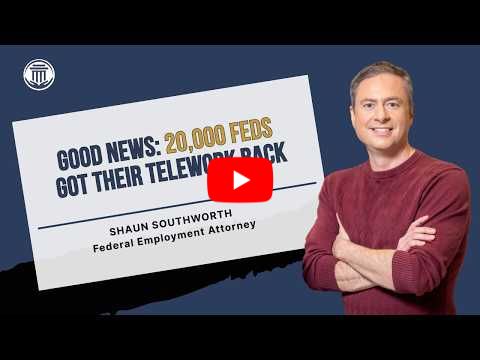
Arbitrator Orders Forest Service to Restore Telework for 20,000 Employees
|
State Department Is Hiring for Jobs It Just Cut — Know Your RIF Rights
|

Thinking About Federal Disability Retirement?
If your medical conditions make it hard to safely or consistently perform your federal job—even with accommodations—it may be time to explore OPM/FERS disability retirement.
We help federal employees:
-
Decide whether disability retirement is the right path compared to accommodation or reassignment
-
Gather and frame medical evidence so it speaks the language OPM expects
-
Prepare and submit disability retirement applications and related documentation
-
Coordinate strategy when disability retirement interacts with pending discipline, EEO complaints, or MSPB appeals
For most disability retirement matters, we offer full‑service application assistance for a flat fee of $5,000, plus any required costs. In a free consultation, we’ll talk through your health limitations, job duties, and timelines so you understand your options before you commit.
👉 Schedule Your Free Consultation Today
|

Disclaimer:
This briefing is for general informational purposes only and does not constitute legal advice or create an attorney‑client relationship. Federal employment law is fact‑specific and time‑sensitive; you should consult a qualified attorney about your own situation and deadlines. Past results do not guarantee future outcomes.
Your service is worth protecting. Let's protect it together at Southworth PC.

Responses