Attorneys for Federal Employees — Nationwide
Nearly 200,000 federal workers and supporters follow our updates across TikTok, Instagram, YouTube, Facebook, and LinkedIn. Each briefing gives you the three stories that actually matter to your job, plain‑English legal guidance, and one short practice to protect your peace of mind. If it helps you, forward it to a colleague—new readers can subscribe at https://fedlegalhelp.com/newsletter.
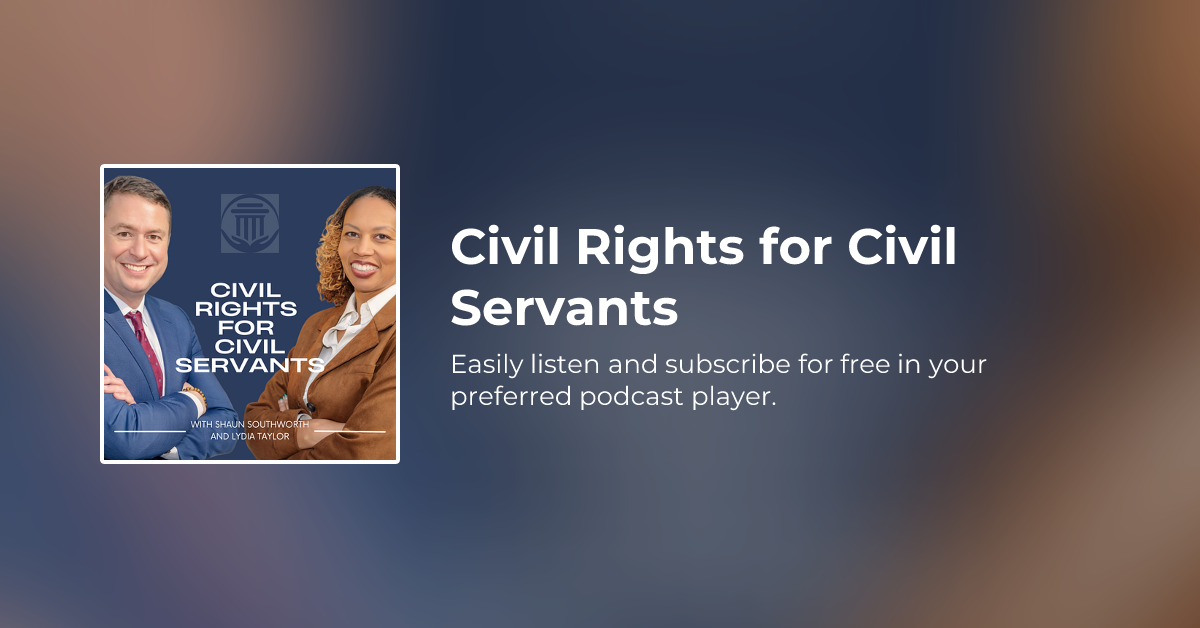
🎧 Listen: Civil Rights for Civil Servants
Shaun Southworth & Lydia Taylor on what's happening to the federal workforce. Latest episode: Apple · Spotify · Amazon Music · Youtube
 |
Today at a Glance
-
Public Service Loan Forgiveness: The Justice Department dropped its appeals of the rulings that threw out the "substantial illegal purpose" rule, so the orders vacating that rule stand and PSLF eligibility is back to what the statute says.
-
Refusing An Unlawful Order: Two longtime public servants used a Federal News Network interview to point federal employees to the Follow the Rules Act, which makes it a prohibited personnel practice to punish an employee for refusing an order that would violate a law, rule, or regulation.
-
Forced Rating Distributions: Documents obtained by Government Executive show a USCIS office fit its 2025 ratings to a curve months before the practice was lawful, and supervisors ended up with a larger share of the top scores than the employees they rated.
Top Stories:
1. The Justice Department Drops Its Appeals in the Public Service Loan Forgiveness Case — the Orders Vacating the "Substantial Illegal Purpose" Rule Now Stand
Source: Federal News Network (Associated Press), October 22, 2026
TL;DR: On October 21 and 22, the Justice Department filed stipulations dismissing its appeals of two June 30, 2026 decisions that struck down the Education Department's October 2025 rule for the Public Service Loan Forgiveness program. That rule would have allowed the Education Secretary to disqualify an employer from PSLF after determining the employer had "a substantial illegal purpose." Judge Myong Joun of the U.S. District Court for the District of Massachusetts vacated the rule weeks before its July 1 effective date, holding that it exceeded the agency's statutory authority and threatened First Amendment protections; Judge Amir Ali of the U.S. District Court for the District of Columbia ruled the same day in a separate case brought by nonprofit organizations. The dismissal papers were one-sentence joint stipulations under Federal Rule of Appellate Procedure 42(b)(1), with each side bearing its own fees and costs, and the government gave no explanation. California Attorney General Rob Bonta, whose office sued as part of a 22-state coalition in November 2025, said the dismissal leaves the district court's ruling in place. PSLF cancels the remaining balance on eligible federal Direct Loans for borrowers who make 120 qualifying monthly payments while working full time in public service.
For federal employees, this means:
- Eligibility is governed by the statute Congress wrote, not the vacated rule: full-time federal employment qualifies, and the employer-disqualification screen is not in effect.
- If you let your certifications lapse while the rule was pending, file your employment certification now — months of qualifying work are credited only after the employment is certified.
- Keep your own records, including pay stubs, SF-50s, and signed certification forms, because borrowers have corrected servicer payment counts on the strength of their own documentation.
Legal Insight
PSLF is statutory. Under 20 U.S.C. § 1087e(m), the Secretary of Education must cancel the remaining principal and interest on an eligible Direct Loan for a borrower who has made 120 qualifying monthly payments while employed in a "public service job," a term the statute defines to include a full-time job in government. The implementing regulation is 34 C.F.R. § 685.219. With the 2025 rule vacated and the appeals dismissed, the statutory definition controls, and the practical question for most federal employees is simply keeping employment certifications current.
2. "Refusing an Unlawful Order" Is a Protected Act — Two Former Officials Say Almost No Civilian Employee Has Heard of the Law That Says So
Source: Federal News Network (Workforce Rights/Governance), October 22, 2026
TL;DR: Federal News Network's Federal Drive interviewed Sean O'Keefe, a former NASA administrator and Secretary of the Navy, and Josh Gotbaum, a career civil servant who later served as a political appointee, about a Brookings commentary they published on September 10, 2026. Their argument is that military members are trained on lawful and unlawful orders while civilian employees are not, and that most of the more than two million federal civilians have never been told the protection exists. Gotbaum said an employee facing a questionable order has a third option besides obeying and quitting: ask what is being directed and why, put the question in writing, and ask agency counsel whether the action is lawful. He also recounted the statute's history — an earlier version protected refusal to violate a law but not a rule or regulation, and Congress amended it so the protection reaches all three. Both men noted that the value of the protection depends on the forums that enforce it, and the Brookings piece says the administration has weakened the Office of Special Counsel and the Merit Systems Protection Board.
For federal employees, this means:
- The protection covers refusing an order that would require you to violate a law, rule, or regulation — not an order you disagree with as a matter of policy.
- Ask in writing before you refuse: what is being directed, on what authority, and whether agency counsel has reviewed it. A contemporaneous email is the record a later case is built on.
- If a personnel action follows your refusal, the claim is a prohibited personnel practice, and the ordinary route is a complaint to the Office of Special Counsel followed, if OSC closes the matter, by an individual right of action appeal to the Board.
Legal Insight
The Follow the Rules Act, Pub. L. No. 115-40 (June 14, 2017), amended 5 U.S.C. § 2302(b)(9)(D), which now makes it a prohibited personnel practice to take, fail to take, or threaten a personnel action against an employee for "refusing to obey an order that would require the individual to violate a law, rule, or regulation." The amendment responded to Rainey v. Merit Systems Protection Board, 824 F.3d 1359 (Fed. Cir. 2016), which read the earlier text to protect only a refusal to violate a statute. Employees seek corrective action through the Office of Special Counsel under 5 U.S.C. § 1214 and, after OSC's process runs, from the Board under 5 U.S.C. § 1221. These cases turn on timing and on what was written down at the time, so an employee who is directed to do something they believe is unlawful should speak with a federal employment attorney before the personnel action lands.
3. Documents Show a USCIS Office Fit Its 2025 Ratings to a Curve — Supervisors Received a Larger Share of the Top Scores Than the Employees They Rated
Source: Government Executive, October 21, 2026
TL;DR: Government Executive reviewed emails, contemporaneous memos, and a ratings spreadsheet from the National Records Center at U.S. Citizenship and Immigration Services showing that the office applied a forced distribution to its 2025 appraisals — months before federal regulations permitted the practice. Timothy Turner, the center's former section chief for human resources and training, said the mandate arrived in late November 2025 with a December 5 deadline, and that leadership set award percentages first and then fit ratings to the budget. A November 26 email said the center could "afford" between 60 and 70 "achieved excellence" ratings and described a mandated "20-40-20" curve, and the then-director wrote that an employee who scored a 5 on production goals "will have to" be given "mainly 3s in the subjective areas" unless a 5 rating was intended. A deputy director compared the exercise to a television game show. Of the center's 414 employees, 19 percent received a 3, 39 percent a 4, and 24 percent a 5 — but 37 percent of supervisors received the top rating, compared with 23 percent of non-supervisors. USCIS did not respond to the publication's questions.
For federal employees, this means:
- A rating of record must rest on an actual evaluation of your own performance for the period covered — not on a quota, a curve, or the size of an award budget.
- If you believe your summary level was lowered to fit a distribution, act quickly: the regulation allows a rating of record to be changed within 60 days of issuance on an informal request by the employee, as spelled out in your agency's policy.
- Keep the paper — your performance plan, mid-year feedback, production reports, and any message describing a curve, a cap, a "nomination," or an award budget driving scores.
Legal Insight
OPM's regulation is explicit: a rating of record "must be based only on the evaluation of actual job performance for the designated appraisal period," and an agency "must not issue a rating of record that assumes a level of performance by an employee without an actual evaluation of that employee's performance." 5 C.F.R. § 430.208(a)(1)-(2). The same section permits OPM to establish a standardized distribution that agencies must apply going forward, § 430.208(c), allows a change within 60 days on the employee's informal request, § 430.208(i)(1), and now bars challenging a rating of record through a negotiated grievance procedure, subject to 5 U.S.C. § 7116(a)(7), § 430.208(k). Ray Limon, a former member of the Merit Systems Protection Board, told Government Executive that artificially deflated ratings could amount to a prohibited personnel practice; those are listed at 5 U.S.C. § 2302(b), and subsection (b)(12) reaches a personnel action that violates a law, rule, or regulation implementing a merit system principle. With ratings now weighing more heavily in reduction-in-force retention, an employee who believes a score was set by quota should document it and consult a federal employment attorney.
Legal Tip of the Day
Keep a Same-Day Record of What You Are Told
When a supervisor gives you a direction that concerns you, such as a change to your duties, a conversation about your rating, or an instruction you are not sure is proper, the record you make that day often matters more than your memory months later. Write down who said what, when, and in what setting. Then send a short, polite email confirming your understanding and asking any questions you have. Keep your own private notes outside government systems. Write down any deadlines that may be running, and ask who can answer your questions about them. Do not assume that a verbal comment or an unwritten understanding will be remembered the same way by everyone involved.
In Case You Missed It
A few quick hits from our recent posts:
HHS Loses Telework Appeal: FLRA Says a Return-to-Office Memo Can't Override Your Union Contract
|

|

Report: State Department Asked Foreign Service Officers Up for Promotion Who They Voted For
|

Worried About Retaliation or Being Targeted for Speaking Up?
If you’ve reported misconduct, safety concerns, discrimination, or waste/fraud/abuse—and now you’re seeing sudden schedule changes, bad performance reviews, or threats of discipline—you may be in whistleblower or retaliation territory.
We represent federal employees who:
-
Reported concerns and then saw adverse actions
-
Were sidelined, reassigned, or given impossible workloads after speaking up
-
Face investigations, PIPs, or proposed removals that look like payback
-
Need help navigating OSC complaints, EEO claims, or MSPB appeals tied to retaliation
A free, confidential consultation can help you sort out what’s normal agency behavior and what may cross the line—and what to do before your options narrow.
👉 Schedule Your Free Consultation Today
|
Disclaimer:
This briefing is for general informational purposes only and does not constitute legal advice or create an attorney‑client relationship. Federal employment law is fact‑specific and time‑sensitive; you should consult a qualified attorney about your own situation and deadlines. Past results do not guarantee future outcomes.
Your service is worth protecting. Let's protect it together at Southworth PC.

Responses