Attorneys for Federal Employees — Nationwide
Nearly 200,000 federal workers and supporters follow our updates across TikTok, Instagram, YouTube, Facebook, and LinkedIn. Each briefing gives you the three stories that actually matter to your job, plain‑English legal guidance, and one short practice to protect your peace of mind. If it helps you, forward it to a colleague—new readers can subscribe at https://fedlegalhelp.com/newsletter.
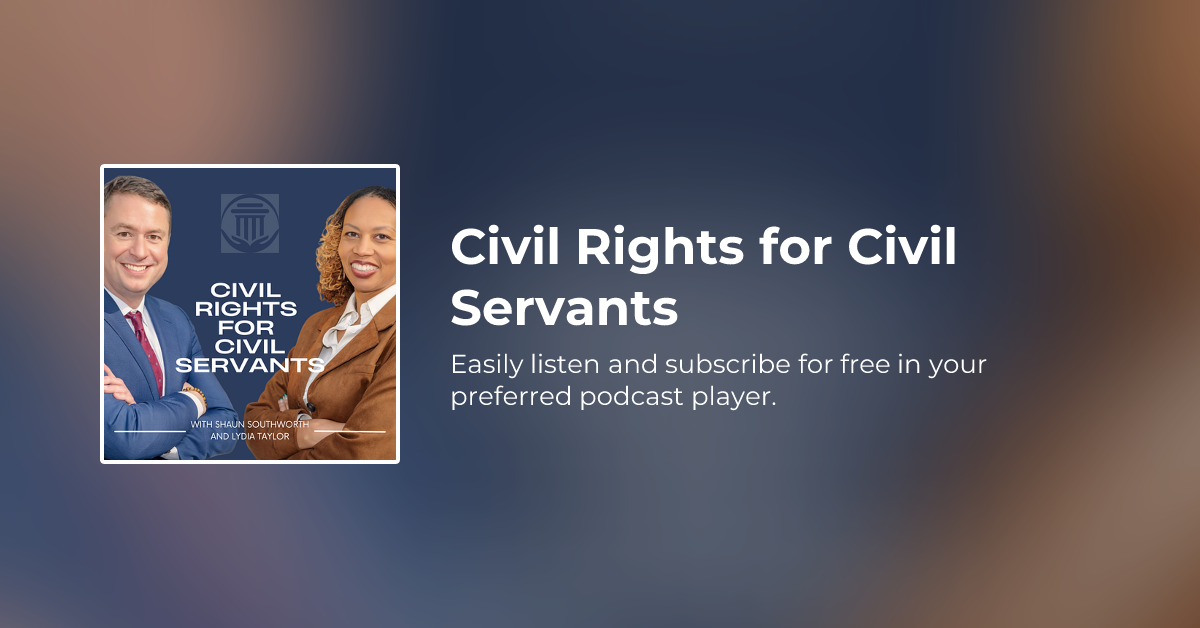
🎧 Listen: Civil Rights for Civil Servants
Shaun Southworth & Lydia Taylor on what's happening to the federal workforce. Latest episode: Apple · Spotify · Amazon Music · Youtube
 |
Today at a Glance
-
DHS Personnel Leak: Searchable records on more than 41,000 current and former DHS employees and contractors were published Wednesday — names, work phones, emails, job titles, and group memberships. DHS says it is "aware of a potential breach"; the Privacy Act sets what the agency owes you next.
-
OPM Retaliation Memo: A new OPM memorandum says reporting misconduct, recommending discipline, and testifying in EEO, grievance, MSPB, and suitability proceedings are all protected activity — and that a suitability referral, or the threat of one, cannot be used to punish it.
-
USDA Reassignment Letters: NRCS sent new "permanent reassignment" letters dated October 28, even though a federal judge's October 13 stay bars USDA from "issuing or enforcing" any reassignment or relocation notice.
Top Stories:
1. Hackers Publish a Searchable List of 41,000 DHS Employees and Contractors — What the Privacy Act Requires the Agency to Do Now, and What You Can Recover
Source: Government Executive, October 29, 2026
TL;DR: Searchable records identifying more than 41,000 current and former Department of Homeland Security employees and contractors were published Wednesday by the nonprofit Distributed Denial of Secrets, which said it received the data from a hacktivist group calling itself the Department of Peace. The records include names, phone numbers, email addresses, job titles, and internal group memberships across ICE, CBP, CISA, and other components; some entries describe surveillance, computer-forensics, and undercover roles. Nextgov/FCW corroborated portions of the data and found that some records are historical. The hackers said they pulled the data from an Okta single sign-on service used by DHS; Okta said it has found no evidence its own systems were compromised. DHS said it is "aware of a potential breach and is actively working to address the situation swiftly and effectively," and would provide more information when available. It follows the DMDC breach affecting roughly 3 million people; DHS has not yet described any employee notification.
For federal employees, this means:
- If you work or worked at DHS, assume your work contact information and job title may be public. Do not search for or download the leaked data on any government device or network, and treat any unexpected call, text, or email that references your assignment as a possible impersonation attempt.
- Watch for a written breach notice. Under OMB's governmentwide breach policy, the agency must assess the risk of harm to the people affected and decide whether and how to notify them; keep every notice you receive and note the date.
- If the exposure changes the risk of your assignment — undercover or enforcement work, for example — raise it with your supervisor in writing and ask what the agency will do. That request, and the agency's response or silence, is the record any later claim rests on.
Legal Insight
The Privacy Act requires every agency to "establish appropriate administrative, technical, and physical safeguards to insure the security and confidentiality of records and to protect against any anticipated threats or hazards to their security or integrity." 5 U.S.C. § 552a(e)(10). An individual harmed by an agency's failure to comply may sue the agency in federal district court, 5 U.S.C. § 552a(g)(1)(D) — but damages require a finding that the agency acted in a manner that was "intentional or willful," and then only "actual damages," with a $1,000 floor, costs, and attorney fees, 5 U.S.C. § 552a(g)(4). That is a high bar: "actual damages" does not include mental or emotional distress, FAA v. Cooper, 566 U.S. 284 (2012), and suit generally must be filed within two years, 5 U.S.C. § 552a(g)(5). OMB Memorandum M-17-12 (Jan. 3, 2017) sets the governmentwide framework agencies must follow to assess a breach and notify affected individuals. Keep every notice the agency sends and a record of any out-of-pocket cost the exposure causes you; that is the evidence a claim would rest on.
2. OPM Tells Agencies That Reporting Misconduct, Recommending Discipline, and Testifying Are All Protected Activity — and That a Suitability Referral Cannot Be Used to Punish Any of It
Source: FEDweek, October 29, 2026
TL;DR: In a memorandum dated October 28, 2026, OPM told Chief Human Capital Officers, managers, and supervisors that agencies have reported employees reluctant to report a colleague's misconduct or serve as a witness, and supervisors reluctant to propose discipline, because they fear being named in an EEO complaint, grievance, or Inspector General complaint. The memo answers that an EEO complaint or MSPB appeal "is a proceeding against the agency, not the official," that an official acting within the scope of federal employment "is not personally liable for a personnel action," and that giving truthful testimony is itself protected activity. It states that a report to a supervisor, a disclosure already known to others, an oral report, and a report made as part of an employee's ordinary duties are all protected when the employee reasonably believes wrongdoing occurred, and that "an honest report that proves mistaken remains protected." It also states that OPM's amended suitability rules bar an agency from using "a suitability referral, or the threat of one, to punish an employee for protected activity." The memo builds on OPM's November 21, 2025 personal-liability memo and reflects OPM's authority, since September 2, 2026, to decide suitability removals of other agencies' employees and hear the appeals that used to go to the MSPB. It adds that protected activity "does not insulate an employee from the consequences of his or her own misconduct or unacceptable performance."
For federal employees, this means:
- The protections run in both directions. If you report a supervisor's abuse of authority, flag a falsified record, or testify in a coworker's EEO or MSPB case, the memo says you are engaged in protected activity — and your agency is expected to investigate promptly if anyone harasses, threatens, or ostracizes you for it.
- Expect more discipline and more suitability referrals. The memo tells agencies to "support officials who act," not to penalize a supervisor because a subordinate filed a complaint, and to refer serious post-appointment misconduct to OPM rather than let it go unaddressed.
- If you are the subject of a report, filing an EEO complaint, grievance, or appeal is still protected — but it does not pause an action the agency was already contemplating. Your case will turn on whether the agency's reasons are documented, consistent, and applied evenhandedly.
Legal Insight
It is a prohibited personnel practice to take, fail to take, or threaten a personnel action because of a disclosure the employee reasonably believes evidences a violation of law, rule, or regulation, gross mismanagement, a gross waste of funds, an abuse of authority, or a substantial and specific danger to public health or safety, 5 U.S.C. § 2302(b)(8), or because the employee testified for or lawfully assisted another person in an appeal, complaint, or grievance, or cooperated with an Inspector General, 5 U.S.C. § 2302(b)(9)(A)–(C). A disclosure does not lose protection because it was made to a supervisor, concerned information already known, or was oral, 5 U.S.C. § 2302(f)(1), and suitability actions "must be applied consistent with" the merit system principles and § 2302(b), 5 C.F.R. § 731.102(c). In the EEO process, no person may be retaliated against "for participating in any stage of administrative or judicial proceedings" under the federal EEO statutes, 29 C.F.R. § 1614.101(b). An employee who believes a personnel action was taken for protected activity may seek corrective action from the Office of Special Counsel and, if OSC does not obtain relief, file an individual right of action appeal with the Board, 5 U.S.C. §§ 1214, 1221. Because suitability appeals now run to OPM rather than the Board, anyone facing a suitability referral should consult a federal employment attorney promptly.
3. USDA Sends New "Permanent Reassignment" Letters Dated October 28 — the Judge's Stay Bars "Issuing or Enforcing" Any Relocation Notice, and the Letters Say the Move Waits Only Until the Order Is Lifted
Source: Government Executive, October 29, 2026
TL;DR: USDA's Natural Resources Conservation Service (NRCS), the department's second-largest component, has sent employees management-directed reassignment (MDR) letters stating they are being "permanently reassigned" from their current positions, according to a letter obtained by Government Executive. The letter from Acting Associate Chief Scott Edwards, dated October 28, states the reassignments are effective November 1 but that "geographic reassignment will not be effective until the current court order injunction is lifted." On October 13, Judge Vince Chhabria of the U.S. District Court for the Northern District of California stayed USDA's reorganization, prohibiting the department from relocating or reassigning employees outside the local commuting area, "including by issuing or enforcing MDR letters or any other notice or directive of reassignment or relocation in whole or in part." The Ninth Circuit has so far left the stay in place. Last week Secretary Brooke Rollins said the department is "full-bore ahead" on the reorganization. NRCS has also opened a "critical vacancy" portal for local positions at the employee's current grade or lower, with applications due November 2. USDA had sent about 725 MDR letters as of late August and planned to relocate about 2,600 employees.
For federal employees, this means:
- If you received an October 28 letter, keep it, note the date you received it, and send a copy to your union or representative. The stay expressly covers notices of reassignment "in whole or in part."
- Do not treat the letter as a resignation deadline. The stay bars USDA from enforcing any relocation deadline in these letters, and the court required USDA to notify employees of the order and certify its compliance.
- The November 2 portal deadline still matters. Applying for a local position at your current grade or lower is one of the few moves the order leaves available, and the order does not reach a reassignment you apply for and accept through a merit process.
Legal Insight
The stay rests on 5 U.S.C. § 705, which lets a reviewing court "issue all necessary and appropriate process to postpone the effective date of an agency action or to preserve status or rights pending conclusion of the review proceedings." Am. Fed'n of Gov't Emps. v. U.S. Dep't of Agric., No. 26-cv-09976-VC (N.D. Cal. Oct. 13, 2026), ECF No. 107 at 39. Paragraph 3 of the order covers the Farm Production and Conservation mission area, which includes NRCS, and defines "local commuting area" by reference to 5 C.F.R. § 351.203. An agency generally may reassign a career employee, 5 C.F.R. § 335.102, and an employee who refuses a directed reassignment outside the commuting area can be removed — but that removal is an adverse action with the notice, reply, and MSPB appeal rights of 5 U.S.C. § 7513. If you are told to act on one of these letters before the stay is lifted, document it and consult your union or a federal employment attorney before responding.
Legal Tip of the Day
Read the Clock a Notice Starts, Not Just the Notice
When a written notice arrives, whether it is a reassignment letter, a proposed action, or a breach notification, the first question is what it asks of you and by when. Do not assume the date printed on the letter is the date that matters. Note the day you actually received it, save a copy somewhere outside government systems, and read it for any deadline it states. Then ask, in writing, who can answer your questions about it and what happens if you do nothing. Different processes run on different clocks, and an open matter in one office does not pause another. If a notice seems to conflict with an earlier instruction or order, document that and raise it before you act.
In Case You Missed It
A few quick hits from our recent posts:
DHS Employee Data Breach: What ICE, CBP, and USCIS Employees Should Do Now
|

OPM’s Hire-Palooza: Are “On-the-Spot” Job Offers Legal?
|

Nearly 1 in 5 Federal Workers Is Gone: What “Voluntary” Departures Mean Legally
|

Worried About Retaliation or Being Targeted for Speaking Up?
If you’ve reported misconduct, safety concerns, discrimination, or waste/fraud/abuse—and now you’re seeing sudden schedule changes, bad performance reviews, or threats of discipline—you may be in whistleblower or retaliation territory.
We represent federal employees who:
-
Reported concerns and then saw adverse actions
-
Were sidelined, reassigned, or given impossible workloads after speaking up
-
Face investigations, PIPs, or proposed removals that look like payback
-
Need help navigating OSC complaints, EEO claims, or MSPB appeals tied to retaliation
A free, confidential consultation can help you sort out what’s normal agency behavior and what may cross the line—and what to do before your options narrow.
👉 Schedule Your Free Consultation Today
|

Disclaimer:
This briefing is for general informational purposes only and does not constitute legal advice or create an attorney‑client relationship. Federal employment law is fact‑specific and time‑sensitive; you should consult a qualified attorney about your own situation and deadlines. Past results do not guarantee future outcomes.
Your service is worth protecting. Let's protect it together at Southworth PC.

Responses