Attorneys for Federal Employees — Nationwide
Nearly 200,000 federal workers and supporters follow our updates across TikTok, Instagram, YouTube, Facebook, and LinkedIn. Each briefing gives you the three stories that actually matter to your job, plain‑English legal guidance, and one short practice to protect your peace of mind. If it helps you, forward it to a colleague—new readers can subscribe at https://fedlegalhelp.com/newsletter.
Who Protects the Worker?
The full lineup for the September 9 panel is out, and Shaun Southworth is on it. RSVP below.
A lot of you watched it happen to someone down the hall this year: a colleague terminated on probation, a whole office eliminated in a reduction in force (RIF). The organizers of this panel put it plainly: the procedures designed to guard against arbitrary termination were "tested on a scale not seen in generations."
On Wednesday, September 9, from 10:45 a.m. to 12:15 p.m. ET, the USAID Employee Support Fund and the Alliance for American Leadership host a non-partisan virtual panel on what limits should apply when the government eliminates jobs or removes employees, and what happens when those limits are not followed.
The full lineup is now public:
- Congressman Jamie Raskin opens.
- Two former USAID Administrators who served under presidents of different parties share the program: Andrew Natsios moderates, and Ambassador Samantha Power closes.
- Our founding partner, Shaun Southworth, sits on the panel with Kevin Byrnes of Patriots Law Group and Andrew Huddleston, Advocacy Director at the American Federation of Government Employees (AFGE).
It's on Zoom, so no travel voucher needed, but you do need to register.
RSVP here: https://www.usaidemployeefund.org/event
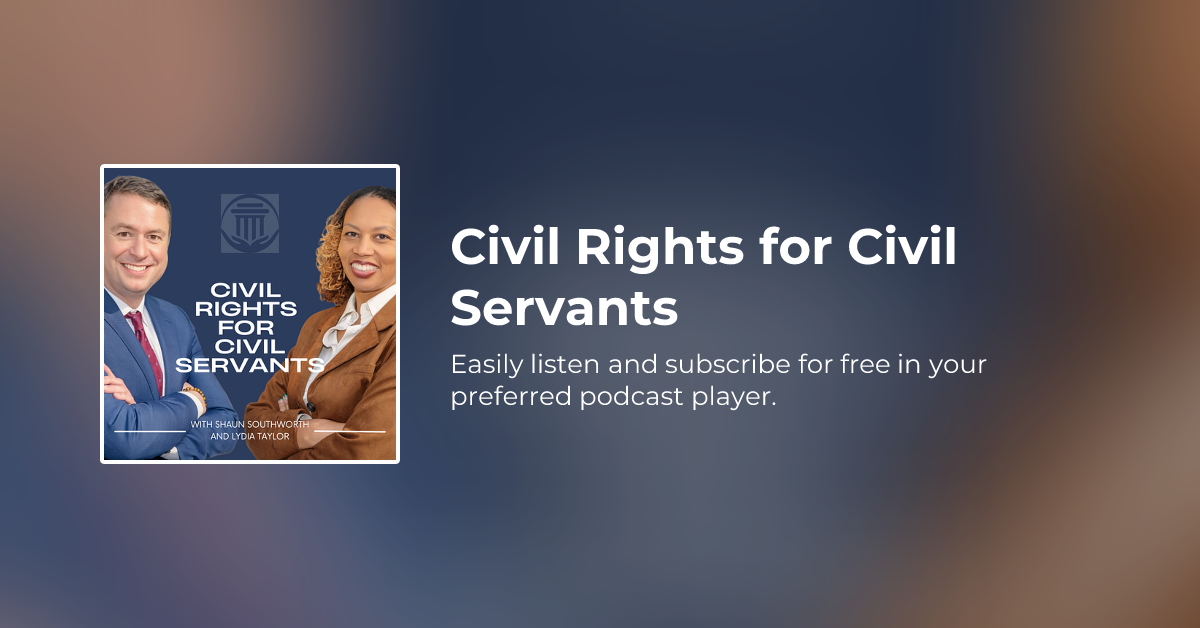
🎧 Listen: Civil Rights for Civil Servants
Shaun Southworth & Lydia Taylor on what's happening to the federal workforce. Latest episode: Apple · Spotify · Amazon Music · Youtube
 |
Today at a Glance
-
MSPB Ends Mandatory Douglas-Factor Review: The Board published its final penalty rule Thursday. Starting with appeals filed on or after October 5, 2026, the Board will judge a penalty on the "totality of the circumstances" rather than requiring all 12 Douglas factors in every case. Appeals already pending on that date stay under the current framework.
-
"Article II" Firings Go to Court Two Ways: The former U.S. Pardon Attorney sued the Justice Department in federal district court Thursday after the MSPB paused her 17-month-old appeal, and the full Federal Circuit hears the lead "Article II" case, Jackler, in December.
-
Teleworking Fed Pleads Guilty Over Six Hidden Contractor Jobs: A former CISA employee admitted billing up to 33 hours a day across a federal job and multiple contractor positions, a reminder that outside-employment and time-card rules carry both disciplinary and criminal consequences.
Top Stories:
1. MSPB Finalizes the End of Mandatory Douglas-Factor Review — New Penalty Standard Applies to Appeals Filed On or After October 5
Source: Federal News Network, September 3, 2026
TL;DR: The Merit Systems Protection Board published a final rule in Thursday's Federal Register (91 Fed. Reg. 56549) ending the requirement that the 12 factors from Douglas v. Veterans Administration be addressed in every misconduct case. The new regulation, 5 C.F.R. § 1201.56(b)(3), says the agency's choice of penalty "is entitled to substantial deference" and that the Board will review a penalty "only to determine whether it is within the tolerable limits of reasonableness in light of the charges sustained," based on "the totality of the circumstances relating to the efficiency of the service, on a case-by-case basis." The rule takes effect October 5, 2026, and applies only to appeals filed with the Board on or after that date; appeals pending on October 5 will be decided under the framework in effect when they were filed. It covers only appeals under 5 U.S.C. § 7513, not Senior Executive Service actions under § 7543 or performance-based actions under chapter 43. The Board wrote that the Douglas considerations "remain available to the parties and to the Board wherever they are material to the reasonableness of the penalty," and that what ends is "the treatment of the twelve factors as a compulsory analytic code." The Board received approximately 676 unique comments on the joint OPM–MSPB docket, many in opposition. OPM's companion proposals on performance improvement plans, settlement agreements, and tables of penalties are not finalized in this document and remain pending.
For federal employees, this means:
- The date you file your MSPB appeal now determines which review standard applies. An appeal filed before October 5 is decided under the current Douglas framework; an appeal filed on or after October 5 is decided under the new "totality of the circumstances" standard. The 30-day appeal window under 5 C.F.R. § 1201.22(b) has not changed.
- Keep building your reply to a proposed action around the same facts that have always mattered: length of service, a clean record, how similarly situated employees were treated, rehabilitation potential, and mitigating circumstances. The Board's own preamble says those considerations remain "relevant and cognizable under the totality of the circumstances wherever the record makes it material," and that a penalty determination "that ignores material record evidence" risks being "mitigated or reversed."
- The agency's obligations at the front end have not changed. It still must identify in the proposal notice the aggravating factors it will rely on, and it still must prove the reasonableness of its penalty by a preponderance of the evidence. In the Board's words, "a deciding official who reaches beyond the notice courts reversal after this rule exactly as before it."
Legal Insight
Two things are unchanged by this rule: 5 U.S.C. § 7513(a) still permits an adverse action "only for such cause as will promote the efficiency of the service," and 5 U.S.C. § 7701(c)(1)(B) still requires the agency to prove its case, including the reasonableness of the penalty, by a preponderance of the evidence. What changes is the Board's review method at 5 C.F.R. § 1201.56(b)(3), which codifies the "tolerable limits of reasonableness" test from Douglas v. Veterans Administration, 5 M.S.P.R. 280, 306 (1981), and the mitigation framework of Lachance v. Devall, 178 F.3d 1246, 1260 (Fed. Cir. 1999), while dropping the mandatory 12-factor recitation; the Board may still mitigate to the "maximum reasonable penalty" when the agency's choice falls outside those limits. Comparator evidence, affirmative defenses under § 7701(c)(2), and judicial review under 5 U.S.C. § 7703(c) are expressly preserved. If you are facing a proposed or pending adverse action, the October 5 filing-date line and the way the penalty record is built both matter now; consult a federal employment attorney early.
2. Fired Pardon Attorney Sues in Federal Court After the MSPB Shelves Her Appeal — the "Article II" Firing Question Reaches the Full Federal Circuit in December
Source: Government Executive, September 3, 2026
TL;DR: Former U.S. Pardon Attorney Elizabeth Oyer filed suit Thursday in the U.S. District Court for the District of Columbia, Oyer v. Blanche, No. 1:26-cv-03092, challenging her March 7, 2025 removal from a career Senior Executive Service position. The removal memo, signed by Todd Blanche when he was Deputy Attorney General (he is now Attorney General), stated she was removed "[p]ursuant to Article II of the Constitution and the laws of the United States," effective immediately, with no advance notice, no stated cause, and no opportunity to respond. Oyer alleges the removal followed her refusal to recommend restoring firearm rights to actor Mel Gibson, who has a domestic-violence conviction; the Justice Department's position before the Board was that SES members exercise significant executive authority and are removable at will. Oyer appealed to the MSPB on April 3, 2025, but on June 2, 2026, the Board's administrative judge dismissed the appeal without prejudice for at least six months while the Federal Circuit decides Jackler v. Department of Justice, No. 26-1575, the en banc appeal of the Board's March 20, 2026 decision holding that immigration judges are inferior officers removable at will and that the Board lacks jurisdiction over such removals. The complaint calls the MSPB "a dead end" and pleads six counts, including Fifth Amendment due process, First Amendment political-affiliation discrimination, and an Appointments Clause theory that, even under the Department's own view, only the Attorney General, not the Deputy, may exercise Article II removal authority, making the removal "void ab initio." Government Executive reports the Federal Circuit will hear Jackler en banc in December.
For federal employees, this means:
- An "Article II" removal notice is not a routine adverse action. It typically has no proposal, no reply period, and no statement of cause. Whether the Constitution permits that for career employees is the question now before the full Federal Circuit.
- "Dismissed without prejudice" is a pause, not a loss. Under 5 C.F.R. § 1201.29(c), the judge sets a date certain by which the appeal must be refiled, or refiles it automatically. Missing a refile date is the real risk; track it the way you would an original deadline.
- Watch the threshold ruling in Oyer's case. Employees normally must finish the MSPB process before any court will hear them. Oyer argues that a constitutionally framed firing plus Board inaction opens the district court door. If the court agrees, it changes the map for everyone removed under an Article II notice.
Legal Insight
A career SES member may be removed "only for misconduct, neglect of duty, malfeasance, or failure to accept a directed reassignment or to accompany a position in a transfer of function," 5 U.S.C. § 7543(a), and only after at least 30 days' advance written notice stating specific reasons, at least 7 days to answer, and a written decision, § 7543(b), with a right of appeal to the Board under § 7543(d) and § 7701. Those are the protections the Department contends Article II overrides for employees it classifies as inferior officers. A dismissal without prejudice under 5 C.F.R. § 1201.29 preserves the appeal but does not decide it, and the 30-day MSPB filing deadline in 5 C.F.R. § 1201.22(b) still runs from the effective date of any removal, Article II label or not. If you receive such a notice, consult a federal employment attorney immediately.
3. A CISA Employee Held Six Contractor Jobs While Teleworking Full Time and Billed 33-Hour Days — She Pleaded Guilty to a Federal Felony
Source: Government Executive, September 3, 2026
TL;DR: A former employee of the Cybersecurity and Infrastructure Security Agency pleaded guilty Wednesday, September 2, in the U.S. District Court for the District of Columbia to making false, fictitious, or fraudulent claims against the United States, according to the U.S. Attorney's Office for the District of Columbia. She was a full-time CISA employee from September 2016 to October 2025 who, between January 2021 and August 2024, also held contractor positions supporting the Drug Enforcement Administration, the Departments of Energy, Justice, and Agriculture, the Federal Highway Administration, and the Nuclear Regulatory Commission. In February 2022 alone, her combined reported hours exceeded 24 in a single day on 15 occasions, including 33 hours on four consecutive days. She admitted concealing each job from the others and acknowledged she could do so because every position was remote. The loss to the government was nearly $250,000, which she must repay in full; sentencing is set for January 20, 2027.
For federal employees, this means:
- Outside work is allowed but regulated. Under 5 C.F.R. § 2635.802 you may not hold outside employment that conflicts with your official duties, and under § 2635.803 your agency may require prior approval through its supplemental ethics regulation. Many agencies do; check yours before you take a second job.
- A time card is a certification. 5 C.F.R. § 2635.705(a) requires employees to use official time "in an honest effort to perform official duties." Reporting hours you did not work is charged administratively as falsification and, as this case shows, can also be charged as a federal crime.
- Telework runs on trust. If you telework and hold approved outside work, keep the hours separate and documented so the record answers questions before they are asked.
Legal Insight
The criminal statute here, 18 U.S.C. § 287, makes it a felony punishable by up to five years' imprisonment to present a claim to the United States "knowing such claim to be false, fictitious, or fraudulent," and a timesheet certifying hours not worked is such a claim. On the administrative side, time-and-attendance falsification and unapproved outside employment are charged as misconduct under 5 U.S.C. § 7513, and falsification charges are treated as serious precisely because they go to an employee's trustworthiness. For appeals filed on or after October 5, the reasonableness of any penalty in such a case will be reviewed under the new standard described in Story 1.
Legal Tip of the Day
When You’re Reassigned Without a Clear Reason
A reassignment may be presented as routine, but it can still affect duties, career path, commute, telework, supervision, reputation, or accommodation needs. Ask for the reassignment details in writing, including effective date, position description, reporting chain, duty station, and expected duties. Keep a timeline of what happened before the reassignment, especially if it followed EEO activity, whistleblowing, medical leave, or conflict with management. Do not assume that management discretion means there are no legal issues, but do not refuse the reassignment without advice.
In Case You Missed It
A few quick hits from our recent posts:
Paid 24.72% Under Market, Then Frozen: What the 2027 Federal Pay Freeze Letter Really Says
|

|

You Won at the MSPB but the Agency Appealed: Why You Should Still Be Paid While You Wait
|

Worried About Retaliation or Being Targeted for Speaking Up?
If you’ve reported misconduct, safety concerns, discrimination, or waste/fraud/abuse—and now you’re seeing sudden schedule changes, bad performance reviews, or threats of discipline—you may be in whistleblower or retaliation territory.
We represent federal employees who:
-
Reported concerns and then saw adverse actions
-
Were sidelined, reassigned, or given impossible workloads after speaking up
-
Face investigations, PIPs, or proposed removals that look like payback
-
Need help navigating OSC complaints, EEO claims, or MSPB appeals tied to retaliation
A free, confidential consultation can help you sort out what’s normal agency behavior and what may cross the line—and what to do before your options narrow.
👉 Schedule Your Free Consultation Today
|

Disclaimer:
This briefing is for general informational purposes only and does not constitute legal advice or create an attorney‑client relationship. Federal employment law is fact‑specific and time‑sensitive; you should consult a qualified attorney about your own situation and deadlines. Past results do not guarantee future outcomes.
Your service is worth protecting. Let's protect it together at Southworth PC.

Responses