Attorneys for Federal Employees — Nationwide
Nearly 200,000 federal workers and supporters follow our updates across TikTok, Instagram, YouTube, Facebook, and LinkedIn Each briefing gives you the three stories that actually matter to your job, plain‑English legal guidance, and one short practice to protect your peace of mind. If it helps you, forward it to a colleague—new readers can subscribe at https://fedlegalhelp.com/newsletter.
Who Protects the Worker?
Shaun Southworth joins former USAID Administrator Andrew Natsios, Kevin Byrnes, and AFGE representative on a September 9 panel. RSVP below.
A lot of you watched it happen to someone down the hall this year: a colleague terminated on probation, a whole office eliminated in a reduction in force (RIF). You don't need anyone to explain why this panel matters. The organizers put it plainly: the procedures designed to guard against arbitrary termination were "tested on a scale not seen in generations." On Wednesday, September 9, from 10:45 a.m. to 12:15 p.m. ET, the USAID Employee Support Fund and Alliance 4 American Leadership host a non-partisan virtual panel on what limits should apply when the government eliminates jobs or removes employees, and what happens when those limits are not followed. Former USAID Administrator Andrew Natsios moderates. Our founding partner, Shaun Southworth, joins labor and employment attorney Kevin Byrnes and a representative from the American Federation of Government Employees (AFGE) on the panel. It's on Zoom, so no travel voucher needed, but you do need to register. Should be an interesting conversation. Please join us.
RSVP here: https://www.usaidemployeefund.org/event
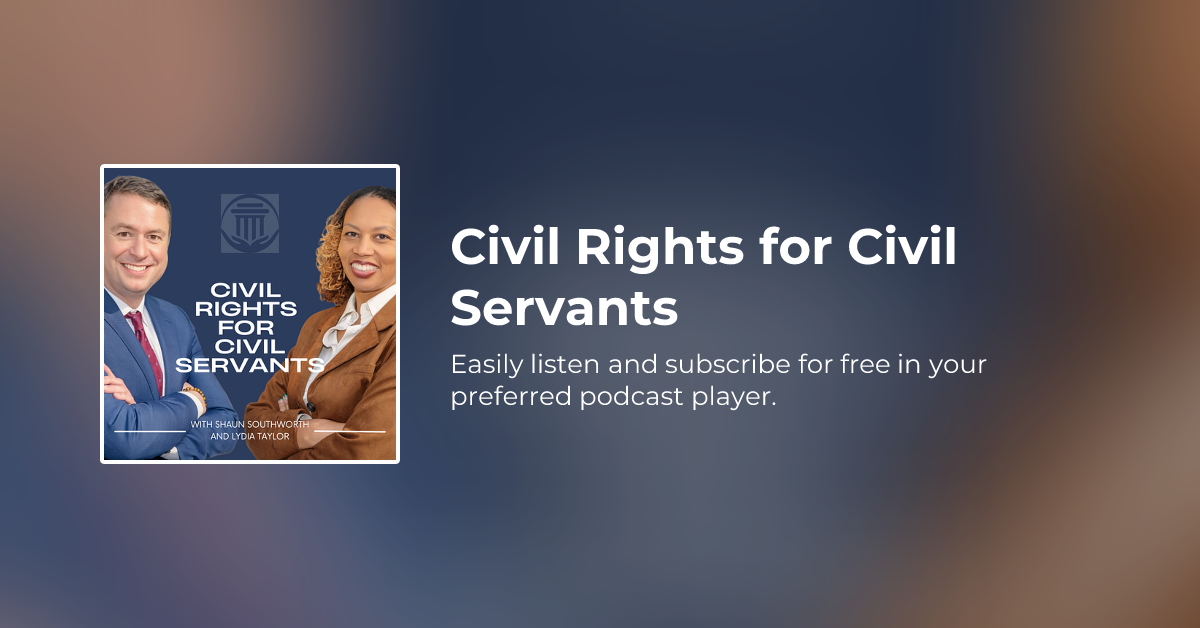
🎧 Listen: Civil Rights for Civil Servants
Shaun Southworth & Lydia Taylor on what's happening to the federal workforce. Latest episode: Apple · Spotify · Amazon Music · Youtube
 |
Today at a Glance
-
GSA Clearance Terminations: GSA has terminated the security clearances of several hundred employees after an audit of who actually needs access to classified information. Notices went out late last week; GSA says affected employees can still enter their buildings while "next steps" are worked out.
-
MSPB Backlog: The Merit Systems Protection Board's own data show 789 petitions for review pending at headquarters as of August 31, with the number "awaiting Board action" up from 6 last October to 249, while the Board operates with two of its three seats filled.
-
OPM Insurance Office Before Open Season: OPM named a new head of its healthcare and insurance division starting September 8, weeks after another round of departures from that office and just over nine weeks before Open Season opens on November 9.
Top Stories:
1. GSA Terminates Hundreds of Security Clearances After a Need-for-Access Audit — What a "Termination" Is, and Is Not
Source: Federal News Network, September 2, 2026
TL;DR: The General Services Administration has terminated the security clearances of several hundred employees following an audit of which employees actually need access to classified information, Federal News Network reported Wednesday. Notices went out late last week; an internal email from a senior Federal Acquisition Service leader said "hundreds" of employees received one, told them not to resubmit security paperwork, and said anyone without a termination letter keeps their clearance unchanged. GSA said employees can still enter their duty stations and that "next steps" are being worked out this week. A GSA spokesman said the agency is "strengthening internal controls by ensuring that all security clearances are strictly aligned with operational necessity," is conducting "a thorough audit to confirm every clearance holder has a demonstrated, current need for access," and issued guidance to affected employees on August 27. FNN reports that it is unclear how many GSA employees still hold clearances, and that comparable audits at other agencies have not been publicly disclosed.
For federal employees, this means:
- Read your notice for the exact word. A termination or administrative withdrawal of access because the agency decided you no longer need it is different from a revocation for failing the adjudicative standards. Keep the letter; the distinction matters for future investigations and reciprocity.
- Check your position description and sensitivity designation. If your position of record still says a clearance is required, ask HR and your security office, in writing, whether the position is being re-designated. A gap between "no clearance" and "position requires clearance" is the fact pattern behind removals for failure to maintain a clearance.
- If your notice cites your conduct, finances, foreign contacts, or any adjudicative guideline, treat it as a revocation and act quickly: agencies must provide a written explanation, the documents relied on, a chance to reply, and an appeal, and the deadlines in agency regulations are short.
Legal Insight
Executive Order 12968 governs eligibility for access to classified information. Section 2.1(b)(2) bars agencies from requesting or approving eligibility "in excess of actual requirements," and § 2.1(b)(4) directs that access "shall be terminated when an employee no longer has a need for access." Under § 5.1, a need-for-access determination "is a discretionary determination and shall be conclusive," so it carries none of the review procedures in § 5.2; those procedures (a written explanation, the documents relied on, a written reply, an appeal to a panel of at least three members, and representation by counsel) attach when an employee is found not to meet the § 3.1 standards, which is a revocation. Section 3.3(c) adds that where access was terminated for lack of need and a new need arises, eligibility "shall be reapproved without further investigation" for an employee adjudicated favorably within the prior five years who has stayed with the same employer, certifies in writing that nothing relevant has changed, and has no new adverse information. If an agency later removes an employee for failing to hold a clearance the position requires, the action proceeds under 5 U.S.C. § 7513, and the Merit Systems Protection Board may decide only whether cause existed, whether the clearance was in fact denied or revoked, and whether transfer to a nonsensitive position was feasible, while enforcing the § 7513 procedural protections; it may not review the merits of the clearance decision. Department of the Navy v. Egan, 484 U.S. 518, 530 (1988). Anyone whose notice reads as a revocation, or who is told the position still requires a clearance, should consult a federal employment attorney promptly.
2. MSPB's Own Numbers: 789 Petitions Pending, 249 Awaiting a Board Vote, and Only Two Board Members
Source: U.S. Merit Systems Protection Board (Monthly Petition for Review Data), September 1, 2026
TL;DR: The Merit Systems Protection Board posted updated petition-for-review data on September 1. As of August 31, 789 petitions for review (PFRs) were pending at Board headquarters. The chart separately tracks petitions "awaiting Board action": that figure was 6 at the end of October 2025, the month the Board regained a quorum, and has risen every month since, to 51 in April, 147 in June, 199 in July, and 249 in August. The Board decided 71 petitions in August and received 68; monthly decisions peaked at 132 in March and fell to 63 in July. Total pending has come down from a high of 991 at the end of December. The Board's updated quorum FAQ, dated August 28, confirms it has two members, Chairman James J. Woodruff II (sworn in as a member October 28, 2025, and confirmed as Chairman on August 7) and Vice Chairman Henry J. Kerner, with the third seat vacant; the FAQ states the quorum "is currently intact." From April 10 to October 27, 2025, the Board had one member and could not decide any petition. The chart does not explain why cases awaiting a vote are accumulating while total pending falls.
For federal employees, this means:
- If you have a petition for review pending, plan for a longer wait. The deadlines that run against you do not pause: a PFR is due 35 days after the initial decision issues (or 30 days after receipt, if received more than 5 days after issuance), and the Board's FAQ notes those deadlines were not tolled even when there was no quorum.
- If you won before the Administrative Judge and the agency petitioned for review, you are entitled to interim relief while the petition is pending: reinstatement, or, if the agency determines your return would be "unduly disruptive," pay and benefits. The agency's petition should address its compliance; if it does not, raise it.
- With two members, a 1-1 split means the initial decision may simply be deemed the Board's final decision, without precedential effect. If either member leaves, the Board again cannot decide any petition until a second member is confirmed.
Legal Insight
The Board is a three-member body, 5 U.S.C. § 1201, that acts by majority vote; when two members cannot agree, "the decision, recommendation, or other order under review may be deemed the final decision or order of the Board," and such decisions "shall not be precedential." 5 C.F.R. § 1200.3(a), (b), (e). Petitions for review must be filed within the window set by 5 C.F.R. § 1201.114(e); if no party petitions, the initial decision becomes the Board's final decision under § 1201.113. Interim relief for a prevailing appellant is statutory, 5 U.S.C. § 7701(b)(2)(A)–(B), and an agency's petition should address its compliance and include the certification described in 5 C.F.R. §§ 1201.114(b) and 1201.116(a). Once the Board issues a final decision, a petition for judicial review is due within 60 days after the Board issues notice, 5 U.S.C. § 7703(b)(1)(A). Because several short deadlines surround a pending petition, anyone with a case at the Board should consult a federal employment attorney about timing.
3. OPM Names a New Insurance Chief Nine Weeks Before Open Season, After Another Round of Departures From the Office That Runs It
Source: Government Executive, September 2, 2026
TL;DR: Matthew Kiley, a former Department of Health and Human Services official in the first Trump administration and founder of a management consulting firm, will become associate director of OPM's healthcare and insurance division on September 8, according to an internal memo obtained by Government Executive. He replaces Shane Stevens, who announced his departure in May. The change follows OPM's June decision to offer healthcare and insurance employees another chance at the deferred resignation program ahead of an "organizational change"; those who accepted went on paid administrative leave at the end of August and will separate in March 2027. GovExec cites a recent Government Accountability Office report finding that OPM's total headcount fell 35% between December 2024 and March 2026 and that the reductions "have reduced institutional knowledge and operational capacity at the agency." An OPM spokesperson told GovExec in July that the agency feels "very confident in our staffing levels and OPM's ability to deliver on a successful open season." For 2026, FEHB and PSHB enrollees paid on average 12.3% and 11.3% more toward premiums.
For federal employees, this means:
- Put the dates on your calendar now. Under OPM's regulation, this year's Open Season runs Monday, November 9, through Monday, December 14, unless OPM changes it, and changes take effect with the first pay period beginning in January.
- If you plan to add a spouse or child, gather proof of relationship (marriage certificate, birth or adoption certificate) before November. Every Open Season election that adds a family member is now verified, and the election is not processed until an ineligible family member is removed or the election is corrected.
- Expect slower answers from OPM, and start with your own agency's benefits office for enrollment problems. Keep copies and confirmations of everything you submit.
Legal Insight
The Open Season window is set by regulation: 5 C.F.R. § 890.301(f)(1) opens it on the Monday of the second full workweek in November and closes it on the Monday of the second full workweek in December, and § 890.301(f)(2) lets the OPM Director modify those dates. Family-member eligibility is governed by § 890.302, and OPM's final rule of June 2, 2026, 91 Fed. Reg. 32,875 (effective July 2, 2026), implements the verification requirement Congress added in § 90101 of Pub. L. No. 119-21; OPM's July 15 Benefits Administration Letter, as reported by FEDweek, requires verification of every Open Season election that adds a family member. If a family member is removed as ineligible, 5 C.F.R. § 890.308(e)–(f) gives the enrollee 60 calendar days from the initial decision to request reconsideration in writing, requires a written final decision within 30 days, and reinstates coverage retroactively if acceptable proof is later provided.
Mindful Moment of the Day
The Cubicle Boundary
Cubicles can make it hard to feel like you have any space of your own. You may hear side conversations, frustration about policy changes, office gossip, or someone venting about management while you are trying to focus. When the noise starts to get under your skin, pause and notice three neutral things in your own workspace: the edge of your monitor, your pen, the feel of your chair. Then return to one task in front of you. You are not being rude by protecting your attention. You are allowed to create a small pocket of steadiness, even when the office energy is loud.
In Case You Missed It
A few quick hits from our recent posts:
Shutdown Averted Until December 11: What the Continuing Resolution Means for Federal Employees
|

IRS Audit Collections Fell 35% the Year It Lost a Quarter of Its Audit Staff, Watchdog Finds
|

OPM Cut the Workload Question: What Changes When Your Agency Runs Its Own Employee Survey
|

Worried About Retaliation or Being Targeted for Speaking Up?
If you’ve reported misconduct, safety concerns, discrimination, or waste/fraud/abuse—and now you’re seeing sudden schedule changes, bad performance reviews, or threats of discipline—you may be in whistleblower or retaliation territory.
We represent federal employees who:
-
Reported concerns and then saw adverse actions
-
Were sidelined, reassigned, or given impossible workloads after speaking up
-
Face investigations, PIPs, or proposed removals that look like payback
-
Need help navigating OSC complaints, EEO claims, or MSPB appeals tied to retaliation
A free, confidential consultation can help you sort out what’s normal agency behavior and what may cross the line—and what to do before your options narrow.
👉 Schedule Your Free Consultation Today
|

Disclaimer:
This briefing is for general informational purposes only and does not constitute legal advice or create an attorney‑client relationship. Federal employment law is fact‑specific and time‑sensitive; you should consult a qualified attorney about your own situation and deadlines. Past results do not guarantee future outcomes.
Your service is worth protecting. Let's protect it together at Southworth PC.

Responses