Nearly 200,000 federal workers and supporters follow our updates across TikTok, Instagram, YouTube, Facebook, and LinkedIn. Each briefing gives you the three stories that actually matter to your job, plain‑English legal guidance, and one short practice to protect your peace of mind. If it helps you, forward it to a colleague—new readers can subscribe at https://fedlegalhelp.com/newsletter.
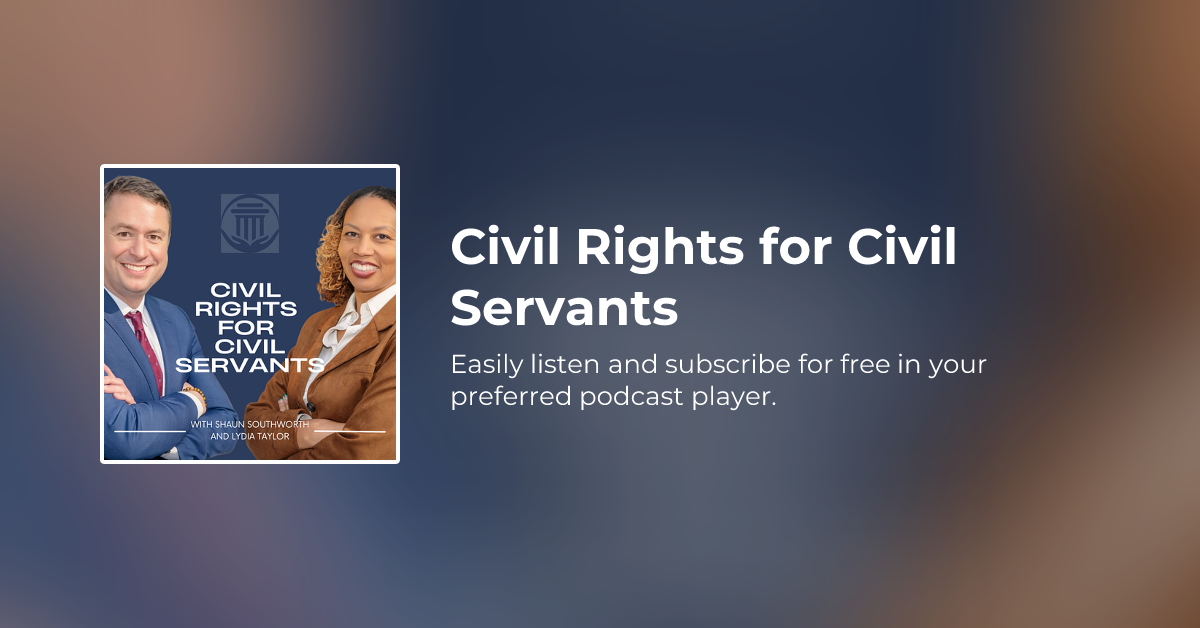
🎧 Listen: Civil Rights for Civil Servants
Shaun Southworth & Lydia Taylor on what's happening to the federal workforce. Latest episode: Apple · Spotify · Amazon Music · Youtube
 |
Today at a Glance
-
EEOC Class Complaints: NASA employees asked the EEOC on Thursday to reconsider its 2-1 August decision decertifying a class complaint filed in 2013 and deciding the merits without briefing. The EEOC cites the case to support its proposed rule ending federal-sector class complaints; comments close September 28.
-
Labor Department Accommodation Backlog: A bipartisan group of House members asked the Labor Department to account for a backlog of hundreds of reasonable accommodation requests, with answers due October 16. The department has also told more than 3,000 employees that accommodation-related personal data was emailed outside the agency.
-
Air Force Rehiring: The Department of the Air Force is asking Congress to fund more than 4,300 civilian positions it says were cut below established requirements. Former employees may qualify for noncompetitive reinstatement.
Top Stories:
1. NASA Employees Ask the EEOC to Reconsider the Decertification of Their 13-Year-Old Class Complaint — the Case the Commission Cites to Justify Ending Class Complaints; Comments Close September 28
Source: Government Executive, September 18, 2026
TL;DR: A group of NASA employees filed a motion Thursday asking the Equal Employment Opportunity Commission (EEOC) to reconsider its August decision stripping class status from a discrimination complaint first filed in 2013, Government Executive reports. The complaint alleges that NASA's performance appraisal system disadvantaged Black and Asian American employees compared with white colleagues; an EEOC administrative judge certified the class in 2022 over NASA's objection. In August the Commission voted 2-1 to decertify the class and, rather than return the case to the administrative judge, ruled for NASA on the merits of the class agents' individual complaints. The motion says the decision focused on one of the six flaws the class identified in the appraisal system and ignored four of them entirely, and that the Commission decided the merits without letting the parties file briefs, and it accuses the majority of "flagrant distortions" of the facts and law. The employees acknowledge they filed after the 30-day reconsideration window but say the EEOC never notified them of its ruling. Commissioner Kalpana Kotagal dissented from this decision and two others decertifying classes, saying they make it "harder for federal employees to pursue class claims." EEOC officials have since cited the NASA case in support of their August 28 proposed rule ending federal-sector class complaints and the right to request a hearing; comments on that rule close September 28.
For federal employees, this means:
- If you are a class agent or class member in a pending federal-sector class complaint, the Commission's appellate decision becomes final unless a party requests reconsideration within 30 days of receipt. Confirm how the EEOC delivers decisions to you (the Public Portal or first-class mail), keep proof of the date you received anything, and calendar the deadline that day.
- The Commission applied the disparate-impact framework, under which the agency must show a challenged practice is job related and consistent with business necessity, and the complainant can still prevail by identifying a less discriminatory alternative the agency refuses to adopt. The NASA decision found the agency's practices "undisputedly job-related and consistent with business necessity" and said class members "have not, and cannot, demonstrate a viable alternative," so if you have a disparate-impact claim, be ready to name the alternative and show it works.
- The proposed rule that would eliminate class complaints and the right to a hearing before an administrative judge, 91 Fed. Reg. 55690 (Aug. 28, 2026), takes comments through September 28, one week from today; the NASA case is part of the EEOC's stated rationale.
Legal Insight
Federal-sector class complaints are processed under 29 C.F.R. § 1614.204, which assigns the certification decision to an EEOC administrative judge. A Commission decision on appeal is final unless a party requests reconsideration within 30 days of receipt, and the Commission may grant reconsideration only where the decision "involved a clearly erroneous interpretation of material fact or law" or "will have a substantial impact on the policies, practices or operations of the agency," 29 C.F.R. § 1614.405(c); a complainant may also file a civil action in federal district court within 90 days of receiving the Commission's final decision, § 1614.407(c). The disparate-impact standard comes from Title VII, 42 U.S.C. § 2000e-2(k)(1)(A), which places the business-necessity burden on the employer and preserves the complainant's alternative-practice showing. Class members should consult a federal employment attorney about how a decertification decision affects their individual deadlines.
2. House Members Press the Labor Department on Its Reasonable Accommodation Backlog — and 3,000 Employees Learn Their Accommodation Data Was Emailed Outside the Agency
Source: Government Executive, September 18, 2026
TL;DR: A bipartisan group of House members has asked acting Labor Secretary Keith Sonderling to account for delays in processing reasonable accommodation (RA) requests from its employees with disabilities, Government Executive reported Friday. Reps. Brian Fitzpatrick, R-Pa., and Yassamin Ansari, D-Ariz., led the letter, which the outlet reports was signed by 40 other House members. Employees told the outlet last month that the department has a backlog of hundreds of RA requests, some pending for months or longer, and is looking at artificial intelligence tools to triage the workload. The lawmakers wrote that interim accommodations "are infrequently considered while requests remain pending," that staffing shortages have contributed to the backlog, and that delays "increase the Department's exposure to Equal Employment Opportunity complaints, grievances, and litigation." Requests surged after the return-to-office mandate; in February the EEOC and OPM told agencies not to take a "blanket approach" to rescinding or denying telework accommodations. The letter asks for current processing times, the number of pending requests, and the department's oversight mechanisms, with a response due October 16. Separately, the department has notified more than 3,000 employees that on July 22 an email containing a spreadsheet of personally identifiable information about employees' accommodation requests was sent to a personal email address outside the department, and that its investigation found more than one such email.
For federal employees, this means:
- Put every accommodation request in writing and keep a copy, even though the rules let you ask orally. Ask for your agency's written RA procedures and its maximum processing time, and if you need the accommodation now, ask in writing for an interim accommodation while the request is pending.
- Silence is not neutral. Unreasonable delay in providing an accommodation can itself violate the Rehabilitation Act, and if your request has been denied or has sat well past the agency's own deadline, you have 45 days from that event to contact an EEO counselor; do not wait for HR to catch up.
- If you received a Labor Department notice about the July 22 incident, keep it and ask in writing exactly what information about you was sent. Medical information you provided for an accommodation must be kept in separate, confidential files.
Legal Insight
Section 501 of the Rehabilitation Act, 29 U.S.C. § 791, requires federal agencies to provide reasonable accommodation to qualified employees with disabilities unless doing so would impose an undue hardship, applying the ADA's standards, 29 C.F.R. § 1614.203(b), and determining the accommodation through an interactive process, 29 C.F.R. § 1630.2(o)(3). The EEOC's regulation requires every agency to adopt and post written RA procedures that set maximum processing times, provide for expedited handling and interim accommodations, notify the employee of delays, and deliver denials in writing with the reasons, 29 C.F.R. § 1614.203(d)(3). Medical information gathered for an accommodation request must be kept on separate forms in separate files and treated as a confidential medical record, 29 C.F.R. § 1630.14(c)(1), and the Privacy Act, 5 U.S.C. § 552a(b), bars disclosure of records without consent unless a listed exception applies, with a civil remedy at § 552a(g). An employee whose request has been denied or left pending must contact an EEO counselor within 45 days, 29 C.F.R. § 1614.105(a)(1); a federal employment attorney can help pin down when that clock started.
3. The Air Force and Space Force Want to Add Back More Than 4,300 Civilian Jobs Cut Below "Established Requirements" — Here Is What Former Employees Should Know About Reinstatement
Source: Federal News Network, September 17, 2026
TL;DR: The Department of the Air Force is asking Congress to fund the equivalent of more than 4,300 full-time civilian positions across 30 specialties in the Air Force, Space Force, and Air National Guard, at a cost of $291 million, after acknowledging in its fiscal 2027 budget documents that fiscal 2026 staffing levels were set below "established requirements," according to a Federal News Network analysis of the request. The largest share, more than 1,600 positions at $92 million, is base support: fire, law enforcement and emergency services, and maintenance and logistics. A department spokesperson told Air & Space Forces Magazine, which first reported the increases, that the positions are not a "one-for-one restoration" of jobs that existed before last year's cuts. In all, the services are requesting nearly 3,200 more civilian billets, for 173,114 authorized positions if enacted; about 151,000 civilians worked for the two services as of July, and more than 34,000, nearly 20 percent, have left since January 20, 2025, according to OPM data cited by Federal News Network. Air Force Secretary Troy Meink told reporters last week that "there's going to be a constant adjustment" in civilian staffing.
For federal employees, this means:
- These are requested positions, not funded ones; they depend on Congress acting on fiscal 2027 appropriations, and the department says the list is not a one-for-one restoration. Watch for vacancy announcements rather than assuming a former job is coming back.
- If you left a Department of the Air Force civilian job under the deferred resignation program or by resigning, you may not have to compete with the public. A former employee who completed the service requirement for career tenure, or who is a preference eligible, can be reinstated noncompetitively at any time; a former career-conditional employee without career tenure has three years from the separation date, so a deferred resignation that took effect September 30, 2025, leaves a window through September 30, 2028. Keep your SF-50s; they prove eligibility and tenure.
- If you were separated by a RIF (Reduction in Force) rather than by resignation, check whether you registered for the agency's Reemployment Priority List, which gives two years of placement priority for competitive-service vacancies in your former commuting area.
Legal Insight
Reinstatement is governed by 5 C.F.R. § 315.401, which lets an agency appoint a former career or career-conditional employee to a competitive-service position without competition, with no time limit for a preference eligible or for anyone who completed the service requirement for career tenure, and a three-year limit from the separation date for other former employees, § 315.401(b). Reinstatement creates eligibility, not a right to a job; the agency decides whether to use it. OPM's interim rule on shared certificates and pooled hiring, 91 Fed. Reg. 58347 (Sept. 15, 2026), takes effect October 15 and will let agencies select from certificates that other agencies or OPM issued, so watch governmentwide announcements as well.
Legal Tip of the Day
While Your Accommodation Request Is Pending
A reasonable accommodation request that sits for weeks or months can start to feel like a decision. It is not, and that is where people go wrong: they wait quietly for HR, and the waiting itself becomes the harm. Put your request in writing if you have not already, and note the date you submitted it. Ask in writing for your agency's accommodation procedures and the maximum time it gives itself to respond. If you need help now, ask in writing for an interim accommodation while the request is pending. Keep a private timeline, outside government systems, of every date, name, and reply.
In Case You Missed It
A few quick hits from our recent posts:
OPM Health Claims Data Warehouse: Federal Employee Privacy
|

Need Help with Discipline or Performance?
If you’ve just been put on a PIP, received a proposed suspension or removal, or are worried your “coaching” has turned into a paper trail, it’s time to get real advice—not just hallway rumors.
At Southworth PC, we represent federal employees nationwide in:
-
Proposed discipline and removals
-
Performance issues and PIPs
-
EEO discrimination, harassment, and retaliation
-
Whistleblower and civil rights matters
-
MSPB, EEOC, and OSC cases
-
OPM/FERS disability retirement applications (flat‑fee full‑service assistance)
In a free, confidential consultation, you speak directly with an attorney about your timeline, key documents, and options. Deadlines can be quick in the federal sector, so if you have a deadline, don’t wait.
👉 Schedule Your Free Consultation Today
|

Disclaimer:
This briefing is for general informational purposes only and does not constitute legal advice or create an attorney‑client relationship. Federal employment law is fact‑specific and time‑sensitive; you should consult a qualified attorney about your own situation and deadlines. Past results do not guarantee future outcomes.
Your service is worth protecting. Let's protect it together at Southworth PC.

Responses