Nearly 200,000 federal workers and supporters follow our updates across TikTok, Instagram, YouTube, Facebook, and LinkedIn. Each briefing gives you the three stories that actually matter to your job, plain‑English legal guidance, and one short practice to protect your peace of mind. If it helps you, forward it to a colleague—new readers can subscribe at https://fedlegalhelp.com/newsletter.
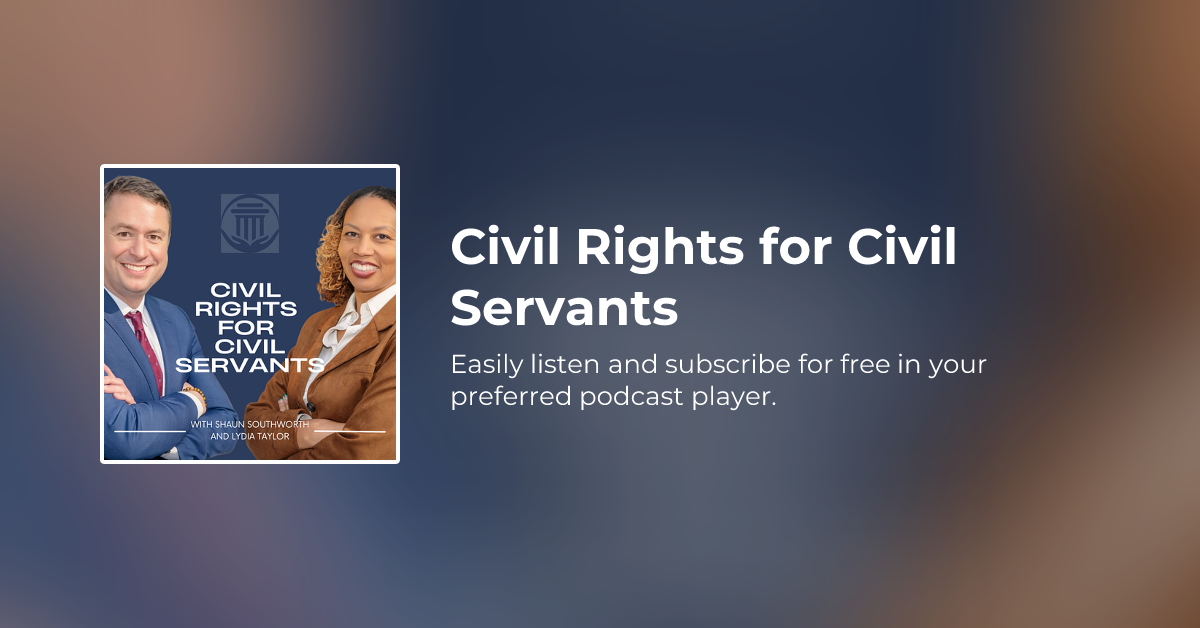
🎧 Listen: Civil Rights for Civil Servants
Shaun Southworth & Lydia Taylor on what's happening to the federal workforce. Latest episode: Apple · Spotify · Amazon Music · Youtube
 |
Today at a Glance
-
Shutdown RIFs Settled: The administration signed a settlement Friday in the unions' shutdown-layoff case, confirming every RIF notice from last fall's 43-day lapse was rescinded, every separated employee was reinstated, and agencies have 30 days to strip RIF authority out of their shutdown plans through the end of 2026.
-
Loyalty Question Replaced: After a federal judge stayed the "favorite executive order" essay, OPM told agencies to stop scoring prior answers, use a new Question 3 for announcements closing on or after September 26, and draft an agency-priorities Question 5 by September 30.
-
Hatch Act and the Shutdown Banners: OSC closed more than 1,000 complaints about partisan shutdown messaging without seeking discipline, but its new advisory spells out when naming a political party in an official communication crosses the line.
Top Stories:
1. Shutdown Layoffs Are Off the Table Through 2026 — the Settlement Confirms Every Notice Was Rescinded and Every Separated Employee Reinstated
Source: Government Executive, September 25, 2026
TL;DR: The unions that sued over reductions in force (RIFs) carried out during the October–November 2025 shutdown signed a settlement with OMB, OPM, and roughly 40 agencies, dated September 23 and announced Friday. The government represents that the OMB "Lapse Memorandum" and OPM's companion guidance "have been rescinded in full and are no longer operative," that every RIF notice issued between October 1 and November 12, 2025 was rescinded, and that every employee separated under those notices was reinstated. About 4,200 notices went out during the lapse, according to Government Executive. Within 30 days OPM and OMB must send a memorandum to every agency head and CHCO confirming the rescission, and agencies must remove any language from their shutdown contingency plans that authorizes starting a RIF or treating RIF administration as an "excepted" activity during a lapse. Any future change to add that language back takes effect only 30 days after the agency notifies the unions and publishes it. The case, AFGE v. OMB, No. 3:25-cv-08302-SI (N.D. Cal.), goes into abeyance and will be dismissed with prejudice on December 31, 2026 or when FY2027 appropriations are enacted, whichever comes first, unless an agency gives notice that it intends to restore that authority. The current continuing resolution runs through December 11.
For federal employees, this means:
- If you received a RIF notice during the shutdown, the government has represented in a signed settlement that it was rescinded and, if you were separated, that you were reinstated. If either did not happen, raise it with your union or HR now, in writing.
- Employees at State, GSA, and SBA who were separated during the lapse are covered by the settlement's recital that they received "all pay to which they otherwise would have been entitled ... including backpay" for the period between separation and reinstatement. Check your earnings and leave statements against that promise.
- The protection is time-limited. The plan-rewrite obligation covers contingency plans in effect through December 31, 2026, and the next funding deadline is December 11. Watch for any agency notice of a change to its shutdown plan — that notice must be public and lets the unions reopen the case.
Legal Insight
A RIF is governed by 5 U.S.C. § 3502 and 5 C.F.R. Part 351, which require a specific written notice at least 60 full days before the release date under 5 C.F.R. § 351.801(a)(1) and simultaneous written notice to the employee's exclusive representative under § 351.801(a)(2). During a lapse in appropriations, the Antideficiency Act permits agencies to employ personal services only for "emergencies involving the safety of human life or the protection of property," which excludes "ongoing, regular functions of government," 31 U.S.C. § 1342 — the ground the unions argued made shutdown RIF processing unlawful. The settlement admits nothing, but it removes that authority through the end of this year. If your reinstatement, back pay, or leave restoration is incomplete, consult your union representative or a federal employment attorney; a RIF separation is appealable to the MSPB, and the settlement does not cut off individual rights.
2. OPM Replaces the "Favorite Executive Order" Question — Agencies May No Longer Score Prior Answers, and a New Question 3 Applies to Announcements Closing September 26 or Later
Source: Government Executive, September 25, 2026
TL;DR: On September 11, U.S. District Judge George O'Toole (D. Mass.) stayed the Merit Hiring Plan's third essay question — which asked applicants to name a favorite Trump administration executive order and how they would advance it — after finding it likely violated the First Amendment because it "directly links" an applicant's personal views to potential duties. In a September 18 email to agencies, reported Friday, OPM instructed that "agencies cannot consider candidate responses to the prior Question 3 in their evaluation of candidates for any open vacancy," but that agencies "do not need to reopen previous hiring actions or repost current job announcements that close on or before September 25, 2026." For announcements closing September 26 or later, and for all new announcements, the old prompt is replaced with a revised Question 3: "In this role, you will be expected to professionally and efficiently implement executive direction. Provide an example where you implemented leadership direction on a strategy or policy decision that differed from your own recommendation." OPM also directed each agency to draft a new Question 5 asking how an applicant's skills would advance one to three "current agency-wide priorities," with wording due by September 30. Neither the stay nor OPM's guidance requires agencies to revisit selections already made.
For federal employees, this means:
- If you applied while the "favorite EO" question was in use and the announcement closed on or before September 25, OPM's guidance does not require the agency to reopen that action. Nothing in the guidance addresses ratings completed before the stay.
- If you have an application pending on an announcement closing September 26 or later, the agency must swap in the revised Question 3. It asks for an example of implementing a decision you disagreed with — a judgment question, not a political one.
- The essay questions remain part of the Merit Hiring Plan, and OPM describes them as optional. Whether a subjectively graded essay is a valid, job-related assessment is a question the litigation has not yet reached.
Legal Insight
The merit system principles require that selection be "determined solely on the basis of relative ability, knowledge, and skills, after fair and open competition," 5 U.S.C. § 2301(b)(1), and that applicants receive "fair and equitable treatment ... without regard to political affiliation," § 2301(b)(2). It is a prohibited personnel practice to discriminate for or against an applicant "on the basis of marital status or political affiliation," 5 U.S.C. § 2302(b)(1)(E), and 5 C.F.R. § 300.103 requires that any selection procedure be based on a job analysis and be professionally developed. The stay in American Federation of Government Employees v. Kupor, No. 1:25-cv-13305 (D. Mass.), addresses only the third question going forward; an applicant who believes political affiliation affected a completed selection may file a complaint with the Office of Special Counsel under 5 U.S.C. § 1214.
3. OSC Closes the Shutdown-Messaging Hatch Act Cases Without Discipline — but Its New Advisory Draws the Line on Naming a Political Party in Official Communications
Source: Government Executive, September 25, 2026
TL;DR: The Office of Special Counsel (OSC) on Friday released a Hatch Act "assessment and advisory" closing more than 1,000 complaints that employees at 37 agencies and the White House violated the Hatch Act with official shutdown messaging — website banners, mass emails, rewritten out-of-office auto-replies, and a video played at TSA checkpoints — that blamed "Democrats" for the fall 2025 lapse. OSC found that agencies relied on a September 5, 2024 OSC advisory opinion stating that references to a political party when discussing pending legislation or government policy, "without more, typically do not constitute political activity." OSC says agencies read that language more broadly than intended, but the reading was "understandable, especially because agencies could not consult OSC for clarification during the shutdown because OSC's Hatch Act Unit staff was furloughed." Because employees who follow OSC advice "effectively enjoy safe harbor," OSC exercised its discretion under 5 U.S.C. § 1215 not to seek discipline and made no final determination on any individual communication. Going forward, OSC will weigh a clear, contemporaneous non-electoral purpose; timing relative to an election; tone, including "inflammatory or insulting language"; and the scale and audience of dissemination. References that are "gratuitous, made close to an election, and framed as an attack on a party are likely to be political activity," and any reference including express election terms — voting, campaigns, candidates, elections, or primaries — "is likely to violate the Hatch Act."
For federal employees, this means:
- The safe harbor OSC applied belonged to agencies that relied on a specific 2024 advisory before this guidance existed. It will not be available for messaging issued after September 25, 2026. If you are asked to post, send, or record an official communication that names a political party, the four factors in the new advisory are now the test.
- Tone and audience matter. OSC cited the OMB pre-shutdown employee notice as a measured, internal message that was permissible, and public website banners using inflammatory language as the kind that "might weigh in favor of concluding that they violated the Hatch Act."
- If your out-of-office reply, signature block, or agency account is changed to carry partisan content without your consent, document it. OSC's report records that the Education Department altered employees' auto-replies "without those employees' knowledge or consent," and you may ask OSC's Hatch Act Unit for an advisory opinion under 5 U.S.C. § 1212(f) before you act.
Legal Insight
The Hatch Act bars an employee from using "official authority or influence for the purpose of interfering with or affecting the result of an election," 5 U.S.C. § 7323(a)(1), and from engaging in political activity while on duty, in a federal building, in uniform, or in a government vehicle, 5 U.S.C. § 7324(a)(1)–(4). "Political activity" means activity "directed toward the success or failure of a political party, candidate for partisan political office, or partisan political group," 5 C.F.R. § 734.101, and a communication need not contain express electoral advocacy to qualify. The penalties fall on the employee, not the agency: removal, reduction in grade, debarment from federal employment for up to five years, suspension, or reprimand, and a civil penalty of up to $1,000, 5 U.S.C. § 7326. With a midterm election five weeks away, an employee directed to issue partisan content should get the instruction in writing and consult OSC's Hatch Act Unit or a federal employment attorney before complying.
Legal Tip of the Day
When an Instruction Feels Wrong, Get It in Writing
When a supervisor asks you to post, send, or sign something that makes you uneasy — an official message with a political edge, a form you do not understand, a change to your own email signature or auto-reply — the common mistake is assuming the instruction itself protects you. It may not. Before you act, confirm the request in a short, polite email: "To make sure I understand, you are asking me to…" Ask who approved the content and whether your ethics or legal office reviewed it. Note the date, the request, and who made it in a private timeline kept outside government systems. If you still have doubts, pause and get advice before you act, not after. Do not assume that because a request came from above, the consequences will stay there.
In Case You Missed It
A few quick hits from our recent posts:
Forced Federal Relocations Were Sold as Savings. The Receipts Show Millions in Costs.
|

VA Told Congress It Cut $120 Billion in Contracts. The Inspector General Found $1.1 Billion.
|

Need Help with Discipline or Performance?
If you’ve just been put on a PIP, received a proposed suspension or removal, or are worried your “coaching” has turned into a paper trail, it’s time to get real advice—not just hallway rumors.
At Southworth PC, we represent federal employees nationwide in:
-
Proposed discipline and removals
-
Performance issues and PIPs
-
EEO discrimination, harassment, and retaliation
-
Whistleblower and civil rights matters
-
MSPB, EEOC, and OSC cases
-
OPM/FERS disability retirement applications (flat‑fee full‑service assistance)
In a free, confidential consultation, you speak directly with an attorney about your timeline, key documents, and options. Deadlines can be quick in the federal sector, so if you have a deadline, don’t wait.
👉 Schedule Your Free Consultation Today
|

Disclaimer:
This briefing is for general informational purposes only and does not constitute legal advice or create an attorney‑client relationship. Federal employment law is fact‑specific and time‑sensitive; you should consult a qualified attorney about your own situation and deadlines. Past results do not guarantee future outcomes.
Your service is worth protecting. Let's protect it together at Southworth PC.

Responses