Attorneys for Federal Employees — Nationwide
Nearly 200,000 federal workers and supporters follow our updates across TikTok, Instagram, YouTube, Facebook, and LinkedIn Each briefing gives you the three stories that actually matter to your job, plain‑English legal guidance, and one short practice to protect your peace of mind. If it helps you, forward it to a colleague—new readers can subscribe at https://fedlegalhelp.com/newsletter.
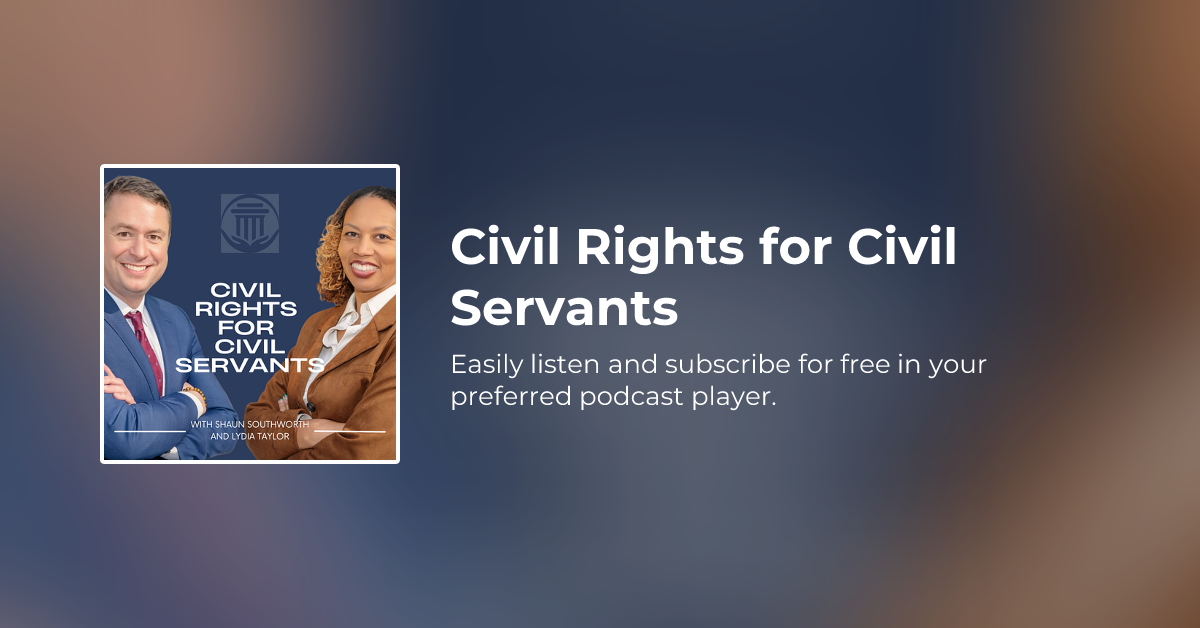
🎧 Listen: Civil Rights for Civil Servants
Shaun Southworth & Lydia Taylor on what's happening to the federal workforce. Latest episode: Apple · Spotify · Amazon Music · Youtube
 |
Today at a Glance
-
Ratings Cap Is Now A Number: OPM told agencies on September 21 that no more than 40 percent of career GS employees may be rated at the top two levels for the appraisal cycle ending September 30, and it set minimum award percentages for each rating level.
-
Advanced Leave At IRS And SSA: Four senators are pressing the IRS and Social Security Administration over their July suspension of advanced annual and sick leave, which they estimate affects more than 120,000 employees. The law makes advanced leave discretionary, but other leave protections are not.
-
FLRA Steps Back From Excluded Agencies: The FLRA dismissed a Marine Corps arbitration appeal on September 22 because Executive Order 14251 removed the Defense Department from the labor statute, and the union in that case cannot take the dismissal to court.
Top Stories:
1. OPM Sets the Cap: Only 40 Percent of GS Employees Can Be Rated Outstanding or Exceeds This Cycle — Here Is What the Memo Requires, Who Is Exempt, and What It Means for Your Award
Source: U.S. Office of Personnel Management (CHCOC memorandum), September 21, 2026
TL;DR: OPM Director Scott Kupor issued a memorandum on September 21 that puts a number on the "standardized distribution" of ratings OPM finalized in its July performance rule. For the fiscal 2026 cycle ending September 30, no more than 40 percent of an agency's career and career-conditional GS employees may receive the top two rating levels combined (Outstanding and Exceeds Fully Successful). The same 40 percent ceiling applies to career SES and Senior Professional employees. There is no cap on any other rating level, and OPM says 40 percent is "a ceiling, not a target." Agencies must round down when calculating the maximum number of top ratings, and if more than 25 employees in a population are not rated by September 30, the agency must convene a separate calibration panel for that group. The memo also sets award parameters: for career GS employees, a Level 5 rating should carry a performance award of at least 7 percent of basic pay, Level 4 at least 4 percent, and Level 3 no more than 3 percent, with at least 60 percent of each agency's bonus pool set aside for Level 4 and Level 5 performers. Agencies may seek a waiver of up to 10 percentage points by October 30, but only by showing they exceeded a majority of their published performance targets, and no agency may exceed 50 percent.
For federal employees, this means:
- If your supervisor rated you at the top two levels, that rating can be lowered by an agency calibration panel before it becomes your rating of record. Ask your supervisor, in writing, what your initial rating was and whether calibration changed it.
- The memo lists who is exempt: Wage Grade employees, Offices of Inspector General, Schedule C and G appointees, noncareer and limited-term SES, agencies with 10 or fewer GS employees, and employees whose ratings are raised through a legal proceeding. If you are a bargaining unit employee and your CBA — Collective Bargaining Agreement — prohibits forced distributions, the memo says the CBA provision controls until the agreement's term ends.
- Ratings now do more than set awards. Under OPM's reduction-in-force rules, your rating of record adds retention credit in a RIF, so a rating lowered by calibration can follow you into a future layoff ranking. Keep copies of your performance plan, your self-assessment, and every rating you receive.
Legal Insight
OPM's authority for the cap comes from its July 7, 2026 final rule, 91 Fed. Reg. 41521, codified at 5 C.F.R. § 430.208(c), which lets OPM "establish and maintain" a standardized distribution of rating levels that covered agencies must apply; the SES counterpart is 5 C.F.R. § 430.305(d). The appraisal statute still requires that ratings rest on established performance standards communicated to the employee, 5 U.S.C. § 4302(c), and a rating that drops below Fully Successful still triggers the assistance and improvement requirements of § 4302(c)(5) before any performance-based action. Employees rated below Fully Successful should read the memo's instruction that they receive "an appropriate performance improvement plan" as the start of a Chapter 43 clock, and anyone who receives a lowered rating, a PIP — Performance Improvement Plan — or a denial of a within-grade increase this fall should consult a federal employment attorney promptly, because the response windows are short.
2. Four Senators Challenge the IRS and SSA Ban on Advanced Leave — Here Is What the Leave Law Actually Says, and What Is Still Guaranteed When Your Balance Hits Zero
Source: Government Executive, September 23, 2026
TL;DR: Senators Elizabeth Warren, Chris Van Hollen, Kirsten Gillibrand, and Ron Wyden sent a letter this week to Frank Bisignano, who serves as both the Senate-confirmed Commissioner of Social Security and the IRS chief executive officer, objecting to the two agencies' July decision to stop granting advanced annual and sick leave "until further notice." The senators estimate the suspension affects more than 120,000 IRS and SSA employees and asked for ten years of data on how much advanced leave employees have actually taken and what it cost. Both agencies told employees the pause will remain in place while they work down "significant" balances of advanced leave already taken, and that in several cases employees are unlikely to earn back what they used. Government Executive reports the IRS has lost more than a quarter of its workforce since January 2025 and that about 7,000 SSA employees took separation incentives last year. NTEU — the National Treasury Employees Union — has a pending lawsuit asking a federal judge to void the IRS directive on the ground that Bisignano's leadership of the IRS without Senate confirmation violates the Appointments Clause.
For federal employees, this means:
- Advanced leave has always been discretionary. An agency "may" advance up to 240 hours of sick leave under 5 C.F.R. § 630.402 and "may" grant annual leave before it accrues under 5 U.S.C. § 6302(d). A blanket suspension is a policy choice the agency is generally free to make, unless your CBA says otherwise.
- What is not discretionary: 12 weeks of unpaid, job-protected leave for a serious health condition under the Family and Medical Leave Act, 5 U.S.C. § 6382; the voluntary leave transfer program, 5 U.S.C. § 6332, which lets coworkers donate annual leave to you in a medical emergency; and the right to request leave without pay. Ask for those by name, in writing.
- If you exhaust leave and cannot report, the risk is an AWOL — absence without leave — charge. Request FMLA or LWOP before the absence, keep the medical documentation your agency asks for, and get every denial in writing.
Legal Insight
Congress wrote advanced leave as an option, not an entitlement: 5 U.S.C. § 6307(d) says a maximum of 30 days of sick leave "may be advanced" when "required by the exigencies of the situation," and 5 U.S.C. § 6302(d) lets annual leave "be granted at any time during the year as the head of the agency concerned may prescribe." That is why the senators' letter argues policy, not illegality. The protections that do bind the agency are the FMLA entitlement in 5 U.S.C. § 6382(a)(1)(D), the leave transfer program in 5 U.S.C. §§ 6331–6340, and, for bargaining unit employees, any advanced-leave provision in a CBA that remains in effect. An employee who is denied leave and then charged AWOL or disciplined for attendance should consult a federal employment attorney before responding, because a denied-leave record is often the foundation of the defense.
3. The FLRA Dismisses a Marine Corps Case Because the Exclusion Order Took Away Its Jurisdiction — and the Union Cannot Appeal That to Any Court
Source: Government Executive, September 23, 2026
TL;DR: On September 22, the Federal Labor Relations Authority — the FLRA, the body that decides federal-sector labor disputes — dismissed the Marine Corps' appeal of an arbitration award in a 2-1 decision, U.S. Marine Corps, Twentynine Palms, 74 FLRA No. 80. An arbitrator had sustained an AFGE Local 2018 grievance over a letter of reprimand, and the agency filed exceptions in April 2022. The FLRA had held the case in abeyance after Executive Order 14251 of March 27, 2025 excluded the Defense Department from the Federal Service Labor-Management Relations Statute. The majority took the case out of abeyance and dismissed it for lack of jurisdiction, noting that the Ninth Circuit vacated the injunction against the order and that the Authority has historically dismissed cases involving excluded entities without reviewing the President's national-security determination. Member Anne Wagner dissented, writing that cases covered by the exclusion orders should stay in abeyance until the litigation "reaches a definitive conclusion — including any actions by the U.S. Supreme Court." NTEU filed the decision with the D.C. Circuit the next day in its own challenge to the order, NTEU v. Trump, No. 25-5157, arguing it proves unions cannot get judicial review by going through the FLRA first.
For federal employees, this means:
- If your agency is covered by Executive Order 14251 or 14343, the FLRA will now dismiss, rather than hold, cases involving your agency. Arbitration awards may stand, but neither side can get the Authority to review or enforce them.
- A letter of reprimand is not appealable to the MSPB — the Merit Systems Protection Board. For minor discipline at an excluded agency, the negotiated grievance procedure was often the only outside review. Ask your union or representative whether your agency is still processing grievances under the old contract.
- Your statutory rights outside the labor statute are not affected by the exclusion orders: MSPB appeals of removals, suspensions over 14 days, and demotions under 5 U.S.C. § 7513; EEO complaints under 29 C.F.R. Part 1614; and whistleblower complaints to the Office of Special Counsel all remain available.
Legal Insight
The exclusion power is statutory: 5 U.S.C. § 7103(b)(1) lets the President exclude an agency or subdivision from the labor statute if he determines it has intelligence, counterintelligence, investigative, or national-security work as a primary function and the statute cannot be applied consistent with national-security requirements. The FLRA did not review whether those findings were correct; it treated the order as removing its jurisdiction. The reason the union cannot appeal is 5 U.S.C. § 7123(a)(1), which bars court review of Authority orders in arbitration cases unless the order involves an unfair labor practice — and a dismissal for lack of jurisdiction does not. Whether unions must go through the FLRA anyway before suing is the question the D.C. Circuit has had under advisement since oral argument on December 15, 2025.
Mindful Moment of the Day
Waiting on the Number
This week's news about a cap on top ratings may land hard if you have spent the year doing strong work and are now waiting to see what comes back after calibration. Notice where the waiting shows up in your body: a tight jaw, shallow breathing, one more check of your inbox. Set both feet on the floor, take three slow breaths, and say silently, "My work this year is real, whatever the number says." Then take one small step: in a private notebook, write down three things you accomplished this year and where the proof of each one lives. Mindfulness here does not mean pretending the rating does not matter; it means letting the number be information, not a verdict on your worth.
In Case You Missed It
A few quick hits from our recent posts:
Is Your 2027 Federal Pay Raise Really Zero? Why the Pay Freeze Isn't Final
|

A Draft Executive Order Could Give OMB a Veto Over NIH Grants. Congress Already Paused This Idea.
|

Hackers Claim a File on FBI Employees and Applicants: What FBI Staff Should Do Now
|

Worried About Retaliation or Being Targeted for Speaking Up?
If you’ve reported misconduct, safety concerns, discrimination, or waste/fraud/abuse—and now you’re seeing sudden schedule changes, bad performance reviews, or threats of discipline—you may be in whistleblower or retaliation territory.
We represent federal employees who:
-
Reported concerns and then saw adverse actions
-
Were sidelined, reassigned, or given impossible workloads after speaking up
-
Face investigations, PIPs, or proposed removals that look like payback
-
Need help navigating OSC complaints, EEO claims, or MSPB appeals tied to retaliation
A free, confidential consultation can help you sort out what’s normal agency behavior and what may cross the line—and what to do before your options narrow.
👉 Schedule Your Free Consultation Today
|

Disclaimer:
This briefing is for general informational purposes only and does not constitute legal advice or create an attorney‑client relationship. Federal employment law is fact‑specific and time‑sensitive; you should consult a qualified attorney about your own situation and deadlines. Past results do not guarantee future outcomes.
Your service is worth protecting. Let's protect it together at Southworth PC.

Responses