Attorneys for Federal Employees — Nationwide
Nearly 200,000 federal workers and supporters follow our updates across TikTok, Instagram, YouTube, Facebook, and LinkedIn Each briefing gives you the three stories that actually matter to your job, plain‑English legal guidance, and one short practice to protect your peace of mind. If it helps you, forward it to a colleague—new readers can subscribe at https://fedlegalhelp.com/newsletter.
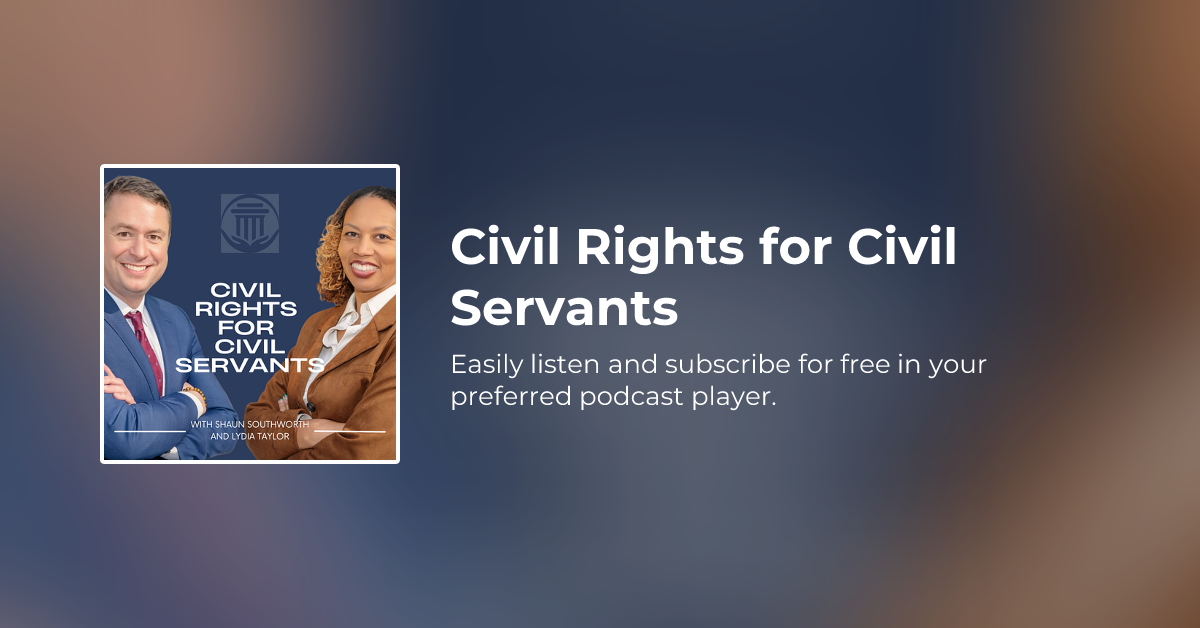
🎧 Listen: Civil Rights for Civil Servants
Shaun Southworth & Lydia Taylor on what's happening to the federal workforce. Latest episode: Apple · Spotify · Amazon Music · Youtube
 |
Today at a Glance
-
FEHB Premiums Up 10.9 Percent: OPM published the 2027 rates Wednesday: the average enrollee share rises 10.9 percent, nine plan options are closing, new family members will need proof of eligibility, and Open Season runs November 9 through December 14.
-
BOP Union Contract Restored: A federal judge in Connecticut ordered the Bureau of Prisons to immediately reinstate the contract it terminated a year ago, finding that the agency gave one reason in its termination letter and a different one on its website.
-
Whistleblower Win at the Federal Circuit: In a precedential decision, the court reversed the Merit Systems Protection Board's dismissal of a VA data scientist's appeal, holding that he plausibly alleged gross mismanagement in reporting that an artificial-intelligence tool was slowing veterans' claims.
Top Stories:
1. Your Share of FEHB Premiums Rises 10.9 Percent in 2027 — Nine Plan Options Are Closing, New Family Members Need Proof of Eligibility, and Open Season Runs November 9 Through December 14
Source: Federal News Network, September 30, 2026
TL;DR: The Office of Personnel Management (OPM) published 2027 plan options and premium rates on Wednesday. Enrollees in the Federal Employees Health Benefits (FEHB) Program will pay an average of 10.9 percent more toward their premiums starting in January, down from 12.3 percent this year but the third straight year of double-digit increases. The overall average premium rises 9.3 percent. Postal Service Health Benefits (PSHB) enrollees will pay an average of 8.2 percent more, while dental and vision premiums rise 1.0 and 1.6 percent. OPM attributes the increases to higher prices and utilization for hospital, physician, and surgical services, growth in behavioral health care, and higher drug spending, particularly on GLP-1s and specialty drugs. FEHB will offer 118 plan options from 45 carriers and PSHB 65 from 17; nine FEHB options are terminating, and enrollees who do not choose a new plan will be moved into Compass Rose Standard. Open Season runs November 9 through December 14, 2026, and FEHB changes for most employees take effect January 10, 2027.
For federal employees, this means:
- Check whether your plan is one of the nine FEHB options ending in 2027: Independent Health Standard and HDHP, Blue Care Network of Michigan Southeast High, two UnitedHealthcare Choice Primary West options, and four Health Net of California options. If you are in one and do nothing, OPM will place you in Compass Rose Standard.
- Starting this Open Season, anyone adding a new family member to FEHB or PSHB must submit documentation proving that person is eligible. Gather proof such as marriage or birth certificates now rather than in December; parents, former spouses, and domestic partners are not eligible family members.
- FEHB and PSHB coverage continues automatically if you make no change, but a Flexible Spending Account (FSAFEDS) does not; you must re-enroll every year. Compare deductibles and out-of-pocket maximums, not premiums alone, and note that carriers will now require intensive behavioral therapy before and during treatment with anti-obesity medications.
Legal Insight
The government's share of your premium is set by statute. Under 5 U.S.C. § 8906(b)(1)–(2), the biweekly government contribution equals 72 percent of the program-wide weighted average premium, but it may not exceed 75 percent of any particular plan's premium. Because that formula caps what the government pays, increases above the cap fall on the enrollee: for 2027 the government's contribution rises 8.6 percent while the enrollee share rises 10.9 percent. Open Season is set by regulation at 5 C.F.R. § 890.301(f), an Open Season change of enrollment takes effect the first pay period beginning in January, and the new documentation requirement implements the FEHB Protection Act of 2025, Pub. L. No. 119-21, § 90101.
2. A Federal Judge Orders the Bureau of Prisons to Reinstate Its Union Contract Immediately — the Agency Gave One Reason in Its Termination Letter and Another on Its Website, and the Court Found That Likely Violated the APA
Source: Federal News Network, September 30, 2026
TL;DR: On Tuesday, Judge Vernon D. Oliver of the U.S. District Court for the District of Connecticut granted a preliminary injunction in National Council of Prison Locals, AFGE v. Federal Bureau of Prisons, No. 3:25-cv-01907 (D. Conn.), ordering the Bureau of Prisons (BOP) to "immediately reinstate" the collective bargaining agreement (CBA) it terminated on September 25, 2025, for the remainder of a term that runs through May 28, 2029. The union represents approximately 30,000 BOP employees. The court did not rule on the validity of Executive Order 14251, the March 2025 order excluding the Justice Department and other agencies from the federal labor-relations statute; it held that BOP's own decision was reviewable because the order, the statute, and OPM's guidance left agencies discretion over whether and when to terminate a contract. On the merits, the court found that BOP "published two incongruent explanations" on the same day: a termination letter that cited the executive order, and a public message from Director William K. Marshall III stating that the "whole purpose of ending this contract" was that it "has too often slowed or prevented changes." An agency, the court wrote, "cannot offer an entirely pretextual explanation that is undermined by its own contradictory assertions made the same day," so the union is likely to succeed on its Administrative Procedure Act (APA) claim. The court found irreparable harm in the loss of representation in disciplinary proceedings and a sharp drop in membership. CBS News reported that the union's president expects the Justice Department to request a stay.
For federal employees, this means:
- If you are a BOP bargaining-unit employee, the contract's protections are back as of the order: union representation at investigatory examinations that may lead to discipline, the negotiated grievance and arbitration process, and the local supplements. Ask for your representative, in writing, at the start of any disciplinary meeting.
- The ruling is about how the agency decided, not whether the executive order is valid. Litigation over EO 14251 continues elsewhere, and a stay request or appeal is likely, so the contract's status could change again. Keep copies of any discipline, schedule change, or leave denial issued since September 25, 2025.
- For employees at other agencies whose contracts were terminated, this decision joins a Rhode Island ruling restoring the VA's AFGE contract and follows the EPA union's lawsuit filed Tuesday. In each, the agency's stated reasons are the central issue, so the paper trail around any termination matters.
Legal Insight
Under 5 U.S.C. § 7103(b)(1), the President may exclude an agency or subdivision from the Federal Service Labor-Management Relations Statute on national security grounds, but the court held that neither the executive order nor that statute required BOP to terminate an existing contract, which made the agency's choice reviewable under 5 U.S.C. § 706(2)(A). Under 5 U.S.C. § 705, a reviewing court may postpone an agency action and preserve rights while the case proceeds, as this order does. If you face discipline at BOP, insist on the contract's representation and grievance rights now and document any refusal; a federal employment attorney can help preserve those claims if the agency does not comply.
3. The Federal Circuit Reverses the MSPB in a VA Whistleblower Case About an Artificial-Intelligence Tool — a Data Scientist Who Reported the Tool Slowed Veterans' Claims Plausibly Alleged Gross Mismanagement
Source: U.S. Court of Appeals for the Federal Circuit, September 22, 2026
TL;DR: In Oguntade v. Merit Systems Protection Board, No. 2025-1114 (Fed. Cir. Sept. 22, 2026), a precedential decision, the Federal Circuit reversed the Board's dismissal of a VA employee's whistleblower appeal for lack of jurisdiction. Dr. Babatunde Oguntade, a Presidential Innovation Fellow at the VA, was assigned in 2020 to update an artificial-intelligence tool meant to speed decisions on veterans' disability claims. After analyzing approximately 120,000 and then 716,000 claims, he told his supervisor in March 2021 that the tool was "giving wrong predictions" and was slowing claims processing by about five days on average, repeated the finding in a blog post the VA approved, and in May 2021 escalated it to the Chief Technology Officer after the tool was kept in production without changes to its classifier. The VA deactivated the tool on July 1, 2021, and removed him on July 7, 2021, despite a "Fully Successful" rating. The Board had held that he failed to nonfrivolously allege a reasonable belief that he disclosed gross mismanagement. The Federal Circuit held that at the jurisdictional stage an appellant need only allege "sufficient factual matter, accepted as true, to state a claim that is plausible on its face," that "the Board may not deny jurisdiction by crediting the agency's interpretation of the evidence," and that his "detailed and facially well-supported" disclosures cleared that bar. The court remanded for merits proceedings; Judge Lourie concurred to caution that the opinion "should not be overread."
For federal employees, this means:
- A whistleblower appeal has two stages. To get in the door at the Board, you do not have to prove the agency was wrong; you must plausibly allege that a disinterested observer who knew the essential facts could share your belief that the disclosure showed gross mismanagement or another protected category. Winning on the merits is a separate, harder showing.
- Document the way Dr. Oguntade did: the data, the dates, the people you told, and the agency's response. The court relied on the specificity of his analyses, his questions about the agency's benchmarks, and his written escalation to a higher official.
- Disclosures about how an agency uses new technology can be protected. "Mere differences of opinion" are not gross mismanagement, but a serious and significant error "not debatable among reasonable people" can be, and whether this one qualifies is now a question for the merits, not a reason to dismiss.
Legal Insight
A protected disclosure under 5 U.S.C. § 2302(b)(8)(A) is one the employee "reasonably believes evidences" a violation of law, rule, or regulation, gross mismanagement, a gross waste of funds, an abuse of authority, or a substantial and specific danger to public health or safety. An individual right of action appeal requires a complaint to the Office of Special Counsel first under 5 U.S.C. § 1214(a)(3), then nonfrivolous allegations of a protected disclosure and a contributing factor under § 1221(e)(1); the Board's rule, 5 C.F.R. § 1201.4(s), defines a nonfrivolous allegation as one that is "more than conclusory," "plausible on its face," and "material to the legal issues in the appeal." This appeal was lost on that threshold question for three years, so how the OSC complaint and Board pleadings are written matters; if you are weighing a disclosure or believe you have faced retaliation for one, consult a federal employment attorney before you file.
Mindful Moment of the Day
Open Season Without the Spiral
The 2027 rate tables came out this week, and for many of you a higher premium lands in the body before the mind catches up: a tight jaw, a quick calculation, a flash of worry about what else will cost more. Before you open the plan comparison tool, pause. Feel your feet on the floor and take three slow breaths, letting each exhale run a little longer than the inhale. Then say one plain sentence to yourself: “I have until December 14 to decide.” Choose one small step for today, such as checking whether your plan is still offered or locating the paperwork for a family member you plan to add, and let the rest wait. Mindfulness here does not mean pretending the numbers are fine; it means meeting them one decision at a time.
In Case You Missed It
A few quick hits from our recent posts:
GAO's DOGE Report: Did DOGE Have Access to Your Federal Personnel File?
|

|
IRS “Team C” Reassignments: Your Rights When Your Agency Details You
|

Worried About Retaliation or Being Targeted for Speaking Up?
If you’ve reported misconduct, safety concerns, discrimination, or waste/fraud/abuse—and now you’re seeing sudden schedule changes, bad performance reviews, or threats of discipline—you may be in whistleblower or retaliation territory.
We represent federal employees who:
-
Reported concerns and then saw adverse actions
-
Were sidelined, reassigned, or given impossible workloads after speaking up
-
Face investigations, PIPs, or proposed removals that look like payback
-
Need help navigating OSC complaints, EEO claims, or MSPB appeals tied to retaliation
A free, confidential consultation can help you sort out what’s normal agency behavior and what may cross the line—and what to do before your options narrow.
👉 Schedule Your Free Consultation Today
|

Disclaimer:
This briefing is for general informational purposes only and does not constitute legal advice or create an attorney‑client relationship. Federal employment law is fact‑specific and time‑sensitive; you should consult a qualified attorney about your own situation and deadlines. Past results do not guarantee future outcomes.
Your service is worth protecting. Let's protect it together at Southworth PC.

Responses