Attorneys for Federal Employees — Nationwide
Nearly 200,000 federal workers and supporters follow our updates across TikTok, Instagram, YouTube, Facebook, and LinkedIn Each briefing gives you the three stories that actually matter to your job, plain‑English legal guidance, and one short practice to protect your peace of mind. If it helps you, forward it to a colleague—new readers can subscribe at https://fedlegalhelp.com/newsletter.
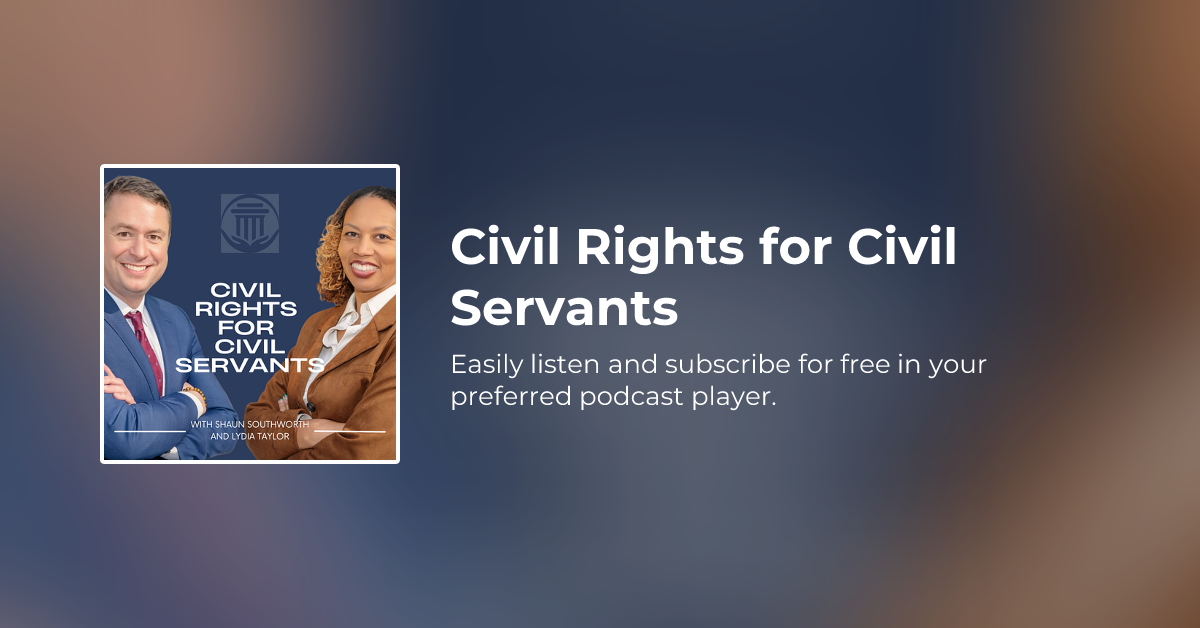
🎧 Listen: Civil Rights for Civil Servants
Shaun Southworth & Lydia Taylor on what's happening to the federal workforce. Latest episode: Apple · Spotify · Amazon Music · Youtube
 |
Today at a Glance
- Federal-Sector EEO Process: The law firm KCNF reports that the EEOC, apparently working with OMB, may be preparing sweeping changes to the federal-sector EEO process — including eliminating the guaranteed right to a hearing before an EEOC Administrative Judge. Nothing has changed yet, and no proposed rule text is public.
- Administrative Leave Rule Heads Toward Final: The comment window closed yesterday on an OPM proposal that would expand paid administrative leave for deferred resignations, RIF notice periods, and settlement resignations — and would give agencies "sole and exclusive discretion" over whether you can withdraw a resignation.
- Advanced Leave Cut Off at IRS and SSA: Both agencies told employees they will no longer approve advanced annual or advanced sick leave, and pending requests are denied. Accrued leave is unaffected, and both unions are challenging the change.
Top Stories:
1. Report: EEOC Preparing Sweeping EEO Process Overhaul — Guaranteed Hearings Could End
Source: KCNF (Kalijarvi, Chuzi, Newman & Fitch), July 29, 2026
TL;DR: The Washington, D.C. employment law firm Kalijarvi, Chuzi, Newman & Fitch (KCNF) reports that the EEOC, apparently working with the Office of Management and Budget (OMB), is preparing sweeping changes to the federal-sector EEO complaint process under 29 C.F.R. Part 1614. According to the report, the EEOC walked agency counsel through the proposed changes on July 27 — recording devices were prohibited, copies of the proposed language could not leave the room, and no attorneys representing federal employees were invited. The reported changes would eliminate informal EEO counseling, require agencies to investigate and issue a mandatory Final Agency Decision (FAD) within 180 days, and end the guaranteed right to request a hearing before an EEOC Administrative Judge. Employees would instead appeal the FAD to a renamed Office of Federal Sector, which would decide whether a hearing is warranted; class complaints would reportedly be eliminated as well. KCNF notes that without a guaranteed administrative hearing, more disputes could shift to federal district court, a costlier and more procedurally demanding path. A Notice of Proposed Rulemaking is expected in September. No proposed regulatory text is public, and none of these changes has taken effect.
Southworth PC insight: If an NPRM publishes in September, notice and comment has to run its course — and for perspective, the last major Part 1614 revision took from a December 2009 proposed rule to a mid-2012 final rule.
For federal employees, this means:
- Nothing has changed. Counseling, the 180-day investigation, and the right to request a hearing before an EEOC Administrative Judge all remain in effect for current and new complaints.
- If you have a pending EEO complaint, keep handling it under today's rules — this report is not a reason to rush, skip, or change any step.
- Watch for a possible Notice of Proposed Rulemaking in September; if one publishes, a public comment period would follow before any final rule could take effect.
Legal Insight. Under current law, when a complainant requests a hearing, 29 C.F.R. § 1614.109(a) provides that the Commission shall appoint an Administrative Judge to conduct it — a decision-maker who is not employed by the agency accused of discrimination, with authority over discovery and sworn testimony. That right, and the rest of Part 1614, remains in effect unless and until a final rule changes it, and any change requires published proposed text and public comment first. This briefing will cover the proposed rule in detail if and when it is published.
2. The Comment Window Just Closed on an OPM Rule About Paid Leave — and About Taking Back a Resignation
TL;DR: The Office of Personnel Management's proposed rule on administrative leave (RIN 3206-AP07; doc. 2026-13073) closed for public comment yesterday, July 29, 2026, and now moves toward a final rule. The proposal amends 5 C.F.R. Parts 351, 630, and 715, and it would add a new list of accepted uses of administrative leave at proposed 5 C.F.R. § 630.1403(c) — including extended paid leave for employees who sign an agreement to separate on a future date through a deferred resignation program, a voluntary separation incentive payment, or an early retirement authorization; paid leave between the date a reduction-in-force (RIF) notice is received and the separation date; and extended leave "to facilitate the voluntary resignation of an employee with documented poor performance or misconduct under a settlement agreement." It would also add a prohibition: an agency could not keep using administrative leave for investigative purposes once an employee hits the 10-workday calendar-year limit for a given investigation, and would have to move to investigative leave instead. Separately, the proposal rewrites 5 C.F.R. § 715.202 to state that an agency may accept or decline a request to withdraw a resignation "in its sole and exclusive discretion," may decline only for a valid reason it explains to the employee — and that "[a]voidance of adverse action proceedings is not a valid reason." Proposed 5 C.F.R. § 351.806 would change the RIF notice period standard from keeping an employee in duty status "when possible" to doing so "[u]nder ordinary circumstances."
For federal employees, this means:
• If you are weighing a deferred resignation, an incentive payment, or an early-retirement offer, read the paid-leave terms in the agreement itself. The proposal treats extended administrative leave as a discretionary management tool, not a benefit you can insist on.
• Treat a resignation as final the moment you sign it. Under the proposal, an agency could refuse to let you withdraw it for reasons including that it already committed to hiring a replacement or that you accepted deferred-resignation benefits.
• If you are placed on paid leave during an investigation, count the workdays. After 10 workdays in a calendar year on that investigation, the agency is expected to shift you to investigative leave, which carries its own statutory conditions.
Legal Insight. The Administrative Leave Act of 2016 (section 1138 of Pub. L. No. 114-328) created three provisions that govern this territory: administrative leave at 5 U.S.C. § 6329a, investigative and notice leave at 5 U.S.C. § 6329b, and weather and safety leave at 5 U.S.C. § 6329c. The 10-workday annual ceiling that drives the proposed prohibition comes from 5 U.S.C. § 6329a(b)(1), and the bar on starting investigative leave before that period runs is at 5 U.S.C. § 6329b(b)(3)(A). The resignation-withdrawal language matters most in adverse-action cases, because a resignation submitted under pressure is often the fact pattern behind a constructive-removal appeal — and the proposal's statement that avoiding adverse-action proceedings is not a valid reason to refuse a withdrawal would be a point in the employee's favor if it survives into the final rule.
3. IRS and Social Security Stop Approving Advanced Leave — What Is Left When Your Sick Leave Runs Out
Source: Government Executive, July 29, 2026
TL;DR: Human resources officials at the Internal Revenue Service and the Social Security Administration told employees last Friday that neither agency will grant advanced annual leave or advanced sick leave until further notice, and that pending requests will be denied. In nearly identical emails, both agencies said the change is intended to maintain service to the public and to address cases in which employees took large amounts of advanced leave, and that the suspension will remain in place pending efforts to reduce "existing significant advanced leave balances." The change does not affect an employee's ability to use leave already accrued, and employees at both agencies can still receive donated leave through the Voluntary Leave Transfer Program or take unpaid leave under the federal Family and Medical Leave Act. Both agencies are led by Frank Bisignano, the Senate-confirmed Social Security commissioner who also serves as the IRS's first chief executive officer. AFGE Council 220 President Jessica LaPointe said the union has filed a grievance alleging that SSA repudiated a provision of its collective bargaining agreement, and National Treasury Employees Union (NTEU) President Doreen Greenwald said NTEU "will vigorously challenge this move." Government Executive reported that employees who separate from federal service with a negative leave balance must refund the cost of the advanced leave, and that agencies may deduct it from a final paycheck.
For federal employees, this means:
• Check your leave balances this week. A negative balance is a debt you repay with future accruals — and if you separate before earning it back, the agency can recover it from your final pay.
• If you have a medical need and no accrued leave, the remaining paths are donated leave through the Voluntary Leave Transfer Program, unpaid FMLA leave, and — where the condition is a disability — a reasonable-accommodation request.
• If you are in a bargaining unit, tell your steward now. Both AFGE and NTEU are treating this as a contract violation, and negotiated grievance deadlines are usually measured in days, not months.
Legal Insight. Advanced sick leave has never been an entitlement: 5 C.F.R. § 630.402 provides that an agency "may" advance up to 240 hours to a full-time employee for qualifying medical reasons, and advance annual leave is likewise discretionary. That is why the legal challenge here runs through the contract rather than the leave statute — the unions' theory is that unilaterally cancelling a bargained practice repudiates the collective bargaining agreement and is an unfair labor practice under 5 U.S.C. § 7116(a)(1) and (a)(5), enforceable through the negotiated grievance and arbitration procedure at 5 U.S.C. § 7121, with review of an arbitrator's award by the Federal Labor Relations Authority under 5 U.S.C. § 7122. Employees who lose access to advanced leave still retain up to 12 administrative workweeks of unpaid leave under 5 U.S.C. §§ 6381–6387 and eligibility for donated leave under 5 U.S.C. §§ 6331–6340. If a medical condition is driving the need for leave, the timing matters, and it is worth speaking with a federal employment attorney before you go into a leave-without-pay or AWOL posture.
Mindful Moment of the Day
The Dashboard Reality Check
A dashboard full of overdue items, pending approvals, or unresolved cases can make you feel like you are failing, even when the workload is bigger than one person. Notice the moment your mind turns numbers into a judgment about your worth. Take a breath and say, “These are data points, not my identity.” Then pick the next clean action: update one note, move one case, send one clarification, or close one loop. Mindfulness helps separate the reality of the workload from the extra weight of self-blame. You can care deeply about the mission without letting the numbers define you.
Programming Note
Our podcast will be delayed this week — our Media Relations Cooridnator Ruby Alosbanos is out, so the new episode will drop Monday, August 3 instead of this Friday.
Also, this week's emails will not include our usual blog post roundup. Don't worry — the content is still coming, just on Instagram instead. Follow us there so you don't miss it: @southworth_pc
We'll be back to our normal schedule next week, and wish Ruby a great, relaxing vacation.
Worried About Retaliation or Being Targeted for Speaking Up?
If you’ve reported misconduct, safety concerns, discrimination, or waste/fraud/abuse—and now you’re seeing sudden schedule changes, bad performance reviews, or threats of discipline—you may be in whistleblower or retaliation territory.
We represent federal employees who:
-
Reported concerns and then saw adverse actions
-
Were sidelined, reassigned, or given impossible workloads after speaking up
-
Face investigations, PIPs, or proposed removals that look like payback
-
Need help navigating OSC complaints, EEO claims, or MSPB appeals tied to retaliation
A free, confidential consultation can help you sort out what’s normal agency behavior and what may cross the line—and what to do before your options narrow.
👉 Schedule Your Free Consultation Today
|

Disclaimer:
This briefing is for general informational purposes only and does not constitute legal advice or create an attorney‑client relationship. Federal employment law is fact‑specific and time‑sensitive; you should consult a qualified attorney about your own situation and deadlines. Past results do not guarantee future outcomes.
Your service is worth protecting. Let's protect it together at Southworth PC.

Responses