Attorneys for Federal Employees — Nationwide
Nearly 200,000 federal workers and supporters follow our updates across TikTok, Instagram, YouTube, Facebook, and LinkedIn. Each briefing gives you the three stories that actually matter to your job, plain‑English legal guidance, and one short practice to protect your peace of mind. If it helps you, forward it to a colleague—new readers can subscribe at https://fedlegalhelp.com/newsletter.
Who Protects the Worker?
The full lineup for the September 9 panel is out, and Shaun Southworth is on it. RSVP below.
A lot of you watched it happen to someone down the hall this year: a colleague terminated on probation, a whole office eliminated in a reduction in force (RIF). The organizers of this panel put it plainly: the procedures designed to guard against arbitrary termination were "tested on a scale not seen in generations."
On Wednesday, September 9, from 10:45 a.m. to 12:15 p.m. ET, the USAID Employee Support Fund and the Alliance for American Leadership host a non-partisan virtual panel on what limits should apply when the government eliminates jobs or removes employees, and what happens when those limits are not followed.
The full lineup is now public:
- Congressman Jamie Raskin opens.
- Two former USAID Administrators who served under presidents of different parties share the program: Andrew Natsios moderates, and Ambassador Samantha Power closes.
- Our founding partner, Shaun Southworth, sits on the panel with Kevin Byrnes of Patriots Law Group and Andrew Huddleston, Advocacy Director at the American Federation of Government Employees (AFGE).
It's on Zoom, so no travel voucher needed, but you do need to register.
RSVP here: https://www.usaidemployeefund.org/event
🎧 Listen: Civil Rights for Civil Servants
Shaun Southworth & Lydia Taylor on what's happening to the federal workforce. Latest episode: Apple · Spotify · Amazon Music · Youtube
 |
Today at a Glance
-
USDA Relocations: Four unions filed the separate lawsuit Judge Illston said the USDA claims required, with a renewed bid for a preliminary injunction; according to the complaint, the first relocated employees must report to new duty stations by September 21.
-
Air Traffic Controller Pay: Congress funded a 3.8 percent controller raise in April, but the law makes the last 2.8 percent contingent on an FAA Administrator finding that scheduling and staffing efficiencies have been achieved — a finding he has not made.
-
Hiring Assessments: OPM's interim final rule stripping the Uniform Guidelines on Employee Selection Procedures from federal hiring regulations has been in effect since July 31; comments close September 29, and Title VII's own disparate-impact standard is unchanged.
Top Stories:
1. Four Unions File the Separate USDA Lawsuit the Judge Pointed Them To — Renewed Injunction Bid Targets Relocations With a September 21 Report Date
Source: Federal News Network, September 8, 2026
TL;DR: On Tuesday, AFGE, AFSCME, NFFE and NTEU, joined by local governments and science and conservation groups, filed a new lawsuit in the U.S. District Court for the Northern District of California against the Agriculture Department and Secretary Brooke Rollins, with a renewed motion for a preliminary injunction to halt the department's reorganization and the forced relocations that come with it. The filing follows Judge Susan Illston's September 2 order in the broader AFGE v. Trump case, which held that the USDA claims "should be the subject of a separate lawsuit." The new complaint, No. 3:26-cv-09976, alleges that the reorganization violates the Administrative Procedure Act and appropriations riders in which Congress barred USDA from relocating offices or employees, or reorganizing, without advance approval from the House and Senate Appropriations Committees. The plan would move more than half of USDA's roughly 2,600 National Capital Region employees to hubs around the country; USDA told the court on August 28 that 64 percent of the 725 employees who had received Management Directed Reassignment (MDR) letters accepted, while the unions counter that "at least one out of three relocated employees is leaving the agency rather than relocating" and that some accepted only to pursue hardship exemptions or accommodations. According to the complaint, the first group of relocated employees must report to new duty stations by September 21, 2026, and "hundreds or thousands more MDR letters are forthcoming."
For federal employees, this means:
- If you hold an MDR letter, nothing about your deadlines has changed. A lawsuit does not pause a reassignment; only a court order does. Put any hardship-exception or reasonable-accommodation request in writing before your letter's response deadline.
- Declining a directed reassignment outside your commuting area is handled as an adverse action, not a resignation: the agency must give you written notice of a proposed removal and a chance to reply, and you can appeal a removal to the Merit Systems Protection Board (MSPB). For severance pay purposes, that separation is "involuntary" unless your position description or another written agreement provides for such a move (5 C.F.R. § 550.703).
- Watch the docket. A ruling on the renewed injunction motion will land while report dates are still running; if the court denies it, the September 21 and later dates stand.
Legal Insight. The complaint's lead claim rests on section 716(a) of USDA's fiscal year 2026 appropriations act, Pub. L. No. 119-37, which — as the complaint quotes it — bars using appropriated funds through a reprogramming that "relocates an office or employees" or "reorganizes offices, programs, or activities" unless the Secretary "notifies in writing and receives approval from the Committees on Appropriations of both Houses of Congress at least 30 days in advance," with a parallel Forest Service rider in section 421 of Pub. L. No. 119-74; the unions ask the court to set the actions aside under 5 U.S.C. § 706(2)(A) and (C) as "not in accordance with law" and "in excess of statutory jurisdiction, authority, or limitations." The individual employee's rights run on a separate track: whether or not the reorganization survives, a removal for declining a directed reassignment must meet 5 U.S.C. § 7513(a)'s standard that the action "promote the efficiency of the service" and can be appealed to the Board within 30 days of the effective date, or of receipt of the decision if later, under 5 C.F.R. § 1201.22(b). If you are deciding whether to accept, decline, or retire — including a possible discontinued service retirement under 5 U.S.C. § 8414(b)(1)(A) — consult a federal employment attorney before your letter's response deadline passes.
2. Congress Funded a 3.8 Percent Raise for Air Traffic Controllers in April — They Have 1 Percent, and the Law Leaves the Rest to the FAA Administrator
Source: Government Executive, September 8, 2026
TL;DR: Sens. Tammy Duckworth and Dick Durbin wrote to Federal Aviation Administrator Bryan Bedford on September 4 urging him to implement the remaining 2.8 percent of a 3.8 percent raise Congress approved for air traffic controllers in the Homeland Security and Further Additional Continuing Appropriations Act, 2026 (Pub. L. No. 119-86), signed April 30, 2026, which set aside $140 million for it; controllers, supervisors and managers have so far received only the 1 percent governmentwide civilian raise. The reason is in the statute: as both the senators and the FAA describe it, Congress made the increase contingent on the Administrator determining that "improvements in workforce scheduling, staffing utilization, or other operational efficiencies are achieved that contribute to addressing workforce shortfalls and enhancing aviation safety" — a call the law leaves to his "sole discretion," according to CBS News and the Washington Examiner. Bedford told the Washington Examiner last month that working with the National Air Traffic Controllers Association (NATCA) to get "as much utilization out of our workforce as we can" would help "unlock the 2.8%." The senators called the conditions "not a high bar" and quoted the FAA's own 2026–2028 workforce plan: "Chronic use of overtime leads to fatigue, controller burnout and ultimately loss of retention." Government Executive, which reported the letter Tuesday, also notes, citing NPR, that the FAA has moved to fire two LaGuardia controllers who left work early after finishing their duties.
For federal employees, this means:
- If you are a controller, the last 2.8 percent turns on a finding only the Administrator can make, so the leverage is in Congress and in the FAA–NATCA talks, not in your payroll office. Ask your NATCA representative what is on the table for basic watch schedules and facility hours.
- If the determination is made, the increase would be retroactive to the first pay period after January 1, according to the Washington Examiner's description of the statute — a later "yes" comes with back pay.
- Any FAA employee contesting a proposed removal or other major adverse action must choose one forum — the negotiated grievance procedure, the FAA's internal Guaranteed Fair Treatment process, or an MSPB appeal — and the choice is binding.
Legal Insight. Under 49 U.S.C. § 40122(g)(1)–(2), the FAA runs its own personnel management system "notwithstanding the provisions of title 5," and only the parts of title 5 listed in the statute — whistleblower protection, veterans' preference, chapter 71 labor relations, the benefits chapters, and MSPB review, among others — still apply; the General Schedule pay chapter is not on the list, which is why controller pay runs through the FAA's own system and its agreement with NATCA, and why the 3.8 percent came through an appropriations law. That law, as quoted by the senators and described by the FAA, makes the extra 2.8 percent payable only to the extent the Administrator determines the improvements have been achieved, and § 40122(a)(4) separately directs the FAA and its unions to "use every reasonable effort to find cost savings and to increase productivity" — the frame Bedford has invoked. For anyone facing a "major adverse personnel action" as defined in § 40122(j), § 40122(h) offers three routes — the contractual grievance procedure, Guaranteed Fair Treatment, or an MSPB appeal under § 40122(g)(3) — and § 40122(i) requires an election of one; consult a federal employment attorney before making that election, because the statute does not allow the same action to be contested in more than one forum "unless otherwise allowed by law."
3. Three Weeks Left to Comment: OPM Dropped the "Uniform Guidelines" Bias Check From Federal Hiring Rules on July 31 — Comments Close September 29
Source: Federal Register (OPM interim final rule), July 31, 2026
TL;DR: OPM's interim final rule removing every reference to the Uniform Guidelines on Employee Selection Procedures (UGESP) from federal civil service regulations took effect the day it was published, July 31, 2026, and its comment period closes September 29, 2026 (91 Fed. Reg. 48,234; Docket ID OPM-2026-0595). The rule strikes the sentence in 5 C.F.R. § 300.103(c) that required selection procedures to meet UGESP standards, removes the UGESP cross-reference from the category-rating rules at 5 C.F.R. §§ 337.303(b) and 330.213(d), and removes and reserves 5 C.F.R. § 720.206. OPM issued it to conform its regulations to a June 9, 2026 Justice Department Office of Legal Counsel opinion, "Constitutionality of Disparate-Impact Liability Under Title VII," which concluded that UGESP's adverse-impact and validation-study framework rests on an unconstitutional reading of Title VII, and it invoked the good-cause exception to skip advance notice and comment. OPM calls the change "limited" — agencies must still base each employment practice on a job analysis, show a "rational relationship" to performance in the position, and administer it without prohibited discrimination — and says the rule "does not alter agency obligations under Title VII." Since 1978 the guidelines have been the standard for testing whether a hiring assessment screens out a protected group at a disproportionate rate; Federal News Network reported in August that the Partnership for Public Service's Jenny Mattingley credited that framework with giving candidates who believed an assessment was biased "a mechanism to actually question" it.
For federal employees, this means:
- Applicants and internal candidates can still challenge a hiring assessment. Title VII's disparate-impact standard is written into the statute at 42 U.S.C. § 2000e-2(k), and the EEOC's guidelines still sit at 29 C.F.R. part 1607 as of this week; what changed is that OPM's own rules no longer require agencies to follow them. Part 1614 covers applicants as well as employees (29 C.F.R. § 1614.103(c)), and the usual 45-day counselor-contact clock applies (29 C.F.R. § 1614.105(a)(1)).
- HR specialists and hiring managers: the job-analysis, rational-relationship, professional-development and nondiscrimination requirements in 5 C.F.R. § 300.103(a)–(c) remain in force, but OPM says agencies "need not conduct UGESP validation studies or adverse-impact analyses as a matter of OPM regulation."
- If you want a say, comments go to regulations.gov under Docket ID OPM-2026-0595 and must be received by September 29; OPM says it "may revise, withdraw, or confirm" the rule afterward. Comments are posted publicly as received.
Legal Insight. An OLC opinion binds executive-branch agencies, but it does not amend a statute or repeal another agency's regulation, and OPM's rule says as much: it "does not alter agency obligations under Title VII," the ADEA, the Rehabilitation Act, GINA, veterans' preference, or the prohibited personnel practice provisions. Title VII's disparate-impact provision, 42 U.S.C. § 2000e-2(k)(1)(A)(i), still makes a practice unlawful when it "causes a disparate impact" and the employer "fails to demonstrate that the challenged practice is job related for the position in question and consistent with business necessity," and 5 U.S.C. § 2302(b)(1) still makes discrimination in a personnel action a prohibited personnel practice. The open question is how the EEOC — the agency to whose Chair the OLC opinion was addressed — will adjudicate federal-sector disparate-impact claims from here; until that settles, the 45-day counselor-contact deadline in 29 C.F.R. § 1614.105(a)(1) is the date that matters for anyone who believes an assessment screened them out unfairly.
Legal Tip of the Day
Don’t Miss Your EEO Deadline
If you believe discrimination played a role in a workplace decision, do not wait too long to act. Federal EEO matters have short deadlines, and informal conversations with supervisors or HR may not preserve your rights. Write down the date of the event, what happened, who was involved, what protected status may be connected, and what documents support your concern. Keep notices, emails, and calendar entries in a safe personal location, not only on government systems. Do not wait to “see how things play out” if the deadline may be running.
In Case You Missed It
A few quick hits from our recent posts:
GAO Audit: DHS Claimed $10.5 Billion in DOGE Contract Savings. Auditors Found $92 Million.
|

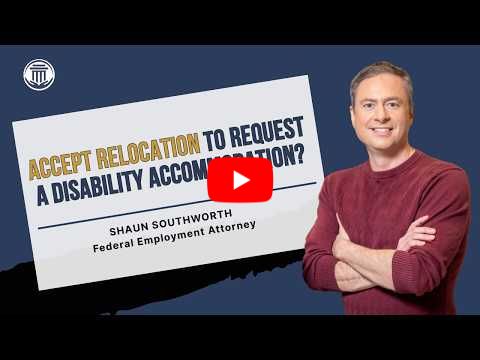
USDA Says 64% Accepted Relocation. Employees Say the Accept Button Was Not a Choice.
|
|

Thinking About Federal Disability Retirement?
If your medical conditions make it hard to safely or consistently perform your federal job—even with accommodations—it may be time to explore OPM/FERS disability retirement.
We help federal employees:
-
Decide whether disability retirement is the right path compared to accommodation or reassignment
-
Gather and frame medical evidence so it speaks the language OPM expects
-
Prepare and submit disability retirement applications and related documentation
-
Coordinate strategy when disability retirement interacts with pending discipline, EEO complaints, or MSPB appeals
For most disability retirement matters, we offer full‑service application assistance for a flat fee of $5,000, plus any required costs. In a free consultation, we’ll talk through your health limitations, job duties, and timelines so you understand your options before you commit.
👉 Schedule Your Free Consultation Today
|

Disclaimer:
This briefing is for general informational purposes only and does not constitute legal advice or create an attorney‑client relationship. Federal employment law is fact‑specific and time‑sensitive; you should consult a qualified attorney about your own situation and deadlines. Past results do not guarantee future outcomes.
Your service is worth protecting. Let's protect it together at Southworth PC.

Responses