Attorneys for Federal Employees — Nationwide
Nearly 200,000 federal workers and supporters follow our updates across TikTok, Instagram, YouTube, Facebook, and LinkedIn Each briefing gives you the three stories that actually matter to your job, plain‑English legal guidance, and one short practice to protect your peace of mind. If it helps you, forward it to a colleague—new readers can subscribe at https://fedlegalhelp.com/newsletter.
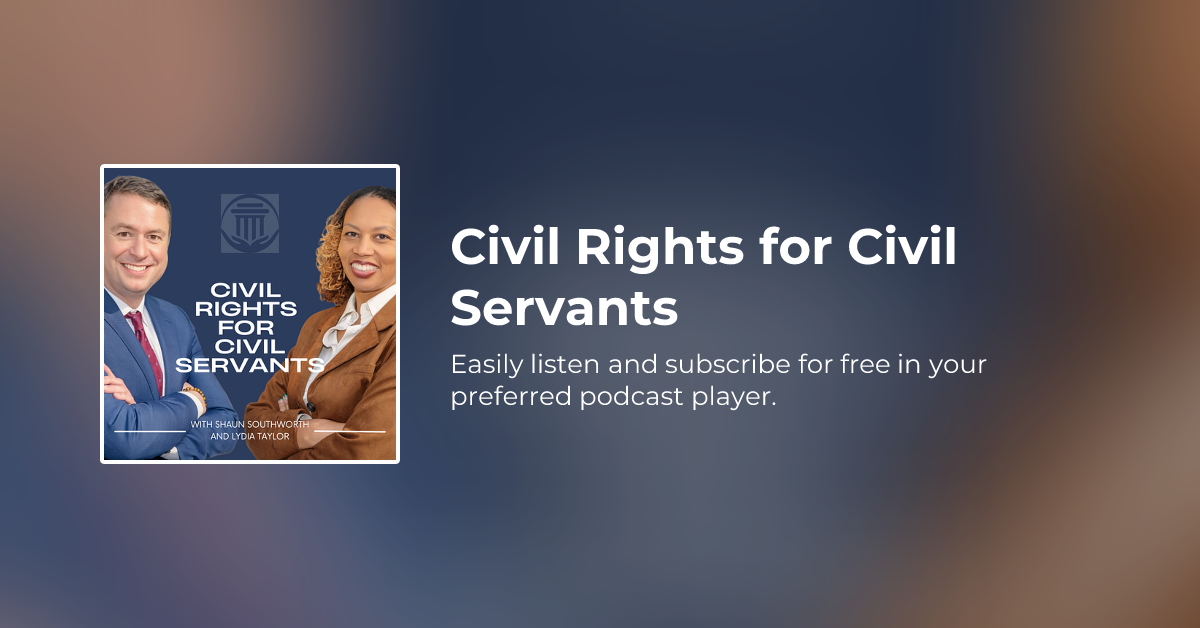
🎧 Listen: Civil Rights for Civil Servants
Shaun Southworth & Lydia Taylor on what's happening to the federal workforce. Latest episode: Apple · Spotify · Amazon Music · Youtube
 |
Today at a Glance
-
IRS Union Materials and Blocked Email: The IRS says a new August 4 policy limiting bulletin boards to “agency-sponsored materials” resolves NTEU’s First Amendment lawsuit. The union says it is getting conflicting signals, and that the agency is still blocking its website and its email — including messages in EEO complaints and MSPB appeals.
-
A Stack of Federal Workforce Bills: Pending legislation would add 12 weeks of paid family and medical leave for federal employees, make identity-protection coverage from the 2015 OPM breach permanent before it expires September 30, and require a governmentwide audit of air quality in federal buildings. None of it is law yet.
-
Retirement Backlog at Its 2026 Low: OPM’s pending retirement inventory dropped to 24,784 in July, the lowest point this year, but the average claim still took 109 days — and 156 days if the application was filed on paper.
Top Stories:
1. The IRS Says a New Bulletin-Board Policy Ends the Union Speech Case — the Union Points to Blocked Email in EEO and MSPB Matters
Source: Government Executive, August 11, 2026
TL;DR: On May 29, 2026, the IRS issued a directive instructing facilities management employees to remove “any and all NTEU materials” from IRS facilities using “whatever steps necessary,” short of vandalism. The National Treasury Employees Union (NTEU) sued the following month in federal court, documenting flyers and decorations taken from communal bulletin boards, removed from employees’ cubicles, and in several instances destroyed. In late June the two sides jointly told the court that management had agreed to stop and to return materials not already destroyed. The IRS then issued a new policy on August 4 stating that only “agency-sponsored materials” — plus non-agency materials required by law, such as Occupational Safety and Health Administration notices — may be posted in common areas, and that “[e]mployees are not authorized to post written materials in IRS facilities.” Employees may still decorate their own workspaces under existing ethics and EEO rules. The IRS asked NTEU whether it would dismiss the confiscation portion of the case as moot, on the view that content-neutral speech policies are generally not First Amendment violations. In a filing Monday, NTEU said it has received “conflicting information,” noting that the agency’s own facilities office has posted notices saying it may approve “non-agency-sponsored materials for display in common areas,” and that the union “might challenge this policy if it believes that it is merely a façade for viewpoint-based discrimination.”
For federal employees, this means:
- The dispute is no longer only about flyers. NTEU amended its complaint last month to add claims over a content filter that blocks nteu.org from agency workstations with a warning that the site contains “potentially damaging content,” a category one IRS employee told Government Executive they had never seen the filter use.
- The IRS also blocked all email from the nteu.org domain, which the union says has affected employees with pending EEO complaints and MSPB appeals. In one example in the complaint, an NTEU attorney representing an IRS employee could not receive a settlement document from the agency attorney for days. The IRS later unblocked NTEU email for managers, HR staff, and some agency attorneys, but left the block in place for bargaining-unit employees.
- If you are working with a union representative on a complaint or appeal and messages are not arriving, do not assume the filing is safe. Confirm receipt by phone, keep your own copy of everything you send, and tell the EEO office or the Administrative Judge in writing if a communication channel is failing. Deadlines do not pause because email did not go through.
Legal Insight
Under 5 U.S.C. § 7102, federal employees have a statutory right to form, join, or assist a labor organization, and 5 U.S.C. § 7116(a)(1) makes it an unfair labor practice for an agency to interfere with, restrain, or coerce employees in exercising rights under that chapter — but that route is contested at agencies covered by the 2025 executive order on collective bargaining, which is why NTEU brought a First Amendment claim in federal court rather than a case before the FLRA. Separately, your right to a representative in the EEO process comes from 29 C.F.R. § 1614.605, and your right to designate a representative in a Board appeal comes from 5 C.F.R. § 1201.31; neither depends on the agency’s willingness to route email. If a blocked channel has caused you to miss a filing date or has kept your representative from receiving documents, document it immediately and consult a federal employment attorney, because the remedy usually depends on how promptly the problem is put on the record.
2. Congress Has a Stack of Federal Workforce Bills — Paid Family Leave, Lifetime Breach Protection, and Building Air Quality
Source: Federal News Network, August 12, 2026
TL;DR: Several bills now pending on Capitol Hill would change federal employment and benefits. The Comprehensive Paid Leave for Federal Employees Act (S. 5168), led by Sen. Brian Schatz (D-Hawaii), would give federal employees 12 weeks of paid leave for every purpose the Family and Medical Leave Act (FMLA) covers, including the employee’s own serious health condition or that of an immediate family member — leave that is currently unpaid. The RECOVER PII Act, introduced this month by Sen. Mark Warner (D-Va.) and Del. Eleanor Holmes Norton (D-D.C.), would make identity-protection coverage permanent for the roughly 22 million people whose information was compromised in the 2015 OPM data breach; the 10 years of coverage Congress previously funded expires September 30, 2026. A bipartisan House bill introduced in July, the Federal Facilities Indoor Air Quality Assessment Act, would require the Government Accountability Office to review air quality across federal facilities and require agencies to plan fixes; Rep. James Walkinshaw (D-Va.) pointed to ventilation problems the General Services Administration’s own inspector general has identified. The Skills-Based Federal Contracting Act (H.R. 5235) cleared the Senate Homeland Security and Governmental Affairs Committee unanimously this month after passing the House earlier this year; it would bar agencies, in most cases, from setting minimum education requirements in contract solicitations absent a contracting officer’s written justification. Republican lawmakers also reintroduced legislation (H.R. 9991 and S. 5228) barring federal employment for anyone who refuses to answer questions in a congressional investigation or is convicted of perjury.
For federal employees, this means:
- Nothing in this list has changed your rights yet. Every item is a bill. Plan around the law as it stands today, not around what is pending.
- The September 30 date is the one with real consequences. If you were covered by the OPM breach monitoring, your coverage ends at the close of the fiscal year unless Congress acts. Check whether you are enrolled, download or save any records you want, and decide now whether you will buy replacement monitoring or place a credit freeze.
- FMLA leave for federal employees remains unpaid. The only paid category is parental leave. If you are planning time off for your own serious health condition or a family member’s, build the plan around accrued annual and sick leave, advanced leave where your agency still grants it, the voluntary leave transfer program, and unpaid FMLA — not around S. 5168.
Legal Insight
Federal employees’ FMLA entitlement is codified at 5 U.S.C. §§ 6381-6387, and 5 U.S.C. § 6382(a)(1) provides 12 administrative workweeks of leave in a 12-month period for the covered reasons; that leave is unpaid except that 5 U.S.C. § 6382(d)(2) allows substitution of paid parental leave following a birth or placement, added by the Federal Employee Paid Leave Act, §§ 7601-7606 of Pub. L. No. 116-92. On the breach side, the Privacy Act’s safeguarding duty appears at 5 U.S.C. § 552a(e)(10), with a civil remedy at 5 U.S.C. § 552a(g); the expiration of monitoring services does not extinguish that provision, but it does remove the practical early-warning tool most affected employees have been relying on.
3. OPM’s Retirement Backlog Hit Its 2026 Low in July — and the Average Claim Still Took 109 Days
TL;DR: OPM’s published retirement processing figures show the pending inventory fell to 24,784 claims at the end of July 2026, the lowest monthly total this fiscal year and down from 33,851 in June and a February peak of 65,237. OPM received 10,538 new claims in July — 8,400 digital and 2,138 on paper — and processed 17,841, of which 14,370 were digital. Processing times moved the other way. Digital claims averaged 98 days in July and all claims averaged 109 days, both up from June, and paper claims averaged 156 days. OPM notes it is still receiving many claims on paper while it works with agencies and payroll offices to move to a fully digital application, and that digital cases move faster because systematic data checks catch missing or incomplete information before it causes a delay.
For federal employees, this means:
- The backlog is shrinking but the wait is not short. If you are planning a retirement date, assume three to four months before your annuity is finalized, and longer if your package goes in on paper. Build a cash cushion for that gap rather than counting on interim payments to match your final annuity.
- File digitally if your agency and payroll office support it. The gap between 98 days and 156 days is nearly two months of your life, and it turns on the format of the application.
- Check your own record before you file. Verify your SF-50s, service-computation date, creditable civilian and military service, deposits and redeposits, and insurance enrollment history. Most avoidable delay comes from an incomplete package, and errors are far easier to fix before the claim is adjudicated than after.
Legal Insight
When OPM issues a decision on your retirement rights that you disagree with, you are entitled to ask for reconsideration — 5 C.F.R. § 831.109 for CSRS, 5 C.F.R. § 841.306 for FERS — and OPM’s final reconsideration decision is appealable to the Merit Systems Protection Board under 5 U.S.C. § 8347(d)(1) for CSRS and 5 U.S.C. § 8461(e)(1) for FERS, with a 30-day filing deadline under 5 C.F.R. § 1201.22(b). Slow processing is not itself an appealable decision, so the practical remedy for delay is documentation and congressional or agency inquiry rather than a Board appeal; the appeal right attaches to the decision, not the wait. If a decision reduces or denies benefits you believe you earned, note the date you received it and consult a federal employment attorney promptly, because the 30-day clock is short and is enforced.
Mindful Moment of the Day
The Policy Change Grounding
A sudden policy change can make a stable routine feel uncertain overnight. Return-to-office rules, telework expectations, reporting lines, or approval procedures may shift before anyone fully understands the details. When you feel the frustration rising, pause and name the reality: “This is a change, and change is hard on the body.” Then identify what is known, what is unknown, and what can wait. Keep the list short. Mindfulness does not mean you have to like the change or pretend it is easy. It helps you stay oriented while the workplace catches up to the new information.
In Case You Missed It
A few quick hits from our recent posts:
A FEMA Contractor Was Paid Through a DOGE Staffer’s Company. Her Deposition Is Now Public.
|

The IRS Restored Union Email for Managers and Left It Blocked for Bargaining Unit Employees
|

A Year After the CDC Shooting, Here Is What the Law Still Gives Federal Employees
|

Worried About Retaliation or Being Targeted for Speaking Up?
If you’ve reported misconduct, safety concerns, discrimination, or waste/fraud/abuse—and now you’re seeing sudden schedule changes, bad performance reviews, or threats of discipline—you may be in whistleblower or retaliation territory.
We represent federal employees who:
-
Reported concerns and then saw adverse actions
-
Were sidelined, reassigned, or given impossible workloads after speaking up
-
Face investigations, PIPs, or proposed removals that look like payback
-
Need help navigating OSC complaints, EEO claims, or MSPB appeals tied to retaliation
A free, confidential consultation can help you sort out what’s normal agency behavior and what may cross the line—and what to do before your options narrow.
👉 Schedule Your Free Consultation Today
|

Disclaimer:
This briefing is for general informational purposes only and does not constitute legal advice or create an attorney‑client relationship. Federal employment law is fact‑specific and time‑sensitive; you should consult a qualified attorney about your own situation and deadlines. Past results do not guarantee future outcomes.
Your service is worth protecting. Let's protect it together at Southworth PC.

Responses