Attorneys for Federal Employees — Nationwide
Nearly 200,000 federal workers and supporters follow our updates across TikTok, Instagram, YouTube, Facebook, and LinkedIn. Each briefing gives you the three stories that actually matter to your job, plain‑English legal guidance, and one short practice to protect your peace of mind. If it helps you, forward it to a colleague—new readers can subscribe at https://fedlegalhelp.com/newsletter.
Today at a Glance
-
HHS Cuts Performance Bonuses: HHS is reducing the percentage-of-pay bonus for top-rated employees and shifting bonus money toward "special act" and "efficiency" awards. CDC employees rated "outstanding" will receive an average 2.58 percent of basic pay, down from the 4 percent CDC announced in March.
-
White House App On Federal Phones: The White House has directed agencies to install its political app on government-furnished mobile devices, and the FAA has confirmed an automatic IT push. The app's content, and a button that sends a pre-written "Greatest President Ever!" message, raises Hatch Act exposure for employees who interact with it during work hours.
-
TSA Privatization Push: At a May 20 House Homeland Security Committee hearing, airline industry executives, an airport CEO and AFGE national President Everett Kelley pushed back on the President's plan to mandate the Screening Partnership Program at small airports. The proposal would cut roughly 4,500 Transportation Security Officer positions and reassign or eliminate another 5,000 jobs.
Top Stories:
1. HHS Cuts Cash Awards for Top Performers and Shifts Bonus Money Toward Efficiency and Anti-Fraud Incentives
Source: Federal News Network, May 21, 2026
TL;DR: The Department of Health and Human Services is scaling back performance-based cash awards for its employees and redirecting bonus dollars to "special act" and "incentive" awards tied to government efficiency and fraud, waste and abuse findings. According to a May 12 email from the Centers for Disease Control and Prevention obtained by Federal News Network, financial awards tied to 2025 performance scores are "undergoing a reduction in dollar amounts." CDC and its Agency for Toxic Substances and Disease Registry (ATSDR) historically used roughly 80 percent of their awards budgets for performance awards; the new cap is 40 percent, with 60 percent allocated to incentive awards. Under the revised CDC schedule, an "outstanding" rating now produces an average bonus of 2.58 percent of basic pay, compared with the 4 percent CDC communicated on March 27. HHS Press Secretary Emily Hilliard told FNN the framework is intended to recognize "both sustained high performance and mission-critical contributions." OPM spokesperson McLaurine Pinover said OPM's summer 2025 guidance, which directed agencies to reserve at least 60 percent of bonus pools for employees rated 4 or 5, "leaves final discretion up to agencies." CDC awarded quality step increases (QSIs) to only 87 employees for 2025 performance, using a "computer-generated, randomized selection process."
For federal employees, this means:
-
If you were told to expect a particular performance-award percentage earlier this cycle and the agency has now reduced it, save the original communication, your appraisal, and any internal email about the recalculation. A documented before/after is the foundation of any grievance, union claim, or EEO/retaliation complaint that may follow.
-
Special act and incentive awards are now the larger share of bonus dollars at CDC and ATSDR. Those awards are discretionary, given out throughout the year, and OPM guidance steers them toward employees who identify fraud, waste, or abuse or who advance "operational efficiency." Employees who want to remain competitive should keep contemporaneous records of efficiency, savings, or anti-fraud contributions.
-
Bargaining-unit employees should ask their union whether the change to award allocation percentages triggered a duty to bargain or notice obligations under the collective bargaining agreement. Non-bargaining-unit employees should review their agency's grievance procedure for any claim that the reduction was applied inconsistently.
Legal Insight:
Federal agencies have broad discretion over performance awards under 5 U.S.C. § 4503 (general agency awards authority) and 5 U.S.C. § 4505a (performance-based cash awards), with implementing regulations at 5 C.F.R. Part 451. Quality step increases are governed by 5 U.S.C. § 5336 and 5 C.F.R. § 531.504, which require a top performance rating. CDC's randomized selection from among QSI-eligible employees is not on its face inconsistent with those regulations. The greater legal exposure here is procedural: if an award reduction reflects discrimination based on a protected characteristic, retaliation for protected EEO activity, or whistleblower reprisal, an employee can initiate EEO counseling within 45 days of the alleged discriminatory act under 29 C.F.R. § 1614.105(a)(1) or file with the Office of Special Counsel under 5 U.S.C. § 2302(b)(8)–(9). Employees who suspect their award reduction was tied to a protected status or activity should consult a federal employment attorney before that 45-day clock runs.
2. White House Orders Agencies to Push Its App Onto All Federal Employees' Government Phones
Source: Government Executive, May 22, 2026
TL;DR: The White House has directed the federal Chief Information Officer, Greg Barbaccia, to coordinate the installation of "The White House" mobile application on government-furnished phones across the executive branch, according to internal communications obtained by Government Executive. The Federal Aviation Administration told employees on Friday, May 22, that its IT team "will automatically install 'The White House' application on all FAA-issued iPhones and iPads, as mandated by the White House," with no employee action required. The application, launched in March 2026, delivers live streams, breaking-news alerts, policy posts, and social-media content from White House and presidential accounts, and includes a "text President Trump" button that sends a pre-filled message reading "Greatest President Ever!" and signs the sender up for alerts. Independent cybersecurity researchers have separately flagged the app for sharing user IP addresses, time zones, and other data with third-party services; the White House removed an earlier GPS-tracking feature after public reporting. White House spokesperson Olivia Wales told Government Executive that "government devices typically include pre-installed apps that provide value to government employees' day-to-day work."
For federal employees, this means:
-
The app delivers political and campaign-style content. Opening it, clicking links inside it, or sending the pre-filled "Greatest President Ever!" text while on duty, in a federal building, or wearing official insignia is the kind of conduct OSC routinely treats as a Hatch Act violation.
-
Most agencies push apps through mobile device management (MDM), and you generally cannot delete an MDM-pushed app on a government phone. You can, however, decline to open it, turn off its notifications where the device allows, and avoid using it on duty.
-
If you receive a Hatch Act contact from the Office of Special Counsel about activity on a government device, do not respond on your own. Initial responses to OSC investigators often shape any later disciplinary case. Talk to a federal employment attorney before answering.
Legal Insight:
The Hatch Act prohibits most career federal employees from engaging in partisan political activity "while on duty," "in any room or building" used for the discharge of official duties, "while wearing a uniform or official insignia," or "while using a vehicle owned or leased by the Government." 5 U.S.C. § 7324(a); see also 5 U.S.C. §§ 7321–7326 and the implementing regulations at 5 C.F.R. Part 734. The Office of Special Counsel has long interpreted these restrictions to reach online and social-media conduct, including liking, sharing, retweeting, or sending political messages directed toward the success or failure of a candidate, party, or partisan political group. Penalties under 5 U.S.C. § 7326 range from reprimand to removal, a debarment, a civil penalty of up to $1,000, or suspension. An automatic install does not create a violation by itself; affirmative engagement with the app's political content on duty or in the workplace is what creates exposure.
3. TSA Workforce and Industry Push Back on White House Plan to Force Small Airports Into Privatized Screening
Source: Government Executive, May 20, 2026
TL;DR: Industry, airport, and federal-employee witnesses pushed back on Wednesday, May 20, against the White House's proposal to mandate that small airports use private screeners under the Transportation Security Administration's Screening Partnership Program (SPP). At a House Homeland Security Committee hearing, Airlines for America President Chris Sununu, Dallas Fort Worth International Airport CEO Chris McLaughlin, and American Federation of Government Employees (AFGE) National President Everett Kelley all urged that the program remain voluntary. Currently just over 20 airports participate in SPP. The Administration's FY 2027 budget would shift roughly 4,500 Transportation Security Officer (TSO) positions to private contractors and cut about 5,000 more jobs through reallocation and shifting exit-lane duties to states and localities, while adding $477 million to expand SPP. The plan would still leave overall federal savings at about $52 million. Republican members signaled openness to expansion; most Democrats opposed mandatory privatization. Kelley noted TSA workers have shown up through two prolonged FY 2026 shutdowns and a recent stripping of collective bargaining rights at the agency.
For federal employees, this means:
-
TSOs at smaller airports targeted for SPP conversion may face job loss, reassignment, or the choice to apply with a private contractor — typically at lower pay and without TSA's pay, leave, and benefit protections. Keep copies of your SF-50s, training certifications, performance records, and any reduction-in-force or transfer notices.
-
TSA's bargaining authority is administrative, not statutory. The TSA Administrator may grant or withdraw collective bargaining for TSOs at will, which means the procedural protections most federal employees rely on do not automatically apply at TSA. Individual documentation matters more than usual.
-
Watch FY 2027 appropriations and authorization language closely. The most direct way to shape whether SPP becomes mandatory is during the appropriations cycle, through union representatives and congressional offices. Public comments and constituent communications carry weight when the legislative text is still being drafted.
Legal Insight:
TSA's screening authority sits at 49 U.S.C. § 44901, and the Screening Partnership Program is codified at 49 U.S.C. § 44920. By its terms, § 44920 permits — but does not require — an airport operator to apply for private screening, with the TSA Administrator retaining oversight and the obligation to act on an application within 60 days. Forcing small airports into SPP would require either a statutory amendment or a structural change in how the Administrator exercises § 44920 discretion. TSO labor relations operate outside the Federal Service Labor-Management Relations Statute (5 U.S.C. ch. 71); bargaining rights at TSA derive from an Administrator's determination, which has been narrowed in 2026. That status matters in practice: the timelines, forums, and procedural protections available to a TSO facing an adverse action or RIF differ in important ways from those that apply to most of the civil service.
Mindful Moment of the Day
Before the Difficult Reply
A sharp email from a manager, colleague, or stakeholder can pull you into a fast reaction. You may feel your fingers move toward the keyboard before your better judgment catches up. Before replying, take three breaths with your hands off the keys. Name the first draft silently: “This is the angry version,” or “This is the scared version.” Then ask, “What response would protect both the record and my peace?” You can still be direct, document clearly, and ask what needs to be asked. The pause simply helps your words come from steadiness instead of adrenaline.
In Case You Missed It
A few quick hits from our recent videos and posts:
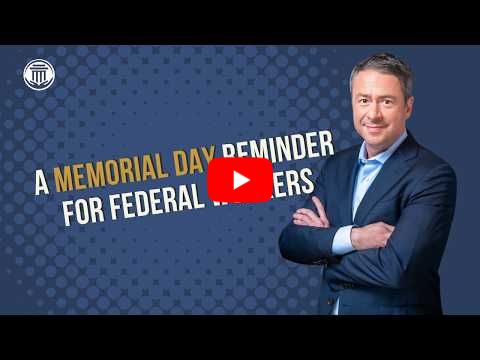
Memorial Day Begins With Remembrance
|
Facing Harassment or Discrimination?
If you’re dealing with slurs, exclusion, hostile emails, or sudden negative treatment after speaking up, you don’t have to wait until things get unbearable to explore your options.
We regularly represent federal employees in:
-
EEO complaints for discrimination, harassment, and hostile work environment
-
Retaliation for prior EEO activity or protected conduct
-
Reasonable accommodation disputes
-
Related discipline or performance issues that follow on the heels of complaints
In your free, confidential consultation, we’ll walk through what’s been happening, key dates (including the short EEO deadlines), and the tools available to you—formal and informal.
👉 Schedule Your Free Consultation Today
|
Disclaimer:
This briefing is for general informational purposes only and does not constitute legal advice or create an attorney‑client relationship. Federal employment law is fact‑specific and time‑sensitive; you should consult a qualified attorney about your own situation and deadlines. Past results do not guarantee future outcomes.
Your service is worth protecting. Let's protect it together at Southworth PC.

Responses