Attorneys for Federal Employees — Nationwide
Nearly 200,000 federal workers and supporters follow our updates across TikTok, Instagram, YouTube, Facebook, and LinkedIn. Each briefing gives you the three stories that actually matter to your job, plain‑English legal guidance, and one short practice to protect your peace of mind. If it helps you, forward it to a colleague—new readers can subscribe at https://fedlegalhelp.com/newsletter.
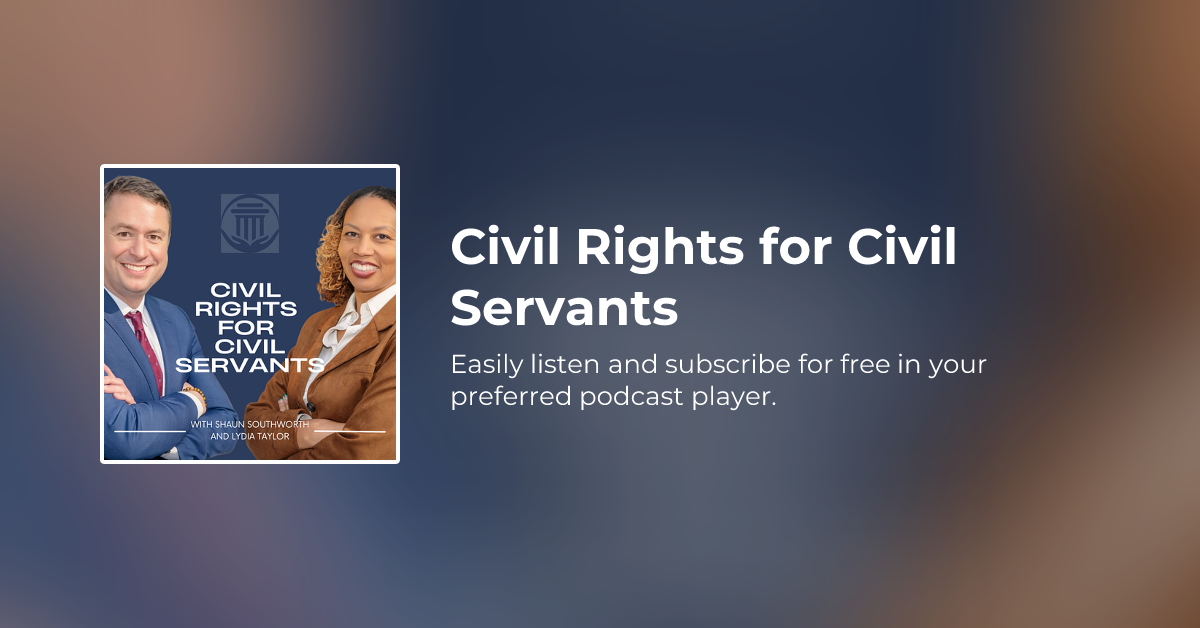
🎧 Listen: Civil Rights for Civil Servants
Shaun Southworth & Lydia Taylor on what's happening to the federal workforce. Latest episode: Apple · Spotify · Amazon Music · Youtube
 |
Today at a Glance
-
BOP Contempt Motion: One week after a federal judge ordered the Bureau of Prisons to "immediately reinstate" its union contract, the union asked the court to hold the agency in civil contempt, filing sworn declarations that wardens were told to "maintain the status quo" and that an employee facing termination was told "There ain't no union."
-
SSA Ends Alternative Work Schedules: Social Security will end every 4/10 and 5/4/9 schedule on November 16. AFGE filed a national grievance, and the compressed-schedule statute sets rules for ending a schedule written into a contract.
-
TSA Chairs, Courtesy Rankings, and an Appeal: TSA's administrator defended removing checkpoint chairs and said officers with a "track record" of discourtesy will not keep their jobs, while DHS's appeal of the order protecting TSO bargaining rights is docketed at the Ninth Circuit with the government's brief due October 26.
Top Stories:
1. One Week After the Order to "Immediately Reinstate" the BOP Contract, the Union Moves for Contempt — Declarations Say Wardens Were Told to Hold the Status Quo, and a 19-Year Employee Facing Termination Was Told "There Ain't No Union"
Source: Government Executive, October 6, 2026
TL;DR: On September 29, Judge Vernon D. Oliver of the U.S. District Court for the District of Connecticut ordered the Bureau of Prisons (BOP) to "immediately reinstate" its collective bargaining agreement (CBA) with AFGE's National Council of Prison Locals, finding the September 2025 termination was likely "entirely pretextual." On October 2, BOP filed a "Notice of Compliance" in National Council of Prison Locals v. Federal Bureau of Prisons, No. 3:25-cv-01907 (D. Conn.), stating that it is complying but that it does not read the injunction to bar it from "re-terminating the CBA in a fresh decision" before the contract's May 28, 2029 expiration. On October 6, the union moved to hold BOP and Director William K. Marshall III in civil contempt. Its sworn declarations allege that union offices and official time have not been restored; that wardens at several institutions reported "zero guidance" or instructions to "maintain the status quo"; and that on October 5 a Case Manager of about 19 years at FCC Forrest City asked for a union representative at a disciplinary meeting, was told "There ain't no union," and was then told she was being terminated from her position. Three employees also declare, as the union summarizes their accounts, that the Director told a September 29 staff meeting he would reinstate the union only when the White House told him to. The union asks for a sworn compliance certification from the Director or a senior official within 48 hours and for coercive sanctions if needed; BOP has not yet answered. These are allegations in the union's filing, not findings by the court.
For federal employees, this means:
- If you work at BOP and are called into a disciplinary or investigative meeting, ask in writing for a union representative and keep a copy of the request and any response; the union's motion is built on exactly these records.
- A denied representative does not erase your statutory rights. For a proposed removal, a suspension of more than 14 days, or a demotion, 5 U.S.C. § 7513(b) separately guarantees at least 30 days' advance written notice, seven days to answer, the right "to be represented by an attorney or other representative," and a written decision — whatever the status of the union contract.
- Watch the docket: BOP's filing says it believes it may issue a new termination on a new rationale; the court has not ruled on that.
Legal Insight
The September 29 order granted a preliminary injunction and relief under 5 U.S.C. § 705, which lets a reviewing court postpone the effective date of agency action pending review, after finding the termination likely arbitrary and capricious under 5 U.S.C. § 706(2)(A). The union's memorandum frames the civil-contempt test as a clear and unambiguous order, clear and convincing proof of noncompliance, and no diligent attempt to comply; BOP's notice previews a sovereign-immunity defense, that courts cannot order "specific performance" of a government contract. For the individual employee the rule is simpler: a removal, long suspension, or demotion taken without the § 7513(b) protections is appealable to the Merit Systems Protection Board within 30 days of its effective date under 5 C.F.R. § 1201.22(b)(1), and anyone facing discipline at BOP right now should consult a federal employment attorney before the reply period runs.
2. Social Security Ends All Alternative Work Schedules on November 16 — AFGE Files a National Grievance, and the Compressed-Schedule Statute Sets the Rules for Terminating a Schedule Written Into a Contract
Source: Federal News Network, October 6, 2026
TL;DR: In an October 5 message to employees obtained by Federal News Network, SSA Chief Human Capital Officer Florence Felix-Lawson said all alternative work schedules (AWS) will end and every employee will move to a standard five-day week on November 16; employees on 4/10 or 5/4/9 schedules may keep them through Friday, November 13. The message says AWS "reduce staffing on the days employees are off" and that "the cumulative effect across the agency is significant and impacts our service to the public." AFGE, representing about 35,000 SSA employees, says AWS has been part of its negotiated contracts for decades, including the current 2019 national agreement, and a spokesperson for its SSA General Committee said the union "filed a national grievance this morning over the agency's illegal repudiation of the contract provisions covering alternative work schedules." FNN notes that in March an arbitrator found SSA violated the same 2019 agreement when it indefinitely suspended telework; SSA has appealed that award to the Federal Labor Relations Authority (FLRA) and is not required to comply while the appeal is pending.
For federal employees, this means:
- If you are an SSA employee on a 4/10 or 5/4/9, the schedule runs through November 13 under the agency's own message. Plan around a five-day week starting November 16, and keep the October 5 email.
- If your compressed schedule was approved as a reasonable accommodation for a disability, ask your reasonable accommodation coordinator in writing whether it continues. "Part-time or modified work schedules" are a listed form of reasonable accommodation under 29 C.F.R. § 1630.2(o)(2)(ii), and an agencywide policy change does not end the duty to engage in the interactive process. FNN's report does not say whether SSA's message addresses accommodation schedules.
- The national grievance is the union's vehicle; your role is the record. Note the date you were told to change schedules, any hardship, and any instruction that conflicts with the agreement, and give it to your steward.
Legal Insight
For employees in a bargaining unit, 5 U.S.C. § 6130(a)(1) makes a flexible or compressed schedule, "and the establishment and termination of any such schedule," subject both to the statute and to the terms of the collective bargaining agreement. Section 6131(a) lets an agency head end a schedule only on a finding of "adverse agency impact," defined in § 6131(b) as reduced productivity, "a diminished level of services furnished to the public," or increased cost. When the schedule is written into a contract, § 6131(c)(3) says the agency "may reopen the agreement to seek termination of the schedule involved," that an impasse goes to the Federal Service Impasses Panel, and that the schedule "may not be terminated until" the agreement is renegotiated, expires, or terminates under its own terms, or the Panel issues its final decision. Whether SSA followed that path or acted unilaterally, as AFGE alleges, is the question the grievance will test.
3. TSA's Administrator Defends Removing Checkpoint Chairs, Plans to Rank Officers on Courtesy, and Says Repeat "Discourteous" Officers Will Not Keep Their Jobs — as DHS's Appeal of the Order Protecting TSO Bargaining Rights Reaches the Ninth Circuit
Source: Federal News Network, October 6, 2026
TL;DR: In an October 6 keynote, TSA Administrator David Cummins said the agency's September 25 order removing chairs from travel document check podiums was "the right thing to do," reasoning that "when you walk into a retail establishment, they're not sitting down to greet you." He said TSA will begin ranking airport teams and individual Transportation Security Officers (TSOs) on customer service, will "call out the bottom five performing teams," and that "if you're a discourteous TSO and you have a track record of being a discourteous TSO, there's not a job for you at the TSA anymore," without detailing how performance would be tracked. He said TSA will not do layoffs but will not backfill every position, citing 15 to 20 percent attrition among roughly 55,000 TSOs. AFGE launched a public "Take a Stand" campaign on October 5 demanding the chairs back, saying no security study supports the change. Separately, DHS on September 25 filed a notice of interlocutory appeal in AFGE v. DHS, the Seattle case in which Judge Jamal Whitehead found in January that TSA's renewed plan to end TSO collective bargaining "plainly" violated a 2025 preliminary injunction, and on July 28 refused to dissolve that injunction. The Ninth Circuit docketed the appeal as No. 26-6312; the government's opening brief is due October 26 and the unions' answering brief November 23.
For federal employees, this means:
- The injunction protecting the 2024 TSO contract remains in force while the appeal proceeds; Judge Whitehead's July 28 order says it stays in effect "unless and until it is modified, dissolved, or stayed." Nothing in the appeal changes your contract rights today.
- If you are a TSO and are counseled, disciplined, or told your "customer service" rating is at issue, ask for the specific incidents, dates, and the written standard being applied, and request union representation under the contract.
- If a medical condition makes prolonged standing difficult, put a request for a seat, stool, or rotation in writing to your supervisor and the reasonable accommodation office, with medical support.
Legal Insight
TSOs sit outside most of Title 5. Section 111(d) of the Aviation and Transportation Security Act, 49 U.S.C. § 44935 note, provides that "notwithstanding any other provision of law," the Administrator "may employ, appoint, discipline, terminate, and fix the compensation, terms, and conditions of employment" of screeners, which is why TSO discipline and appeal rights run through TSA's own policies and the collective bargaining agreement rather than the Merit Systems Protection Board. Officers who believe a courtesy-based action is tied to disability, race, sex, age, or prior EEO activity still have 45 days from the action to contact an EEO counselor under 29 C.F.R. § 1614.105(a)(1), and a TSO facing removal should consult a federal employment attorney early, because the deadlines in TSA's internal process are set by agency policy, not statute.
Legal Tip of the Day
When a Workplace Change Arrives by Email
When your agency announces a change by email — a new schedule, a reversed policy, a new way of rating your work — write down the date, the sender, and what it changes for you the day it arrives, in a private timeline you keep outside government systems. Many people assume the record will always be there when they need it. Messages get recalled, access changes, and dates blur. Note any hardship the change creates. If it affects an accommodation you already have, ask your reasonable accommodation contact in writing whether that accommodation continues. Ask who can answer your questions and whether any deadline is running. Do not assume a broad announcement settles your individual situation, or that waiting will keep your options open.
In Case You Missed It
A few quick hits from our recent posts:
FEHB Premiums Rise 10.9% for 2027 as Pay Freeze Looms: 3 Moves Before Open Season Ends
|

Judge Orders Bureau of Prisons to Reinstate Union Contract Through May 2029
|

AFGE Sues EPA Over Discipline of 139 Employees Who Signed a Dissent Letter
|

Thinking About Federal Disability Retirement?
If your medical conditions make it hard to safely or consistently perform your federal job—even with accommodations—it may be time to explore OPM/FERS disability retirement.
We help federal employees:
-
Decide whether disability retirement is the right path compared to accommodation or reassignment
-
Gather and frame medical evidence so it speaks the language OPM expects
-
Prepare and submit disability retirement applications and related documentation
-
Coordinate strategy when disability retirement interacts with pending discipline, EEO complaints, or MSPB appeals
For most disability retirement matters, we offer full‑service application assistance for a flat fee of $5,000, plus any required costs. In a free consultation, we’ll talk through your health limitations, job duties, and timelines so you understand your options before you commit.
👉 Schedule Your Free Consultation Today
|

Disclaimer:
This briefing is for general informational purposes only and does not constitute legal advice or create an attorney‑client relationship. Federal employment law is fact‑specific and time‑sensitive; you should consult a qualified attorney about your own situation and deadlines. Past results do not guarantee future outcomes.
Your service is worth protecting. Let's protect it together at Southworth PC.

Responses