Attorneys for Federal Employees — Nationwide
Nearly 200,000 federal workers and supporters follow our updates across TikTok, Instagram, YouTube, Facebook, and LinkedIn. Each briefing gives you the three stories that actually matter to your job, plain‑English legal guidance, and one short practice to protect your peace of mind. If it helps you, forward it to a colleague—new readers can subscribe at https://fedlegalhelp.com/newsletter.
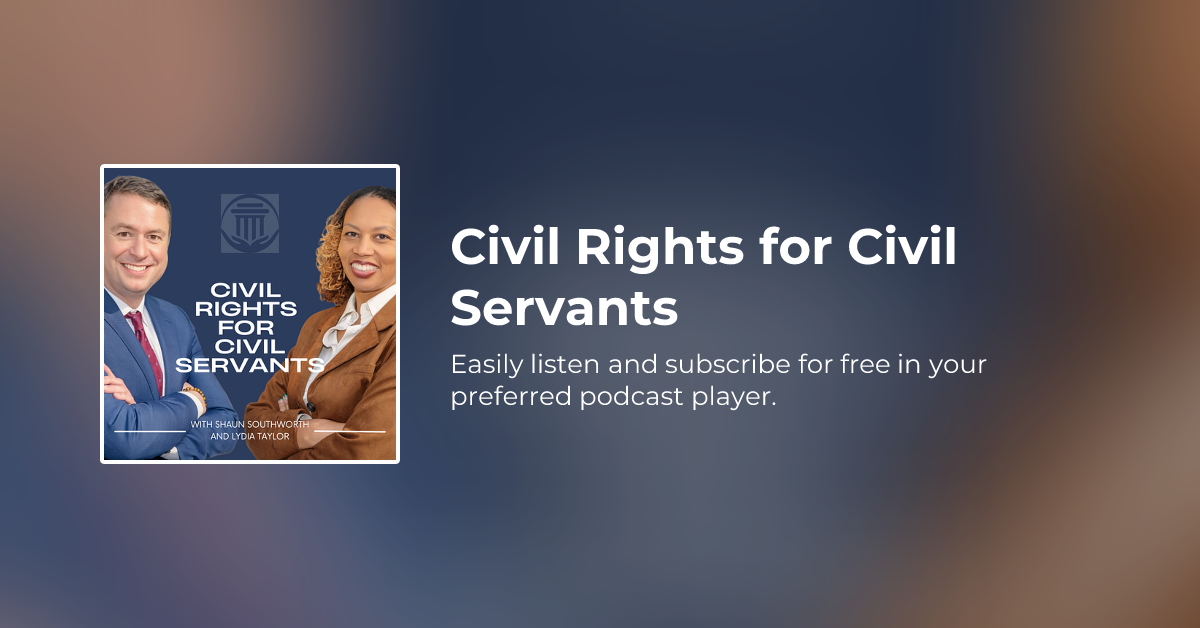
🎧 Listen: Civil Rights for Civil Servants
Shaun Southworth & Lydia Taylor on what's happening to the federal workforce. Latest episode: Apple · Spotify · Amazon Music · Youtube
 |
Today at a Glance
- EEOC Class Complaint Freeze: AFGE and two federal employees sued the EEOC on July 28, alleging the Commission has indefinitely halted processing of every federal-sector class complaint pending before its Administrative Judges. The suit asks the U.S. District Court for the District of Columbia to order the Commission to resume the process its own regulations require.
-
Advanced Leave Suspended At IRS And SSA: Both agencies, now led by the same official, told employees on July 24 that they will no longer grant advanced annual or advanced sick leave until further notice, and pending requests will be denied. Accrued leave is untouched, and donated leave and unpaid FMLA leave remain available.
- Discipline Rules Comment Deadline: The public comment window on the joint OPM–MSPB rule that would cap performance improvement periods at 30 days, ban "clean record" settlements, and retire the Douglas factors closes Monday, August 3.
Top Stories:
1. Union sues EEOC over freeze on all federal-sector class complaints
Source: Federal News Network, July 28, 2026
TL;DR:
The American Federation of Government Employees and two federal employees sued the Equal Employment Opportunity Commission on July 28 in the U.S. District Court for the District of Columbia, alleging the Commission has not processed any federal-sector class complaints since at least late last year and violated the Administrative Procedure Act by imposing a blanket suspension. The suit follows the Commission's suspension of a class complaint brought by Bureau of Prisons employees alleging persistent and severe sexual harassment; the two plaintiffs are female correctional officers at a men's prison in Louisiana, and they named the Commission and Chair Andrea Lucas. The underlying case, Pippen v. Federal Bureau of Prisons, reached the Commission in 2024 and was certified as a class complaint in March 2025, but in December 2025 an Administrative Judge issued a notice pausing it until further notice and canceling all scheduled deadlines. The lawsuit states the notice said the suspension applies to all federal-sector class cases, including disparate-impact cases. An EEOC spokesperson declined to comment or explain the pause, referring questions to the Department of Justice, which did not respond.
For federal employees, this means:
- If you are a class agent or class member in a certified federal-sector class complaint, assume your case is not moving. Have your representative request a written status update, and keep any abeyance or pause notice you receive — that notice is evidence.
- The Commission's pause does not pause anything on your end. Keep documenting new incidents in real time, with dates and witnesses; conduct during the pause may support amended or new claims.
- If your complaint has been pending 180 days or more with no final action and no appeal pending, you may have the option to go to federal district court instead of waiting. That carries real trade-offs and should be a counseled decision.
Legal Insight. Federal-sector class complaints are governed by 29 C.F.R. § 1614.204, which puts the Administrative Judge in charge of certifying the class and moving the complaint through discovery, hearing, and decision. The lawsuit's theory is that a blanket, indefinite suspension is agency action unlawfully withheld or unreasonably delayed and arbitrary and capricious under 5 U.S.C. § 706(1) and § 706(2)(A), because the Commission's own regulations bind the Commission. Separately, 29 C.F.R. § 1614.407(b) permits a civil action 180 days after a complaint is filed where no final action has been taken and no appeal is pending — a frozen case is not necessarily a case without options. If your complaint has been sitting without movement, talk with a federal employment attorney before the calendar decides for you.
2. IRS and SSA stop granting advanced leave — unions call it a contract violation
Source: Government Executive, July 29, 2026
TL;DR. The IRS and the Social Security Administration (SSA) told employees on Friday, July 24, that they will no longer grant advanced annual leave or advanced sick leave until further notice. Advanced leave lets an employee who has exhausted accrued leave borrow against hours not yet earned, commonly for a medical emergency, family care, or the death of an immediate family member. The two agencies sent nearly identical emails stating the change is meant to maintain service to the public and to address cases in which employees took excessive amounts of advanced leave, and describing accumulated advanced leave as "debt carried against the future work" of their employees. Pending requests at both agencies will be denied, and the suspension stays in place while the agencies work to reduce existing advanced leave balances. Accrued annual and sick leave are unaffected, and employees can still receive donated leave through the Voluntary Leave Transfer Program or take unpaid leave under the Family and Medical Leave Act. Both agencies are led by Frank Bisignano, the Senate-confirmed SSA Commissioner and the IRS chief executive. AFGE Council 220 President Jessica LaPointe, who described advanced leave as functioning like a short- or long-term disability insurance program for federal employees, said AFGE has filed a grievance alleging SSA repudiated a provision of its collective bargaining agreement; NTEU National President Doreen Greenwald said the union will challenge the change at the IRS as a violation of its contract.
For federal employees, this means:
- If you have an advanced leave request pending at IRS or SSA, treat it as denied and pivot today. Donated leave through the Voluntary Leave Transfer Program and unpaid FMLA leave are both still available, and FMLA has notice and certification requirements — start that paperwork rather than waiting for the policy to be reversed.
- If your need for leave is tied to a medical condition, submit a written reasonable accommodation request separately from the leave request. A blanket agency leave policy does not answer whether leave is required as an accommodation in your individual case, and the two requests are evaluated under different rules.
- If you are carrying a negative leave balance, know the exposure before you make a move. An employee who separates still owing advanced leave must repay it, and the agency may deduct it from the final paycheck — factor that in before resigning, retiring, or accepting a separation incentive.
Legal Insight. Advanced annual leave and advanced sick leave are discretionary under the federal leave framework in 5 U.S.C. ch. 63 and 5 C.F.R. Part 630 — an agency may grant them, but no employee is entitled to them, which is why the denial of an advanced leave request standing alone is generally not appealable to the Board. The live legal questions sit elsewhere. Repudiation of a term of a collective bargaining agreement, which is what AFGE alleges, is ordinarily pursued as a failure to bargain in good faith under 5 U.S.C. § 7116(a)(5), through the negotiated grievance procedure under 5 U.S.C. § 7121 or before the Authority. Separately, this policy does not displace an employee's entitlement to 12 weeks of unpaid leave under 5 U.S.C. § 6382 or the possibility of leave as a reasonable accommodation where a disability is involved under 29 C.F.R. § 1630.2(o). If you are being pushed into leave without pay because of a medical condition, talk with a federal employment attorney before your leave balance, rather than your rights, decides the outcome.
3. Five Days Left to Comment on the Rule That Would Rewrite Federal Discipline — 30-Day PIPs, No Clean-Record Settlements, No Douglas Factors
Source: Federal Register (OPM and MSPB, "Promoting Employee Accountability," 91 FR 40444), July 2, 2026
TL;DR. The Office of Personnel Management (OPM) and the Merit Systems Protection Board (MSPB) jointly published a proposed rule on July 2, 2026, and comments must be received on or before August 3, 2026. The proposal would cap the opportunity to demonstrate acceptable performance — what most employees call a PIP (Performance Improvement Plan) — at 30 calendar days, and would bar agencies from offering the informal "performance assistance periods" that many collective bargaining agreements (CBAs) currently require first. It would make removal the default penalty an agency proposes for unacceptable performance, give employees generally 7 to 10 calendar days to answer a proposed action, and require an employee to raise any medical issue affecting performance in that answer or waive it. It would prohibit "clean record" settlement provisions that erase discipline from a personnel file, and would bar the use of official time under 5 U.S.C. § 7131(d) for a federal employee representing a coworker in a Part 752 adverse action. Finally, the MSPB proposes to stop applying the 12 Douglas factors and instead ask whether a penalty falls "within the tolerable limits of reasonableness in light of the totality of the circumstances," with no set of factors required in every case. The rule carries RIN 3206-AO91 for OPM and RIN 3124-AA35 for the MSPB.
For federal employees, this means:
• If you want a say, the deadline is Monday, August 3, 2026. Comments go through the docket, and individual employees, supervisors, and union locals may all file. Specific, experience-based comments — how long a realistic improvement period takes in your occupation — carry more weight than general objection.
• If you are on a PIP now or expect one, document everything: the standards you were given, the assistance you received, the dates. Under the proposal, a 30-day clock and the absence of a pre-PIP period would leave far less room to build a record later.
• If you are negotiating or considering a settlement, understand that the "clean record" term many agreements have relied on would no longer be available if this rule is finalized as written. Weigh that before you sign anything now.
Legal Insight. Chapter 43 removals rest on 5 U.S.C. § 4302(c)(6), which requires an opportunity to demonstrate acceptable performance before a reduction in grade or removal, and on 5 U.S.C. § 4303(b), which sets the notice and answer procedures; the statute does not fix the length of the opportunity period, which is why OPM can propose to define it by regulation at 5 C.F.R. § 432.104. Penalty review is governed by 5 U.S.C. § 7513(a)'s "efficiency of the service" standard, and the Douglas framework comes from Board case law — Douglas v. Veterans Administration, 5 M.S.P.R. 280 (1981) — rather than from statute, which is the legal basis MSPB gives for proposing new 5 C.F.R. § 1201.56(b)(3). If you are facing a proposed performance action or adverse action while these rules are pending, the current regulations still govern your case; consult a federal employment attorney about how the existing standards apply before your answer is due.
Legal Tip of the Day
Choosing the Right Path: Grievance, EEO, OSC, or MSPB
Federal employees may have several possible routes when something goes wrong, and choosing the wrong one can create problems. A union grievance, EEO complaint, OSC complaint, or MSPB appeal may involve different deadlines, standards, remedies, and election rules. Before filing, identify the action, the date, the harm, the people involved, and whether the issue involves discrimination, retaliation, whistleblowing, discipline, performance, or contract rights. Do not file everywhere at once just to be safe, and do not assume a coworker’s path fits your situation. Southworth PC can help federal employees compare options and choose a path that fits the facts and deadlines.
Programming Note
Our podcast will be delayed this week — our Media Relations Cooridnator Ruby Alosbanos is out, so the new episode will drop Monday, August 3 instead of this Friday.
Also, this week's emails will not include our usual blog post roundup. Don't worry — the content is still coming, just on Instagram instead. Follow us there so you don't miss it: @southworth_pc
We'll be back to our normal schedule next week, and wish Ruby a great, relaxing vacation.
Thinking About Federal Disability Retirement?
If your medical conditions make it hard to safely or consistently perform your federal job—even with accommodations—it may be time to explore OPM/FERS disability retirement.
We help federal employees:
-
Decide whether disability retirement is the right path compared to accommodation or reassignment
-
Gather and frame medical evidence so it speaks the language OPM expects
-
Prepare and submit disability retirement applications and related documentation
-
Coordinate strategy when disability retirement interacts with pending discipline, EEO complaints, or MSPB appeals
For most disability retirement matters, we offer full‑service application assistance for a flat fee of $5,000, plus any required costs. In a free consultation, we’ll talk through your health limitations, job duties, and timelines so you understand your options before you commit.
👉 Schedule Your Free Consultation Today
|

Disclaimer:
This briefing is for general informational purposes only and does not constitute legal advice or create an attorney‑client relationship. Federal employment law is fact‑specific and time‑sensitive; you should consult a qualified attorney about your own situation and deadlines. Past results do not guarantee future outcomes.
Your service is worth protecting. Let's protect it together at Southworth PC.

Responses