Attorneys for Federal Employees — Nationwide
Nearly 200,000 federal workers and supporters follow our updates across TikTok, Instagram, YouTube, Facebook, and LinkedIn. Each briefing gives you the three stories that actually matter to your job, plain‑English legal guidance, and one short practice to protect your peace of mind. If it helps you, forward it to a colleague—new readers can subscribe at https://fedlegalhelp.com/newsletter.
🎧 Listen: Civil Rights for Civil Servants
Shaun Southworth & Lydia Taylor on what's happening to the federal workforce. Latest episode: Apple · Spotify · Amazon Music · Youtube
 |
Today at a Glance
-
EEOC Class Complaints: A union and two correctional officers have asked a federal court to order the EEOC to restart every federal-sector class complaint, which has been frozen since December 2025. The preliminary-injunction motion was filed August 3.
-
Postal Service Finances: The Postal Service is asking Congress for annual funding and has suspended its own retirement contributions to conserve cash. Your earned FERS annuity is not affected by that suspension.
-
Government Funding: The Senate’s funding patch runs to December 11, which moves the shutdown risk out of October and into a December lame-duck session. The 2027 pay decision is still due before September 1.
Top Stories:
1. Every Federal Class Discrimination Complaint Has Been Frozen Since December — a Court Is Now Being Asked to Restart Them
Source: Federal News Network, July 28, 2026
TL;DR: On August 3, 2026, the plaintiffs in AFGE v. Equal Employment Opportunity Commission, No. 1:26-cv-02640 (D.D.C.), asked the court for a preliminary injunction — a court order requiring the EEOC to resume processing federal-sector class complaints while the case is litigated. The underlying suit was filed July 28, 2026 by the American Federation of Government Employees and two federal employees. According to the complaint, on December 10, 2025 an EEOC administrative judge issued a “Notification of Case Processing Abeyance” stating that “all case processing in the above-captioned matter must be paused until further notice,” that all scheduled deadlines and appearances were cancelled, and that the notification “applies to all class cases in the federal sector, including those alleging disparate impact.” One named plaintiff, Deanna Chelette, is a class agent in a certified class complaint against the Federal Bureau of Prisons alleging sexual harassment of women employees at the Federal Correctional Complex in Pollock, Louisiana — Pippen v. Federal Bureau of Prisons, EEOC No. 460-2024-00132X. The plaintiffs claim the freeze violates the Administrative Procedure Act because the Commission gave no reasoned explanation and is withholding action it is required by regulation to take. Plaintiffs are represented by Cohen Milstein Sellers & Toll, Democracy Defenders Fund, and Burakiewicz & DePriest.
For federal employees, this means:
- If you are a class agent or a class member in a pending EEOC class complaint, your case is likely still in abeyance. Ask your representative to confirm the current status in writing and to keep a dated record of every stay notice you receive.
- A class complaint is not your only route. An individual complaint remains available, and the 45-day clock to contact an EEO counselor runs from the date of the action you are challenging — it does not pause because class processing is paused.
- Preserve evidence now. Witnesses transfer, supervisors leave, and records get purged during long delays. Keep your own copies of emails, schedules, incident reports, and any complaints you filed.
Legal Insight
Federal-sector class complaints are processed under 29 C.F.R. § 1614.204, and hearings before an EEOC administrative judge are governed by 29 C.F.R. § 1614.109. The APA allows a court to compel agency action “unlawfully withheld or unreasonably delayed” under 5 U.S.C. § 706(1) and to set aside action that is arbitrary and capricious under 5 U.S.C. § 706(2)(A). If your class case is stayed, the individual-complaint deadline in 29 C.F.R. § 1614.105(a)(1) still matters, and Title VII’s federal-sector provision, 42 U.S.C. § 2000e-16, is the underlying right being enforced. Because timeliness in this area is measured in days and is easy to lose while waiting on a stayed case, this is a good point to consult a federal employment attorney.
2. The Postal Service Asks Congress for Money — and Has Stopped Paying Into Its Own Retirement Plan to Buy Time
Source: Government Executive, August 10, 2026
TL;DR: At the quarterly meeting of the USPS Board of Governors on Friday, August 7, Postmaster General David Steiner said the Postal Service will seek a “relatively modest appropriation” from Congress. USPS reported a $2.5 billion net loss for the third quarter of fiscal 2026, an improvement from a $3.1 billion loss in the same quarter last year. Earlier this year USPS told lawmakers it would run out of cash in early 2027 if it kept meeting all of its financial obligations; in April it notified OPM that it would hold off on paying its employer contributions to the Federal Employees Retirement System, and Steiner told the Senate Homeland Security and Governmental Affairs Committee in June that the agency now expects to run out of cash sometime between 2031 and 2034. Steiner said that without congressional action this year, USPS will consider lowering service standards, raising prices, and closing thousands of post offices it considers unprofitable, though it would not act on those plans before January 2027. USPS is authorized to request up to $460 million a year as a public service reimbursement and has not requested or received that money since 1982. The Postal Regulatory Commission has limited USPS to one price increase per year through September 30, 2030.
For federal employees, this means:
- If you are a postal employee, the suspension of employer FERS contributions does not reduce the annuity you have earned. Your own payroll deductions continue, and FERS benefits are paid from the Civil Service Retirement and Disability Fund by statute, not from your employer’s current cash.
- Watch for post office closing or consolidation notices in your district. A closing is not a management decision made in silence — there is a required notice-and-comment process and a right to challenge the determination.
- Lower service standards and facility closures usually arrive as reassignments, changed schedules, or excessing before they arrive as layoffs. Read any notice carefully, note the date you received it, and check what your collective bargaining agreement requires before you sign anything.
Legal Insight
Employer FERS contributions are required by 5 U.S.C. § 8423, but an employee’s annuity is computed under 5 U.S.C. § 8415 and paid from the Civil Service Retirement and Disability Fund established by 5 U.S.C. § 8348 — an employer’s failure to make its own contributions does not cancel the benefit you earned. Post office closings and consolidations must follow the procedures in 39 U.S.C. § 404(d), including advance notice and a right to appeal the determination to the Postal Regulatory Commission, and service standards are governed by 39 U.S.C. § 3691. If a facility change reaches you as a reassignment, an excessing action, or a proposed adverse action, the deadlines are short, and it is worth speaking with your union representative or a federal employment attorney before you respond.
3. The Funding Patch Moves the Shutdown Risk From October to December 12
Source: Government Executive, August 6, 2026
TL;DR: The Senate’s bipartisan funding bill would fund the federal government through December 11, 2026, with money running out at midnight on December 12 under the current text. Senators cleared the first procedural motion 89-4. The bill differs from the version the House passed on July 21, which would fund agencies only through December 4, so one chamber must adopt the other’s bill or appropriators must produce a compromise that both chambers pass and the President signs. Prediction market Kalshi put the odds of an October 1 shutdown at 25 percent, down from 64 percent a month earlier. Budget analyst David Berteau noted that Congress rarely introduces a continuing resolution in July and that “the members want to not have a shutdown,” while cautioning that an October shutdown is “not zero.” Once Congress returns from its summer recess, only 16 working days remain on the legislative calendar before the fiscal year ends September 30. Federal employees have been through three partial or full shutdowns in the past year, including a record 43-day lapse at the start of last fiscal year.
For federal employees, this means:
- Plan around two dates, not one: September 30 for the current fiscal year, and December 12 if the Senate’s bill becomes law. A patch does not remove the risk — it relocates it.
- Find out now whether your position is excepted or subject to furlough during a lapse, and get it in writing. That single fact determines whether you report to work unpaid or stay home unpaid.
- A separate deadline lands sooner. The alternative pay plan setting 2027 federal pay is due before September 1, and if it is not issued, a statutory formula produces significantly larger increases.
Legal Insight
During a funding lapse, the Antideficiency Act, 31 U.S.C. §§ 1341-1342, bars agencies from obligating funds that have not been appropriated and permits work to continue only in narrow circumstances, including emergencies involving the safety of human life or the protection of property under § 1342. Back pay for both furloughed and excepted employees is required “at the earliest date possible” after the lapse ends under 31 U.S.C. § 1341(c), added by the Government Employee Fair Treatment Act of 2019. On pay, 5 U.S.C. § 5303(b) allows the President to substitute an alternative pay plan for the automatic adjustment, but only if it is transmitted before September 1.
Legal Tip of the Day
When Work Moves to Personal Phones or Email
Sometimes workplace communication shifts to texts, personal email, or personal phones. That can create recordkeeping, privacy, and security problems, especially when the topic involves discipline, investigations, sensitive information, medical issues, or timekeeping. Ask whether there is an approved official channel for the communication and keep work-related records consistent with agency rules. Do not store sensitive, classified, confidential, or investigative material on personal devices. Also avoid using personal texts as a substitute for clear written workplace instructions when the issue is important. Southworth PC can help federal employees think through documentation and risk when workplace communication moves outside normal systems.
In Case You Missed It
A few quick hits from our recent posts:
GAO Audited DOGE’s Ethics Paperwork. Most of It Could Not Be Verified.
|

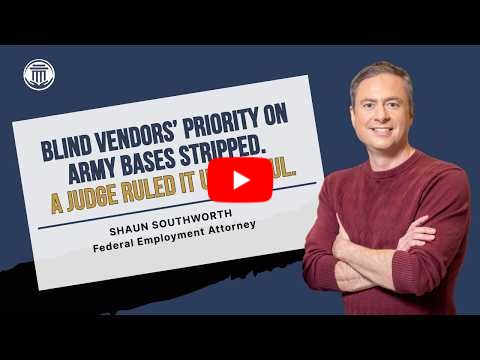
A Federal Court Vacated the Army Dining Waiver. Here’s Why It Matters to Your Case.
|
Thinking About Federal Disability Retirement?
If your medical conditions make it hard to safely or consistently perform your federal job—even with accommodations—it may be time to explore OPM/FERS disability retirement.
We help federal employees:
-
Decide whether disability retirement is the right path compared to accommodation or reassignment
-
Gather and frame medical evidence so it speaks the language OPM expects
-
Prepare and submit disability retirement applications and related documentation
-
Coordinate strategy when disability retirement interacts with pending discipline, EEO complaints, or MSPB appeals
For most disability retirement matters, we offer full‑service application assistance for a flat fee of $5,000, plus any required costs. In a free consultation, we’ll talk through your health limitations, job duties, and timelines so you understand your options before you commit.
👉 Schedule Your Free Consultation Today
|

Disclaimer:
This briefing is for general informational purposes only and does not constitute legal advice or create an attorney‑client relationship. Federal employment law is fact‑specific and time‑sensitive; you should consult a qualified attorney about your own situation and deadlines. Past results do not guarantee future outcomes.
Your service is worth protecting. Let's protect it together at Southworth PC.

Responses