Attorneys for Federal Employees — Nationwide
Nearly 200,000 federal workers and supporters follow our updates across TikTok, Instagram, YouTube, Facebook, and LinkedIn. Each briefing gives you the three stories that actually matter to your job, plain‑English legal guidance, and one short practice to protect your peace of mind. If it helps you, forward it to a colleague—new readers can subscribe at https://fedlegalhelp.com/newsletter.
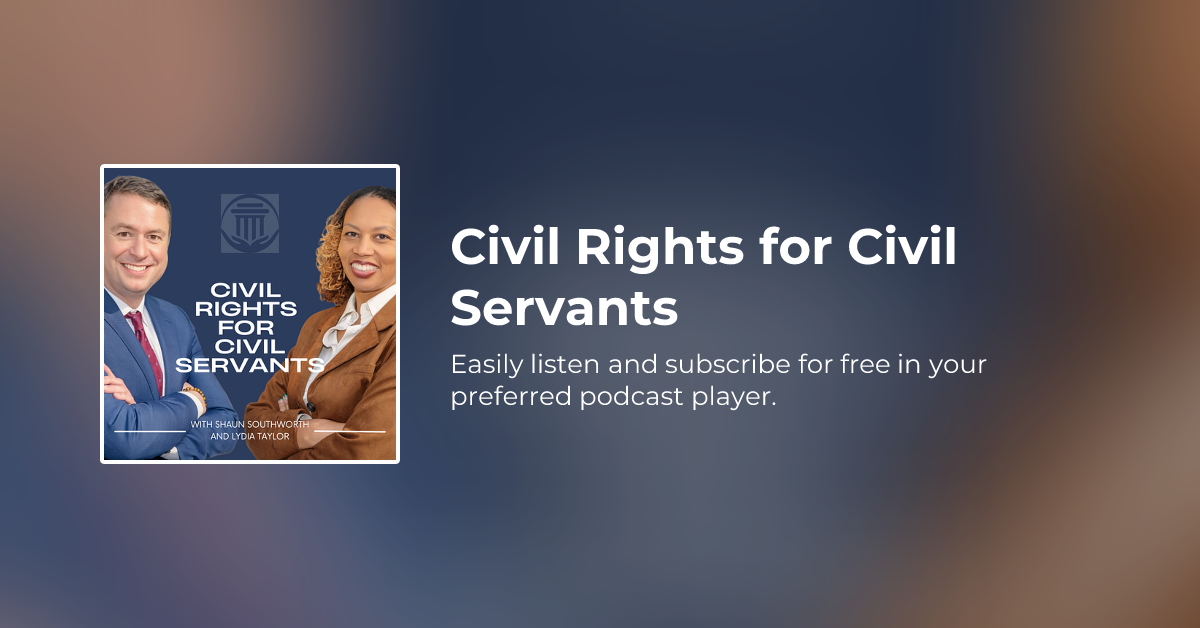
🎧 Listen: Civil Rights for Civil Servants
Shaun Southworth & Lydia Taylor on what's happening to the federal workforce. Latest episode: Apple · Spotify · Amazon Music · Youtube
 |
Today at a Glance
- Schedule Policy/Career In Job Postings: A Partnership for Public Service review of more than 130 federal job postings tagged Schedule Policy/Career found at least a dozen at the GS-13 level or below — despite officials' statements that 97 percent of conversions involved GS-15s or senior leaders.
- DoD EEO Overhaul Pilots: The Defense Department has launched three pilot programs to cut EEO investigation timelines in half, centralize EEO operations, and expedite cases involving senior officials. The deadlines and hearing rights in 29 C.F.R. Part 1614 are EEOC regulations, and they are not changed by any agency pilot.
- GSA Is Hiring Again: After cutting more than 2,500 Public Buildings Service jobs, GSA posted 142 vacancies in a single week and says a few hundred approved opportunities are coming — the moment when RIF-separated employees' reemployment priority rights matter most.
Top Stories:
1. Job Postings Show Schedule Policy/Career Reaching GS-13s and Below — and Tagged in Error at Least Once
Source: Government Executive, August 20, 2026
TL;DR: The Partnership for Public Service analyzed more than 130 USAJOBS listings that mention Schedule Policy/Career, the at-will job category formally implemented by executive order in June, when about 8,000 positions were converted out of the competitive service. The analysis found at least a dozen tagged positions — nearly 10 percent — at the GS-13 level or below, even though administration officials have said 97 percent of conversions involved GS-15s or senior leaders. Some Transportation Security Administration screener listings carried the Schedule P/C tag despite not appearing in the executive order's appendix; TSA told Government Executive those tags were an administrative error and would be corrected. Other listings show a pipeline in motion: International Development Finance Corporation postings state the agency has submitted positions to OPM for conversion but has not yet received approval, the Energy Department flagged some jobs as "potentially meeting the requirements," and three U.S. Agency for Global Media positions are listed as "under review for inclusion." The Partnership's data director said the rollout appears to be reaching beyond the executive order's stated scope. Agencies are reportedly preparing a second round of conversions, and the only public documentation of the program's reach remains officials' statements and the appendix to the executive order.
For federal employees, this means:
- Read the appointment-type language on any vacancy announcement — your own position's or one you are applying to. A Schedule P/C tag means the position sits in the excepted service without MSPB appeal rights for adverse actions.
- Tags can be wrong. The TSA screener listings show the label has been applied in error — if your position or a posting you care about appears tagged, ask your HR office in writing whether the position has actually been submitted to or approved by OPM for conversion, and keep the answer.
- Watch for the markers this analysis surfaced: "submitted to OPM," "potentially meeting the requirements," or "under review for inclusion" in a posting signals a conversion decision that is pending, not final.
Legal Insight
Under 5 U.S.C. § 7511(b)(2), an employee whose position has been determined by the President or OPM to be of a confidential, policy-determining, policy-making, or policy-advocating character and excepted from the competitive service is excluded from the adverse-action appeal rights in Chapter 75 — that is the mechanism that makes Schedule P/C effectively at-will. Conversion does not erase everything: discrimination and retaliation protections under 29 C.F.R. § 1614.103 cover employees and applicants regardless of appointment type, while whistleblower complaints from Schedule P/C employees would, per the reporting, be investigated inside the employee's own agency rather than by the Office of Special Counsel. If your position is converted, or you receive a proposed action while occupying a converted position, consult a federal employment attorney promptly — which forum can still hear your case depends on the claims, and the windows are short.
2. DoD Launches Three Pilots to Overhaul Its EEO Process — What Can Change, and What Cannot
Source: Federal News Network, August 17, 2026
TL;DR: The Defense Department has launched three pilot programs aimed at cutting equal employment opportunity investigation timelines in half, centralizing and standardizing EEO operations across the department, and expediting cases involving senior officials. Anthony Tata, under secretary of defense for personnel and readiness, announced the pilots as part of Defense Secretary Pete Hegseth's broader overhaul of military equal opportunity and civilian EEO programs, which Hegseth says have been "weaponized" by some individuals acting "in bad faith to retaliate against superiors or peers" — he has called it the "no more walking on eggshells" policy. Tata said less than 1 percent of final agency decisions on EEO complaints result in a finding of discrimination. Legal experts quoted by Federal News Network cautioned that the figure counts only complaints that go all the way through the process — it omits complaints resolved through settlement, withdrawal, or alternative dispute resolution, and attorneys interviewed noted that the strongest cases often resolve before a formal finding ever issues. Under the senior-official pilot, a pending complaint would no longer hold up a promotion unless an investigation substantiates the allegations or shows they are likely to be substantiated. DoD did not respond to detailed questions but said the pilots remain underway.
For federal employees, this means:
- Your EEO rights and deadlines do not come from DoD policy. The 45-day window to contact an EEO counselor, the 180-day investigation clock, and the right to a hearing before an EEOC Administrative Judge are set by EEOC regulation and are unaffected by any agency pilot.
- If DoD consolidates counselor operations, keep your own record of the date you first contacted a counselor — timeliness disputes are won and lost on that date, so confirm it in an email you keep.
- A faster investigation can serve complainants — and a slow one does not trap you. Once 180 days pass from filing without a completed investigation, you may move your case to the hearing stage rather than wait.
Legal Insight
Part 1614 binds every federal agency. 29 C.F.R. § 1614.106(e)(2) requires the agency to complete an impartial and appropriate investigation within 180 days of the filing of the complaint unless the parties agree in writing to extend, and 29 C.F.R. § 1614.108(f) requires the agency to provide the complainant the investigative file with notice of the right, within 30 days of receipt, to elect a hearing before an EEOC Administrative Judge or an immediate final agency decision. Hearings are conducted by EEOC Administrative Judges under 29 C.F.R. § 1614.109, and the Commission's federal-sector enforcement and rulemaking authority rests on 42 U.S.C. § 2000e-16(b) — a department pilot can reorganize offices and staffing, but it cannot shrink the rights those regulations give complainants. If you have a pending DoD EEO complaint and are notified of a changed process, office, or timeline, a federal employment attorney can help you confirm that nothing in your case's Part 1614 posture has actually moved.
3. GSA Is Hiring Again After Cutting 2,500 Jobs — RIF-Separated Employees Have Priority Rights Worth Using
Source: Government Executive, August 20, 2026
TL;DR: GSA's Public Buildings Service told staff in an internal notice last week that 142 new vacancies had been posted to USAJOBS — construction managers, lease contracting officers, and building managers — and an agency official told Government Executive the figure represents one week's worth of hiring, with "a few hundred approved hiring opportunities" to include external hires and internal merit promotions. Administrator Ed Forst wrote to office heads that GSA needs to "meaningfully increase" hiring in certain disciplines. The rebound follows deep cuts: PBS has shed more than 2,500 employees since the start of the administration through layoffs, attrition, and separation incentives, and an April Government Accountability Office report found the PBS workforce fell 45 percent between September 2024 and November 2025, with officials telling GAO the agency did not conduct workforce planning before the cuts. PBS said in April it aimed to hire 400 employees over six months, and last fall GSA offered about 400 laid-off employees the chance to return to their jobs. Employees interviewed describe doubled workloads in the meantime.
For federal employees, this means:
- If you were separated from GSA by RIF within the last two years, the agency's Reemployment Priority List (RPL) gives registrants placement priority for most GSA competitive-service vacancies in the local commuting area before the agency hires from outside — but you must register; it is not automatic.
- If you were displaced from any agency, ICTAP — the Interagency Career Transition Assistance Plan — gives well-qualified displaced employees selection priority for other agencies' vacancies in the local commuting area. Claim it expressly in your application and include your RIF documentation.
- If you are still at PBS, the internal notice signals merit-promotion opportunities alongside the external postings — watch internal announcements, not just USAJOBS.
Legal Insight
The Reemployment Priority List is mandatory for the agency: 5 C.F.R. part 330, subpart B (beginning at § 330.201) requires an agency to maintain an RPL and give registered RIF-separated competitive-service employees — tenure groups I and II with a rating above unacceptable — placement priority before hiring from outside its own permanent workforce, with eligibility generally running two years from the RIF separation. Under subpart G, an agency generally must select a well-qualified ICTAP-eligible displaced employee for a local vacancy over any candidate from outside its workforce unless an exception in 5 C.F.R. § 330.707 applies. A rehiring wave at an agency that recently ran a RIF is exactly the situation these priority-placement rules were written for.
Legal Tip of the Day
When Your Performance Rating Suddenly Drops
A sudden drop in a performance rating can affect awards, promotions, discipline, details, and long-term career credibility. Ask for specific examples supporting the rating and compare them to your performance plan, prior feedback, completed assignments, and mid-year reviews. Gather emails, work products, praise, metrics, and records showing what was expected and what was delivered. Pay close attention if the drop follows EEO activity, medical leave, accommodation requests, whistleblowing, or a change in supervisor. Do not assume a rating is harmless just because no discipline has been proposed yet.
In Case You Missed It
A few quick hits from our recent posts:
Hatch Act Complaint Filed Against the Attorney General: What It Means for Career Federal Employees
|

One Hundred Officers, One Group Chat: The Lavender Scare and What Federal Employees Should Know Now
|

Worried About Retaliation or Being Targeted for Speaking Up?
If you’ve reported misconduct, safety concerns, discrimination, or waste/fraud/abuse—and now you’re seeing sudden schedule changes, bad performance reviews, or threats of discipline—you may be in whistleblower or retaliation territory.
We represent federal employees who:
-
Reported concerns and then saw adverse actions
-
Were sidelined, reassigned, or given impossible workloads after speaking up
-
Face investigations, PIPs, or proposed removals that look like payback
-
Need help navigating OSC complaints, EEO claims, or MSPB appeals tied to retaliation
A free, confidential consultation can help you sort out what’s normal agency behavior and what may cross the line—and what to do before your options narrow.
👉 Schedule Your Free Consultation Today
|

Disclaimer:
This briefing is for general informational purposes only and does not constitute legal advice or create an attorney‑client relationship. Federal employment law is fact‑specific and time‑sensitive; you should consult a qualified attorney about your own situation and deadlines. Past results do not guarantee future outcomes.
Your service is worth protecting. Let's protect it together at Southworth PC.

Responses