Attorneys for Federal Employees — Nationwide
Nearly 200,000 federal workers and supporters follow our updates across TikTok, Instagram, YouTube, Facebook, and LinkedIn. Each briefing gives you the three stories that actually matter to your job, plain‑English legal guidance, and one short practice to protect your peace of mind. If it helps you, forward it to a colleague—new readers can subscribe at https://fedlegalhelp.com/newsletter.
🎧 Listen: Civil Rights for Civil Servants
Shaun Southworth & Lydia Taylor on what's happening to the federal workforce. Latest episode: Apple · Spotify · Amazon Music · Youtube
 |
Today at a Glance
-
Disability Accommodations: NTEU is suing the Treasury Department, the IRS, and HHS, alleging they left thousands of Rehabilitation Act accommodation requests unprocessed after canceling telework that had served as a disability accommodation.
-
Union Elections: A federal judge struck down the FLRA rule that would have moved union-representation decisions from career regional directors to the politically appointed board, restoring the process that has run since 1983.
-
Taxes and Your Job: A House committee is pressing the IRS over rising tax delinquency among federal employees and retirees — as OPM's new suitability rule adds tax-filing compliance to the factors that can put a federal job at risk.
Top Stories:
1. NTEU Sues Treasury, IRS and HHS — Says Thousands of Disability Accommodation Requests Went Unprocessed
Source: Federal News Network, June 30, 2026
TL;DR: The National Treasury Employees Union (NTEU) filed suit June 29 in the U.S. District Court for the District of Columbia, claiming the Treasury Department, the IRS, and the Department of Health and Human Services (HHS) failed to process thousands of reasonable-accommodation requests from employees with disabilities. Many of those requests sought telework or remote work — long used as an accommodation — that agencies canceled after the January 2025 return-to-office order. NTEU points to a May 2025 internal Treasury civil-rights memo describing a backlog of more than 6,500 accommodation requests, about 5,800 of them from IRS employees and already months old, well past the 20-calendar-day processing standard the memo itself cited. At the IRS, which has roughly 70,000 employees, the union says every telework request now must clear one of seven senior officials, and that some managers announced such requests would be denied across the board. HHS, which restricts telework as an interim accommodation and routes approvals to the assistant-secretary level, faces a separate backlog of about 9,000 requests it estimates will take six to nine months to clear. NTEU says the delays have forced employees to exhaust leave, risk being marked absent without leave, or leave their jobs. It is the latest in a series of suits challenging how agencies have handled disability accommodations since the return-to-office order.
For federal employees, this means:
- If you have a pending accommodation request, keep a dated copy of it and of every follow-up. A record of when you asked and what the agency did — or did not do — is the backbone of a failure-to-accommodate claim.
- A stalled request is not the end of the road. Agencies must engage in the interactive process, and unreasonable delay can itself violate the law even without a formal denial.
- Mind the separate EEO clock. If you believe you were denied accommodation or retaliated against, the window to contact an EEO counselor is short and runs even while a request sits unanswered.
Legal Insight:
Section 501 of the Rehabilitation Act, 29 U.S.C. § 791, requires federal agencies to provide reasonable accommodation to qualified employees with disabilities, and the EEOC's regulations at 29 C.F.R. § 1614.203 build the interactive process around that duty. A prolonged failure to act on a request — not only an outright refusal — can amount to a denial and, in some cases, evidence of bad faith. An employee who wants to preserve a discrimination claim generally must contact an agency EEO counselor within 45 days of the challenged action under 29 C.F.R. § 1614.105(a)(1); because that deadline can run while an accommodation request goes unanswered, employees who suspect their rights are being ignored should speak with a federal employment attorney before it passes.
2. Judge Strikes Down FLRA Rule That Moved Union-Election Decisions to Political Appointees
Source: Government Executive, June 30, 2026
TL;DR: Chief U.S. District Judge Denise J. Casper, of the U.S. District Court for the District of Massachusetts, ruled June 29 that the Federal Labor Relations Authority (FLRA) acted unlawfully when it rewrote how union representation cases are decided. Since 1983, requests to hold a union election — or to choose among competing unions — have been handled by the FLRA's career regional directors, with appeals going to the agency's three-member, Senate-confirmed board. In a March 2026 interim final rule, the FLRA stripped regional directors of that authority and required them to work "collaboratively" with political leadership, leaving the three-member board with the final say and sharply limiting appeals. A coalition of federal unions sued in April, arguing the change violated the Administrative Procedure Act (APA). The court agreed, finding the FLRA's efficiency rationale contradicted by its own numbers: of 277 representation petitions filed in 2025, only six were appealed to the board, and the agency itself expected just five appeals across all of 2026 and 2027. The court also faulted the FLRA for disregarding four decades of reliance on the existing process. The ruling nullifies the March rule and directs the agency and the unions to submit a final order formally vacating it.
For federal employees, this means:
- If your workplace has a union election, petition, or representation dispute in progress, the pre-March process is back in place — regional directors decide, with appeal rights to the board.
- The ruling turns on how the rule was made, not on a constitutional right to any particular process. An agency can sometimes make a similar change later if it follows the APA and adequately explains itself.
- Representation cases are unusual in that they generally cannot be appealed to a federal court of appeals — one reason the unions challenged the rule directly in district court.
Legal Insight:
Federal employees' right to form, join, or assist a labor organization is guaranteed by 5 U.S.C. § 7102, and the Authority's power to run representation elections — and to delegate that work to regional directors — comes from 5 U.S.C. §§ 7105 and 7111. Because most representation decisions are not reviewable in the courts of appeals under 5 U.S.C. § 7123(a), the unions sued under the APA's arbitrary-and-capricious standard, 5 U.S.C. § 706(2)(A), and prevailed on the ground that the FLRA never justified its own rule. The decision does not change any individual employee's job protections, but it preserves, for now, the machinery that determines who represents federal workers at the bargaining table.
3. House Oversight Presses IRS on Tax-Delinquent Employees — and a New OPM Rule Ties Tax Filing to Your Job
Source: FEDweek, June 30, 2026
TL;DR: House Oversight and Government Reform Committee Chairman James Comer (R-Ky.) has sent the IRS a letter seeking details on federal employees and retirees who owe back taxes and on what the government is doing to collect. He cited a recent inspector general audit finding that, from 2021 to 2024, the share of federal employees and retirees who were tax-delinquent rose from 4.9% to 6.9%, and the amount owed grew by about a third, to $6.3 billion. Of roughly 571,000 current and former federal employees with an outstanding tax obligation, about 50,000 filed no return at all during that period. The audit noted that a legal bar on the IRS sharing tax information with agencies other than Treasury has kept earlier recommendations from being carried out. Comer noted that under the Federal Payment Levy Program overdue taxes can be levied against certain federal payments, including salaries, and asked the IRS how often that has occurred. The letter arrives the same week OPM finalized a rule that lists tax-filing compliance among the "suitability" factors an agency may weigh in deciding whether an employee can keep a federal job.
For federal employees, this means:
- If you owe back taxes, filing on time still matters even if you cannot pay in full. Willful failure to file is treated far more seriously than an unpaid balance you are actively working to resolve.
- Your federal pay — and, in retirement, your annuity — can be reached through the levy program. An installment agreement or other resolution with the IRS generally halts collection while it remains in place.
- Tax problems are no longer only an IRS matter. Under OPM's new suitability rule, unresolved tax issues can factor into a suitability review, a track separate from ordinary discipline.
Legal Insight:
The IRS's authority to levy federal salaries and annuities for unpaid taxes comes from 26 U.S.C. § 6331, including the continuous-levy program at § 6331(h), and willful failure to file a return is a misdemeanor under 26 U.S.C. § 7203; the confidentiality rule Chairman Comer wants revisited is 26 U.S.C. § 6103. Separately, OPM's suitability regulations at 5 C.F.R. Part 731 now allow tax-filing compliance to be weighed in a suitability determination — which, unlike a Chapter 75 disciplinary action under 5 U.S.C. § 7513, can run through OPM rather than the usual adverse-action process. A federal employee with unresolved tax issues who receives any inquiry connecting those issues to suitability or discipline should treat it as a possible adverse action and consult a federal employment attorney promptly.
Legal Tip of the Day
When Your Performance Rating Suddenly Drops
A sudden drop in a performance rating can affect awards, promotions, discipline, details, and long-term career credibility. Ask for specific examples supporting the rating and compare them to your performance plan, prior feedback, completed assignments, and mid-year reviews. Gather emails, work products, praise, metrics, and records showing what was expected and what was delivered. Pay close attention if the drop follows EEO activity, medical leave, accommodation requests, whistleblowing, or a change in supervisor. Do not assume a rating is harmless just because no discipline has been proposed yet.
In Case You Missed It
A few quick hits from our recent videos and posts:
Supreme Court Ends Independent Agency Protection, Spares the Fed by One Vote
|

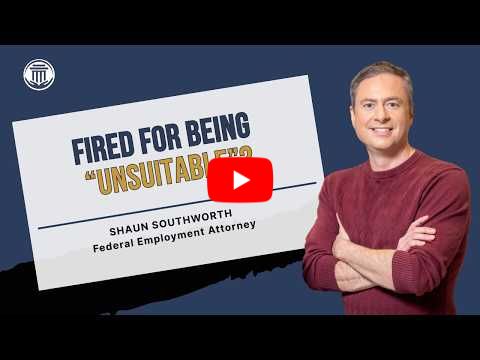
OPM Finalizes Rule Letting Agencies Fire Current Employees as 'Unsuitable'
|
Thinking About Federal Disability Retirement?
If your medical conditions make it hard to safely or consistently perform your federal job—even with accommodations—it may be time to explore OPM/FERS disability retirement.
We help federal employees:
-
Decide whether disability retirement is the right path compared to accommodation or reassignment
-
Gather and frame medical evidence so it speaks the language OPM expects
-
Prepare and submit disability retirement applications and related documentation
-
Coordinate strategy when disability retirement interacts with pending discipline, EEO complaints, or MSPB appeals
For most disability retirement matters, we offer full‑service application assistance for a flat fee of $5,000, plus any required costs. In a free consultation, we’ll talk through your health limitations, job duties, and timelines so you understand your options before you commit.
👉 Schedule Your Free Consultation Today
|

Disclaimer:
This briefing is for general informational purposes only and does not constitute legal advice or create an attorney‑client relationship. Federal employment law is fact‑specific and time‑sensitive; you should consult a qualified attorney about your own situation and deadlines. Past results do not guarantee future outcomes.
Your service is worth protecting. Let's protect it together at Southworth PC.

Responses